
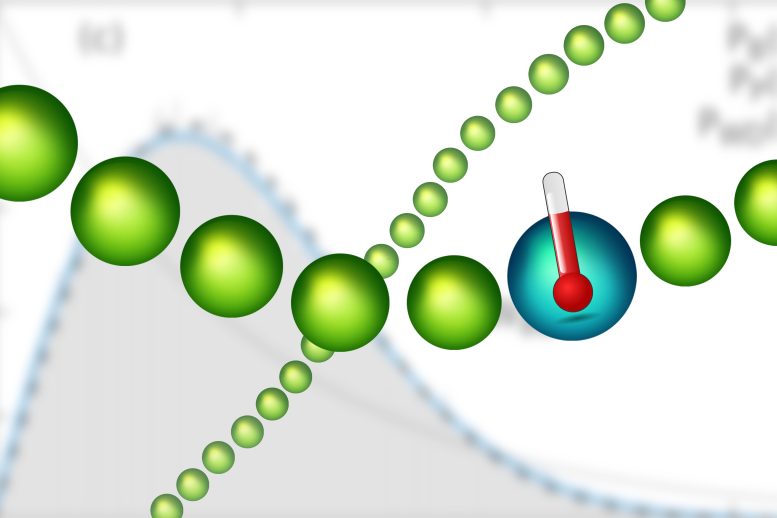
A new study at TU Wien has revealed how chaos theory connects quantum theory and thermodynamics, two seemingly separate areas of physics.
A single particle does not possess a temperature, it only has a certain energy or speed. It is only when many particles with random velocity distributions are present that a well-defined temperature can be derived.
The relationship between thermodynamics and quantum physics has been the subject of increasing interest in recent years. Researchers at TU Wien have used computer simulations to investigate this relationship, and have found that chaos plays a significant role. The simulations indicate that the laws of thermodynamics can only be derived from quantum physics when chaos is present.
Boltzmann: Everything is possible, but it may be improbable
The air molecules randomly flying around in a room can assume an unimaginable number of different states: Different locations and different speeds are allowed for each individual particle. But not all of these states are equally likely. “Physically, it would be possible for all the energy in this space to be transferred to one single particle, which would then move at extremely high speeds while all the other particles stand still,” says Professor Iva Brezinova from the Institute of Theoretical Physics at TU Wien. “But this is so unlikely that it will practically never be observed.”
The probabilities of different allowed states can be calculated – according to a formula that the Austrian physicist Ludwig Boltzmann set up according to the rules of classical physics. And from this probability distribution, the temperature can then also be read off: it is only determined for a large number of particles.
The whole world as a single quantum state
However, this causes problems when dealing with quantum physics. When a large number of quantum particles are in play at the same time, the equations of quantum theory become so complicated that even the best supercomputers in the world have no chance of solving them.
In quantum physics, the individual particles cannot be considered independently of each other, as is the case with classical billiard balls. Every billiard ball has its own individual trajectory and its own individual location at every point in time. Quantum particles, on the other hand, have no individuality – they can only be described together, in a single large quantum wave function.
“In quantum physics, the entire system is described by a single large many-particle quantum state,” says Professor Joachim Burgdörfer (TU Wien). “How a random distribution and thus a temperature should arise from this remained a puzzle for a long time.”
Chaos theory as a mediator
A team at TU Wien has now been able to show that chaos plays a key role. To do this, the team performed a computer simulation of a quantum system that consists of a large number of particles – many indistinguishable particles (the “heat bath”) and one of a different kind of particle, the “sample particle” that acts as a thermometer. Each individual quantum wave function of the large system has a specific energy, but no well-defined temperature – just like a single classical particle. But if you now pick out the sample particle from the single quantum state and measure its velocity, you can surprisingly find a velocity distribution that corresponds to a temperature that fits the well-established laws of thermodynamics.
“Whether or not it fits depends on chaos – that is what our calculations clearly showed,” says Iva Brezinova. “We can specifically change the interactions between the particles on the computer and thus create either a completely chaotic system, or one that shows no chaos at all – or anything in between.” And in doing so, one finds that the presence of chaos determines whether a quantum state of the sample particle displays a Boltzmann temperature distribution or not.
“Without making any assumptions about random distributions or thermodynamic rules, thermodynamic behavior arises from quantum theory all by itself – if the combined system of sample particle and heat bath behaves quantum chaotically. And how well this behavior fits the well-known Boltzmann formulae is determined by the strength of the chaos”, explains Joachim Burgdörfer.
This is one of the first cases in which the interplay between three important theories has been rigorously demonstrated by many-particle computer simulations: quantum theory, thermodynamics, and chaos theory.
Reference: “Canonical Density Matrices from Eigenstates of Mixed Systems” by Mahdi Kourehpaz, Stefan Donsa, Fabian Lackner, Joachim Burgdörfer and Iva Březinová, 29 November 2022, Entropy.
DOI: 10.3390/e24121740
Never miss a breakthrough: Join the SciTechDaily newsletter.
Follow us on Google and Google News.
4 Comments
… So!
Is this like “A single particle does not possess a temperature” mean that this is emergent property?…
I think this would go without saying and apply across the board. Physical measurement – mapping – is the coastline 5 miles long, 10 miles long, or infinitely long? The answer’s somewhere at the moment it’s measured, and the result is directly produced by the chaotic position of involved particles at that moment.
Mathematical relationships among quantum theory,thermodynamics and Boltzman’s law has been established in mathematical theory.Some of CERN experiments and Fermi. Lab. data on muon’s property are bearing this phenomena.But,for present demonstration work in computer on this this great phenomena up to some extent,thanks to the authors.
Could chaos theory help bridge the gap between other quantum behavior and the macro systems that we perceive?