
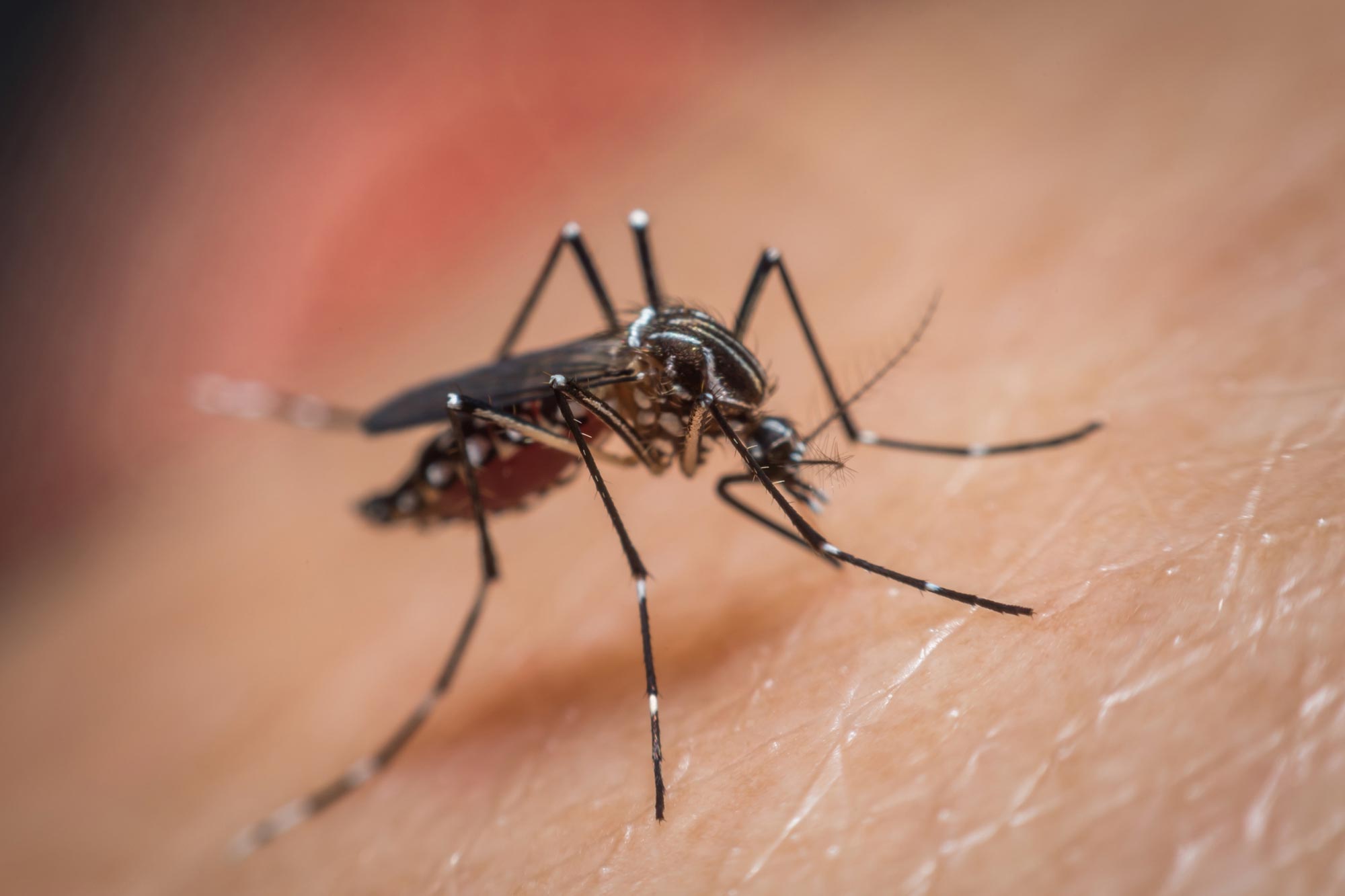
Anita Saraf investigates mosquito saliva to understand how viruses like dengue and West Nile are transmitted, using mass spectrometry to identify potential targets for vaccines and treatments.
You might guess it’d be tough to extract saliva from a mosquito. And you’d be correct. Yet, because mosquitos spread disease via saliva, it’s critical to sample and study.
But Anita Saraf doesn’t collect mosquito spit herself — it gets delivered so she can discover its scientific secrets.
Saraf is the director of the Mass Spectrometry & Analytical Proteomics Laboratory at the University of Kansas, where she uses shotgun proteomics to analyze biological samples — basic science that underpins many drug therapies.
“Collecting saliva from these mosquitoes is challenging due to the small sample size, which is a common limitation in such experiments,” she said. “Our collaborators with the USDA Agricultural Research Service put the mouth of the mosquitoes into a tube, then stimulate salivation and collect the saliva.”

Now, with a new two-year grant of $250,000 per year from the U.S. Department of Agriculture’s National Bio and Agro-Defense Facility, Saraf currently is analyzing these samples of noninfectious mosquito saliva in the fight against “arboviruses” — the term for viruses spread by arthropods like mosquitoes.
These include West Nile, yellow fever, dengue fever, Japanese encephalitis, and other viruses that can harm or kill people, animals, and plants. The USDA has an interest in veterinary applications for the findings, but Saraf’s work could underpin therapies for people as well.
“The USDA wants to study how the virus affects the immune system and changes at the molecular level, particularly the proteome of mosquito saliva,” Saraf said. “When a virus infects a mosquito, it alters the proteins and other basic components of the mosquito, similar to how malaria affects its human host as it progresses through different stages.”
Proteomics Analysis Techniques
Saraf’s proteomics analysis of the saliva succeeds because of using very efficient sample processing methods in tandem with shotgun analysis. This approach is effective with very low volumes or amounts of sample like, for instance, hard-to-obtain mosquito spit.
“At our mass spectrometry core at KU, we use shotgun proteomics, nanoscale liquid chromatography coupled with tandem mass spectrometry, or nLC-MS, which requires only a minimal amount of protein in the nano-gram range, making it ideal for these types of biological samples,” Saraf said. “The sensitivity of our setup is crucial because, without it, we would need much larger protein quantities. Once we receive the saliva samples, we handle all the sample processing, preparation, and digestion to make them ready for mass-spectrometry analysis. We have the latest equipment and a special setup, which gives us high sensitivity, putting us at the forefront of this research.”
The data is analyzed at KU mass spectrometry core to form a robust understanding of how the molecular properties of mosquito saliva can change under different conditions.
“After data collection, the analysis requires extensive post-processing, including interpretation and comparison, for which I have over 24 years of experience,” Saraf said. “This is how we established a collaboration with USDA.”
According to the KU researcher, her lab’s shotgun approach of analyzing proteomes is robust and more sensitive than other methods, affording much more detailed time-course studies.
“We plan to study these changes under different conditions, including environmental variations in the mosquito after virus infection,” she said. “The focus is on the mosquitos’ saliva, which is critical because, like with the parasite (Plasmodium) that causes malaria, arboviruses are transmitted through the saliva when the mosquito bites.”
Saraf and her team also will analyze saliva from a control group of mosquitoes not infected by the virus — but kept under the same feeding conditions and infection duration as the test group. The end goal is to identify specific proteins of interest for future host-vector-virus interaction studies, which could become potential targets for drug therapies.
Future Directions and Implications
To date, Saraf’s team has worked with uninfected mosquitoes to establish baseline data. Once inactivation protocols are approved and authorized, the work will include samples from Biosafety Level 2 (BSL-2) arbovirus-infected mosquitoes.
“We’ll identify differences and changes at the proteome level by comparing the control and infected samples at different stages,” the KU researcher said. “The goal is to determine the protein changes that occur, as these can potentially serve as candidates for vaccine development. We’ll first need to select candidates, which is why we are using controls under the same conditions without infection. We must carefully load equal amounts of protein from both to ensure accurate comparisons — essentially, we’ll be able to compare ‘apples to apples.’”
Saraf’s work product is a list of the protein changes, both qualitative and quantitative, to strengthen the evidence available to fellow researchers and drug developers.
“Last time, our collaborators at USDA found the list very interesting, and it aligned with what has been reported in the literature,” she said. “Selecting candidates for further study will be the goal.”
The study was funded by the U.S. Department of Agriculture.
Never miss a breakthrough: Join the SciTechDaily newsletter.
Follow us on Google and Google News.