
Dengue and Zika Viruses Make Infected Hosts Smell More Delicious to Mosquitoes
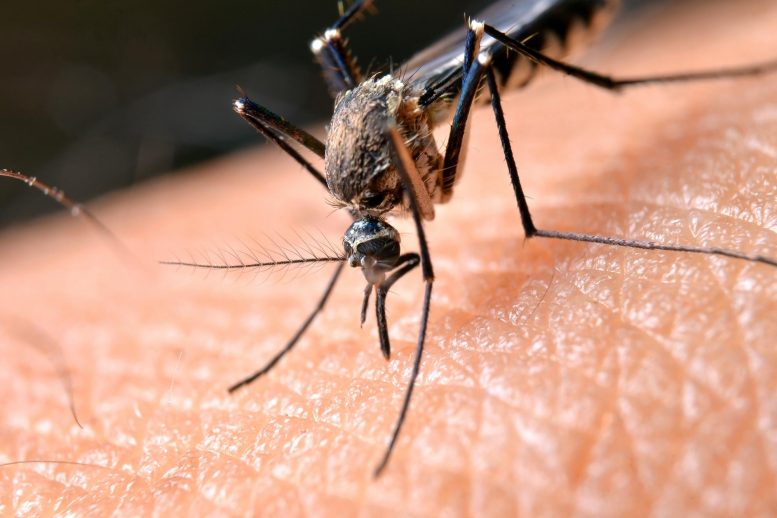
New research shows that when humans and mice are infected with dengue or Zika viruses, they secrete a chemical that may make them more attractive to mosquitoes, the vector that transmits the virus. Almost half of the world’s population lives in an area at risk of dengue fever, and with a lack of treatments, many dengue-affected regions suffer from high morbidity and mortality rates.
Now, with the identity of the chemical attractant in hand, the researchers discovered a way to reduce its release in mice and make mosquito bites less frequent: treatment with a commercially available acne medication. The study was published in the journal Cell on June 30, 2022.
The most common symptoms of Zika are fever, rash, headache, red eyes, joint pain, and muscle pain.
Dengue and Zika viruses rely on mosquitoes to survive in nature. When healthy mosquitoes take a bite from an infected host, they can become infected themselves and spread the virus to other animals they feed on in the future.
“Mosquitoes rely on their sense of smell to detect hosts and guide fundamental behaviors of survival,” says Gong Cheng, the lead scientist of the project at Tsinghua University. “At the beginning of this study, we found that the mosquitoes preferred to seek and feed on dengue- and Zika-infected mice.”
Acetophenone: The Chemical Attractant that Draws Mosquitoes
To investigate why mosquitoes preferred infected hosts, the research team performed a chemical analysis on odor samples from infected mice and humans. The scientists identified the culprit that makes them smell more “delicious” as acetophenone, which was present at an abnormally high level in infected individuals. This chemical compound can also be found in many fruits and some cheeses.
“We found that flavivirus [like dengue and Zika] can utilize the increased release of acetophenone to help itself achieve its lifecycles more effectively by making their hosts more attractive to mosquito vectors,” says Cheng.

Flavivirus Manipulates Skin Microbiota to Increase Mosquito Attraction
Cheng and colleagues then investigated exactly how dengue and Zika viruses increase the level of acetophenone and described it as “a sophisticated interplay between hosts’ skin microbiota, flaviviruses, and mosquitoes.”
The most common symptom of dengue is fever with any of the following: Nausea, vomiting; Rash; Aches and pains (eye pain, typically behind the eyes, muscle, joint, or bone pain); Belly pain, tenderness; Vomiting (at least 3 times in 24 hours); Bleeding from the nose or gums; Vomiting blood, or blood in the stool; Feeling tired, restless, or irritable. Mild symptoms of dengue can be confused with other illnesses that cause fever, aches and pains, or a rash.
When a flavivirus invades a host, the virus enters a tug-of-war with the cells in the host’s body for control of the level of a key protein that regulates the composition of the skin microbiome—RELMα. If the cells are winning, RELMα keeps the acetophenone-producing bacteria in check.
“Intriguingly, both dengue and Zika viruses promoted the proliferation of acetophenone-producing skin bacteria by suppressing the RELMα expression,” Cheng says. As a result, some bacteria over-replicate and produce more acetophenone. Suddenly, these sick individuals smell as delicious to mosquitoes as a tray of freshly baked cookies to a group of five-year-old children.
Isotretinoin as a Potential Solution to Reduce Mosquito Bites
With a clearer understanding of how flavivirus affects the skin microbiome, the team set out to find a way to help the cells win the tug-of-war. After examining existing RELMα literature, the group decided to test whether isotretinoin—a vitamin A derivative commonly used as acne medicine—may suppress the production of acetophenone.
The experiment was simple: feed the mice with isotretinoin and put them in a cage with mosquitoes. The results were encouraging. The authors found that mosquitoes did not feed on isotretinoin-treated infected mice any more than those feeding on uninfected animals. “Dietary administration of isotretinoin, in flavivirus-infected animals, reduced acetophenone volatilization by reshaping resident commensal bacteria on the host skin,” Cheng says.

In the future, Cheng and his team are setting out to apply their findings in the real world. “We plan to dietarily administer isotretinoin in dengue patients to reduce acetophenone-mediated mosquito activity,” says Cheng.
They are attacking the issue from the mosquito side as well. “We plan to identify specific olfactory receptors for acetophenone in mosquitoes and remove the genes from the mosquito population by a gene drive technology,” Cheng explains. Without the receptors, mosquitoes will no longer be able to smell the acetophenone that they love so much, which will possibly mitigate the spread of dengue and other flaviviruses.
For more on this discovery, see Some Viruses Make You Smell Tastier to Mosquitoes.
Reference: “A volatile from the skin microbiota of flavivirus-infected hosts promotes mosquito attractiveness” by Hong Zhang, Yibin Zhu, Ziwen Liu, Yongmei Peng, Wenyu Peng, Liangqin Tong, Jinglin Wang, Qiyong Liu, Penghua Wang and Gong Cheng, 30 June 2022, Cell.
DOI: 10.1016/j.cell.2022.05.016
This work was supported by the National Key Research and Development Plan of China, the National Natural Science Foundation of China, Tsinghua University Spring Breeze Fund, Shenzhen Science and Technology Project, Shenzhen San-Ming Project for Prevention and Research on Vector-borne Diseases, Young Elite Scientists Sponsorship Program, the Yunnan Cheng Gong expert work-station, Provincial innovation team for the prevention and control of highly pathogenic pathogens, and Institute of Medical Biology, Chinese Academy of Medical Science.
Never miss a breakthrough: Join the SciTechDaily newsletter.
Follow us on Google and Google News.