
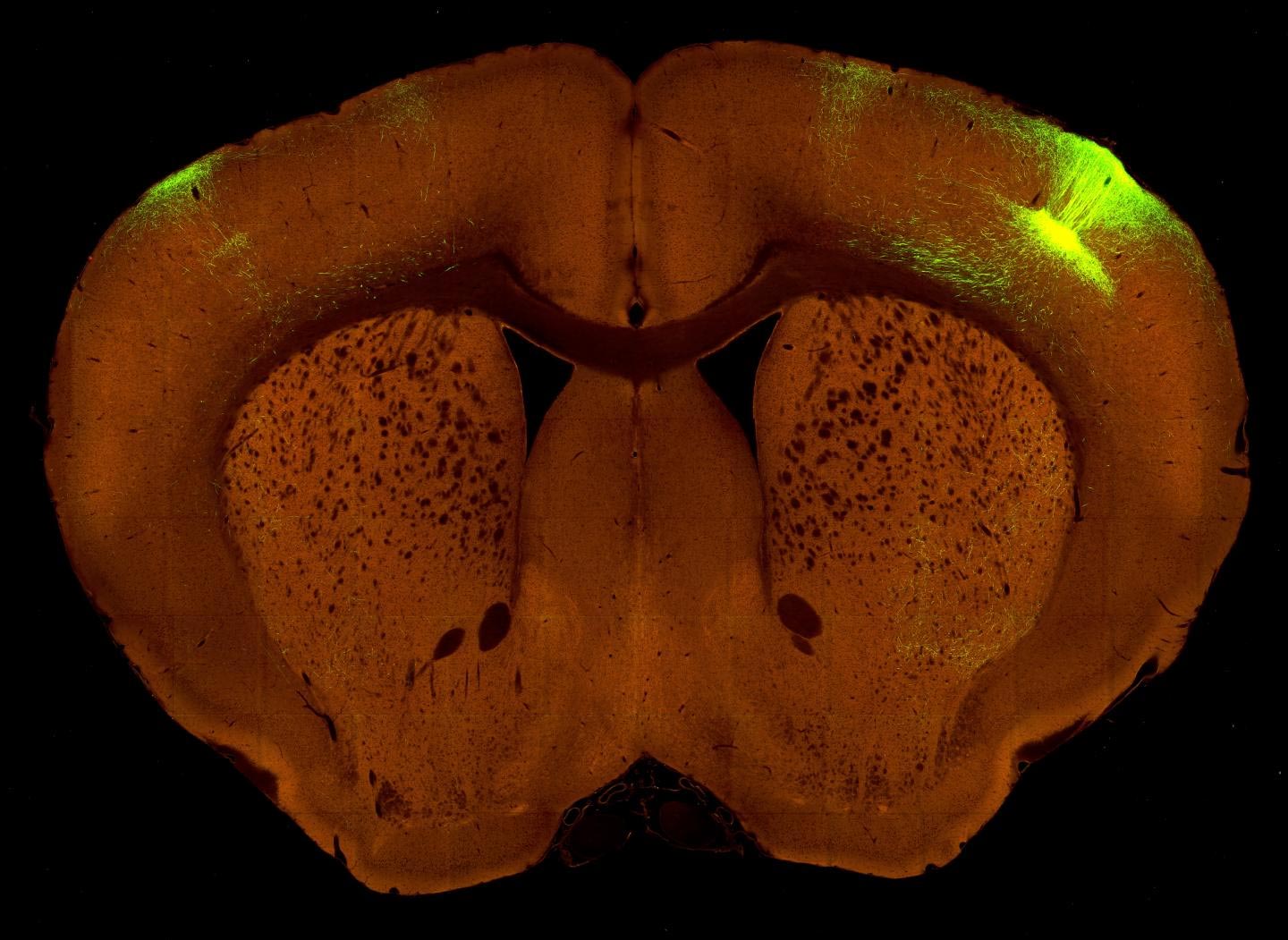
Systematic tracing of how neurons connect reveals mammalian brain’s ‘org chart’ of possible information flow.
In their quest to map the millions of neural highways and connections in the brain, researchers at the Allen Institute have made a significant step forward, unveiling a new high-resolution view of the wiring diagram of the mouse brain. Their study, which was published on October 30, 2019, in the journal Nature, traced thousands of connections between brain areas and lays the groundwork for researchers to better understand how brain circuitry might go awry in diseases and disorders such as Alzheimer’s disease and schizophrenia.
The publicly available dataset resulting from approximately a thousand new experiments represents the most detailed map of connections in a mammalian brain to date, tracing neural wiring within and between the thalamus and cortex, the outermost shell of the mammalian brain that is responsible for higher level functions like memory, decision making, and understanding the world around us.
Sifting through the data, the researchers uncovered an underlying “org chart” of wiring among the different areas comprising these two structures, showing a defined order to the connections that are the underpinnings of what makes our brains tick.
“These connections are the primary way neurons communicate with each other. The elaborate and complicated networks in the brain, their different pathways, and subsystems, process everything we see, our movements, memories, and feelings,” said Hongkui Zeng, Ph.D., Executive Director of Structured Science at the Allen Institute for Brain Science, a division of the Allen Institute, and senior author of the study. “Understanding the connectivity of the brain is fundamental for understanding how the brain works.”
Surveyors of the brain
The study describes a high-resolution expansion of the Allen Mouse Brain Connectivity Atlas, a publicly available resource that captures the brain-wide wiring diagram of the mouse, its “connectome,” at a medium (or mesoscale) level of resolution. The original iteration of that dataset, first debuted in 2014, captured connections between brain regions. To get a more detailed view of how the mammalian brain is wired, the researchers studied connections between specific classes of neurons covering two major parts of the brain, the cortex, and the thalamus. The team’s experiments relied on a specially modified virus that traces neurons’ paths, lighting up the brain’s information routes in glowing colors.
If the first iteration captured the equivalent of the railroad tracks in the brain’s transit system, this new expansion adds the specific routes from one point to another — the neural version of the red line and blue line. The newly acquired dataset captures connections between neurons in the thalamus and the cortex, using special labels to light up five different kinds of neurons that inhabit different layers of the cortex. The mouse brain has approximately 85 million neurons that make roughly 100 billion connections, or synapses. Nobody has yet mapped a complete synapse-by-synapse connectome of a mammalian brain, but capturing the connections made by different classes of cells allowed the researchers to uncover new information about how the wiring diagram is organized.
“This is another landmark, tour-de-force study from the Allen Institute for Brain Science that addresses fundamental issues of brain organization in the mouse,” said David Van Essen, Ph.D., Alumni Endowed Professor of Neuroscience at Washington University School of Medicine in St. Louis and a scientific advisor to the Allen Institute for Brain Science. “The team has acquired, analyzed, and freely shared a vast amount of high-quality anatomical connectivity data, thereby providing the most extensive ‘meso-connectome’ description to date for the wiring of any mammalian brain.”
Alterations in brain connections have been seen in Alzheimer’s disease, Parkinson’s, and several other brain diseases and disorders. Julie Harris, Ph.D., Associate Director of Neuroanatomy at the Allen Institute for Brain Science, who led the connectivity study, is now leading an effort exploring a similar map of connections in a mouse model of Alzheimer’s to better understand how the wiring diagram — and its underlying organization — might change in this prevalent form of dementia.
Finding logic in the brain’s connections
“What came out of these data was a big mess of connections, and at first glance, it looked like everything is connected to everything,” said Harris, who is co-lead author on the Nature article along with Stefan Mihalas, Ph.D., Associate Investigator at the Allen Institute for Brain Science. “The big question for us was, how do you make sense of these patterns? Is there any logic behind it?”
Using a computational approach, the researchers found that different sections of the cortex and thalamus can be mapped into a hierarchy, much like a company’s org chart. Parts of the cortex that are specialized for information gathered via our senses, like vision and smell, are on the bottom rungs, and regions that handle more complicated input — like calling up a memory evoked by a familiar scent — sit at the top. Connections flow both up and down the brain’s org chart, but the connections moving up are different than those moving down. They also found that not all connections respect these hierarchical laws. There are hints that the human cortex uses the same organizational system, and a previous study led by Van Essen showed a similar hierarchy in visual regions of the primate brain.
“This is not a simple hierarchy, like a one-way sequence of ascending steps. There are a lot of connections which do not follow the strict hierarchical rules. But this tells us something about the likely flow of information in these parts of the mammalian brain,” said Christof Koch, Ph.D., Chief Scientist and President of the Allen Institute for Brain Science and one of the study co-authors. “The next step will be to look directly at how neurons pass information through their electrical activity to confirm that this pattern matters.”
###
Reference: “Hierarchical organization of cortical and thalamic connectivity” by Julie A. Harris, Stefan Mihalas, Karla E. Hirokawa, Jennifer D. Whitesell, Hannah Choi, Amy Bernard, Phillip Bohn, Shiella Caldejon, Linzy Casal, Andrew Cho, Aaron Feiner, David Feng, Nathalie Gaudreault, Charles R. Gerfen, Nile Graddis, Peter A. Groblewski, Alex M. Henry, Anh Ho, Robert Howard, Joseph E. Knox, Leonard Kuan, Xiuli Kuang, Jerome Lecoq, Phil Lesnar, Yaoyao Li, Jennifer Luviano, Stephen McConoughey, Marty T. Mortrud, Maitham Naeemi, Lydia Ng, Seung Wook Oh, Benjamin Ouellette, Elise Shen, Staci A. Sorensen, Wayne Wakeman, Quanxin Wang, Yun Wang, Ali Williford, John W. Phillips, Allan R. Jones, Christof Koch and Hongkui Zeng, 30 October 2019, Nature.
DOI: 10.1038/s41586-019-1716-z
Research described in this publication was supported by award number U19MH114830 from the National Institute Of Mental Health, award number U01MH105982 from the National Institute of Mental Health and Eunice Kennedy Shriver National Institute Of Child Health & Human Development, and award number R01AG047589 from the National Institute on Aging, all of the National Institutes of Health. The content is solely the responsibility of the authors and does not necessarily represent the official views of the National Institutes of Health.
Never miss a breakthrough: Join the SciTechDaily newsletter.
Follow us on Google and Google News.
6 Comments
I know there will be many difficulties and challenges but I am determined to do it. If it fails then it will also be a lesson for me
I have read through some similar topics! However, your article gave me a very special impression, unlike other articles. I hope you continue to have valuable posts like this or more to share with everyone!
correct slot that u removed them from screw back down and ur all set no big deal. dont ask samsung or a repair man they’ll just screw u over and throw u around about ten differetn loops. not gettn a straight answer other then bring it n and charge u about $600 to fix. i see alot of people have this problem so there u go simple fix guaranteed. u r welcome.
The brain is the major part of the body and If he disturbs then the whole body performs wrong. Your research about the brain is very good because I have watched all the videos. In this video, I learn a lot of information that I never know before. Thanks for the brain health information.
I hope you continue to have valuable posts like this or more to shYour research about the brain is very good because I have watched all the videos. In this video, I learn a lot of information that I never know before. are with everyone!
Amazing Thanks For Sharing.