
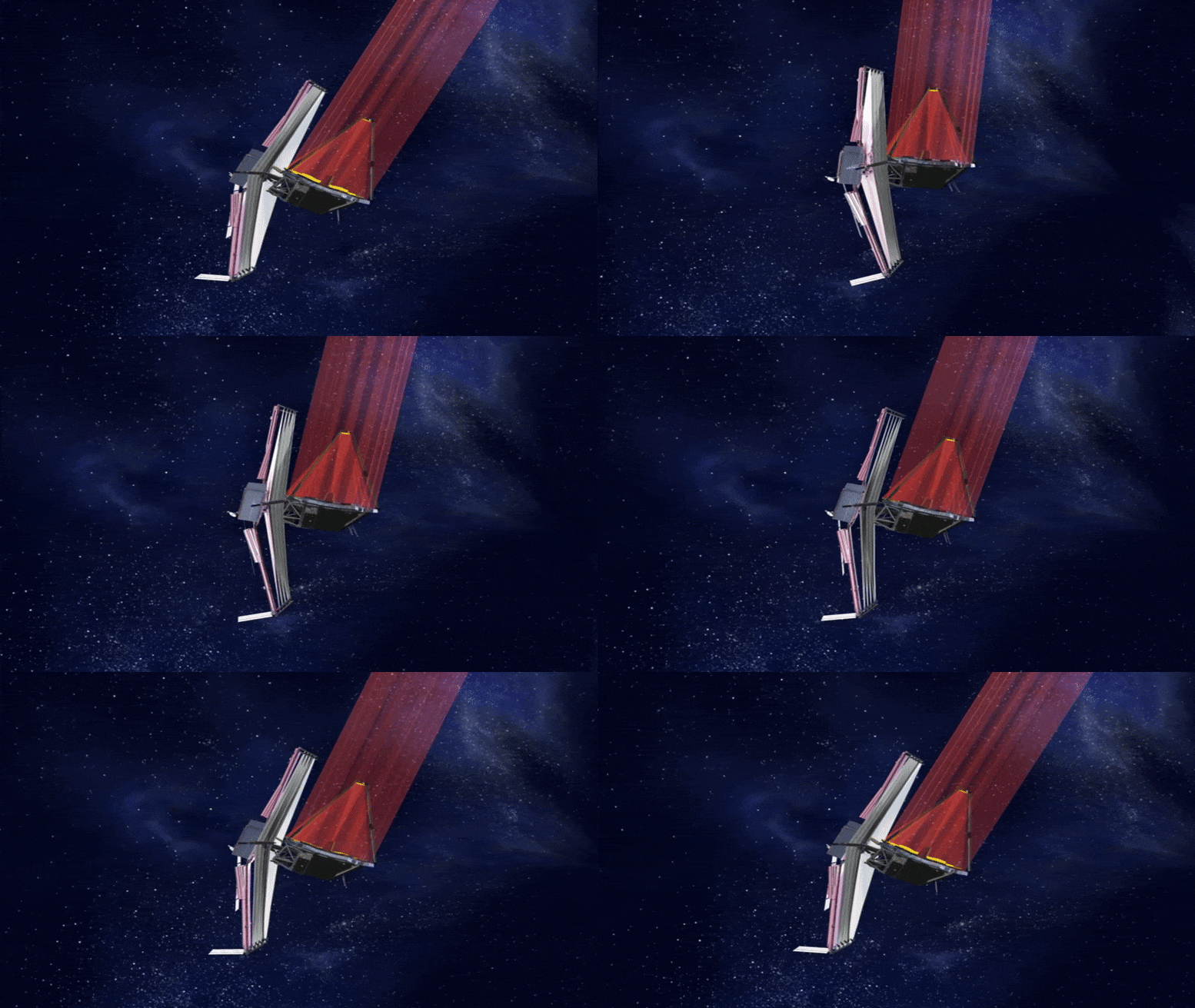
Set to explore deep space, the James Webb Space Telescope will also assist in studying Venus-like exoplanets to predict Earth’s climatic future.
The James Webb Space Telescope, the most complex and expensive space laboratory ever created, is less than two weeks away from its ultimate destination a million miles from Earth. Once it arrives, it will send information about parts of space and time never seen before. It will also send previously unattainable information about parts of our own solar system.
UC Riverside astrophysicist Stephen Kane’s group will be using the telescope to look for planets like Venus in other parts of the galaxy. In addition to work with the Webb mission, Kane is also joining NASA on missions to Venus expected to launch after 2028. Here, he breaks down some unique aspects of the Webb, explains how the separate Venus projects intersect, and how both might benefit Earth.
Q: The Webb telescope cost $10 billion. What contributed to the cost, and what makes it different from other telescopes?
A: Webb is often described as a successor to NASA’s Hubble Space Telescope, which is remarkably still going strong. It was launched in the early 90s and is well past its expiration date — it was never intended to last this long. Its primary mirror is just under 8 feet in diameter. The Webb’s mirror is more than 21 feet across. It’s way bigger. But there are a few other important differences.
Hubble orbits the Earth, and there’s an advantage to that. We can and have accessed it to fix it when something goes wrong. But the disadvantage is that Earth gets in the way of its observations and can limit some of the science it can do. In contrast, Webb is headed to the Lagrange point, a location in space where Earth and the sun’s gravity cancel out, so it can remain in a stable orbit. That location is about a million miles from Earth. From there, as it orbits the sun, it can point anywhere in space without having Earth get in the way.
In addition, the Hubble primarily operates at optical wavelengths, ones we can see with the human eye. Webb is primarily designed to “see” infrared light with extreme sensitivity. This will help us detect a number of things, including stars and planets that are just forming and aren’t yet otherwise visible.
Q: How will you be using Webb’s technology to help you understand more about Venus? Also, why are you studying Venus?
A: Venus could be described as a runaway greenhouse hellscape. It has surface temperatures of up to 800 degrees Fahrenheit, no water, and floats in a nest of sulfuric acid clouds. In my work, I’m trying to answer two questions: 1) how did Venus get to be the way it is? and 2) how commonly does this hellish state occur elsewhere?
Our separate mission to Venus is about answering the former question. That’s about studying Venus itself. Our work with the Webb is about the latter — are there other Venuses? We’ll be using Webb to measure the atmospheres of exoplanets — planets around stars other than our sun — and trying to determine whether they’re more like Earth or Venus. Specifically, Webb will help us look for carbon dioxide and other gases that could indicate runaway greenhouse states.
We are going to do these measurements on planets where we already know how long it takes them to orbit their stars, how close they are to their stars, their size and their mass. But we don’t know much about their atmospheres, or whether they’re in Venus-like states. Webb can tell us this. And it will help us see whether the fate of Venus is a common fate or not.
Q: Greenhouse gases are causing devastating changes to the climate here on Earth. Can Venus science help solve this planet’s problems?
A: Whatever happened to Venus was through non-human processes, but the effect is very similar. Venus is a preview into Earth’s future. Understanding how runaway greenhouse gases work can tell us how to prevent that future.
We know that climate change is real, that temperatures are rising. But there’s a lot of variability in predictions 50 or 100 years out because there are limits to how much we know about how planetary processes influence each other.
Volcanic outgassing, ocean currents, air currents — there are so many pieces in a complex puzzle, and we’re trying to determine our fate based only on data from Earth. We need another source of data where things have already gone wrong, and that’s Venus.
It’s possible Venus could always have been in its current state, but we don’t think so. We believe it could have had water in the past because it rotates slowly, which could allow clouds to form and cool the surface enough to get water. That’s one reason we’re going back, to see the geology on the surface and get clues about its origins.
I often explain the relationship between Venus and Earth this way: it’s like we live in a nice town. There’s a nearby town that at some point burned to the ground, and we don’t know why. If it looks like that town was exactly the same as ours, we can’t ignore that. There is a really important message in there about how we can better take care of where we live.
Never miss a breakthrough: Join the SciTechDaily newsletter.
Follow us on Google and Google News.
3 Comments
Space technology or explorations have always fascinated msnkind. Would personally want to travel to the other sd of moon with lights,to reveal mysteries.
Great work on building such a telescope so we can observe the universe. I would love to see these images.
Venus?..
What a waste of time.