
Findings have implications for increasing plant nitrogen use efficiency, reducing reliance on fertilizers.
Plant scientists have long known that crop yield is proportional to the dose of nitrogen fertilizer, but the increased use of fertilizers is costly and harmful to the environment. Until now, the underlying mechanisms by which plants adjust their growth according to the nitrogen dose has been unknown — a key finding that could help enhance plant growth and limit fertilizer use.
In a new study published in the Proceedings of the National Academy of Sciences (PNAS), plant genomic scientists at New York University’s Center for Genomics & Systems Biology discovered the missing piece in the molecular link between a plant’s perception of the nitrogen dose in its environment and the dose-responsive changes in its biomass.
Taking a novel approach, the NYU researchers examined how increasing doses of nitrogen created changes in plants’ genome-wide expression as a function of time. They then used mathematical models to investigate the rate of change of messenger RNA (mRNA) for thousands of genes within the genome to this experimental set up.
The researchers discovered that the dynamics of mRNA responses to nitrogen dose were governed by simple principles of enzyme kinetics — the rates of reactions catalyzed by enzymes — first described by Michaelis-Menten in 1913. Indeed, the authors found that Michaelis-Menten kinetics could accurately model the rate of change in gene expression in 30 percent of nitrogen-dose responsive genes.
“According to the classic Michaelis-Menten kinetic model, changing enzyme abundance will impact the maximum rate of reaction possible. Because transcription factors establish the rates at which gene transcription from DNA into RNA takes place, they can be directly compared to the catalytic enzymes in the Michaelis-Menten model. This means that increasing the abundance of key transcription factors should be able to boost the rate of nitrogen-dose dependent gene expression and, as a consequence, the rate of plant growth,” said Gloria Coruzzi, Carroll & Milton Petrie Professor in NYU’s Department of Biology and Center for Genomics & Systems Biology, and the paper’s senior author.
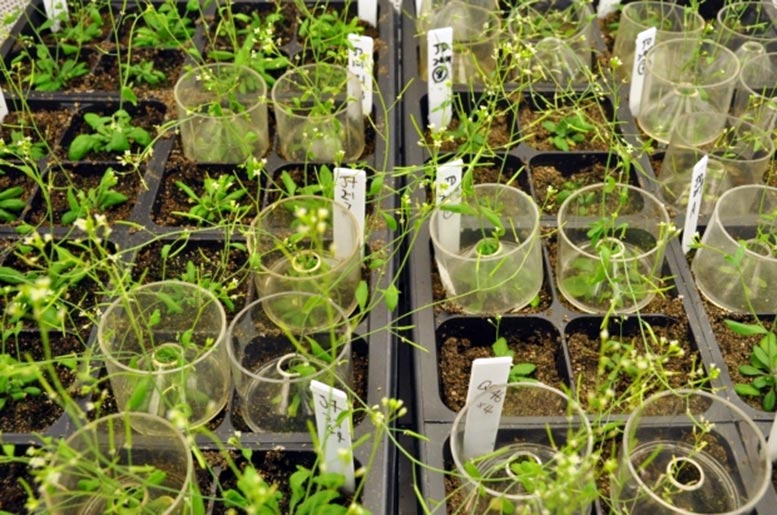
The research team found that increasing the level of the transcription factor TGA1 accelerated the rates of nitrogen-dose responsive gene expression and the rate of plant growth. The plants that overexpressed TGA1 had increased growth rates in response to nitrogen, reaching a plant biomass three times greater than wild type plants.
“By modeling the transcriptome kinetics underlying nitrogen-dose sensing using a classic principle of Michaelis-Menten kinetics, we discovered a regulatory gene whose increased expression may boost crop growth within low-nitrogen soils,” said Coruzzi. “Because TGA1 is conserved in plants, including crops such as rice, tomatoes, and wheat, our findings have implications for improving nitrogen use efficiency in crops, which can benefit agriculture and sustainability.”
###
Reference: “Nutrient dose-responsive transcriptome changes driven by Michaelis–Menten kinetics underlie plant growth rates” by Joseph Swift, Jose M. Alvarez, Viviana Araus, Rodrigo A. Gutiérrez and Gloria M. Coruzzi11 May 2020, Proceedings of the National Academy of Sciences.
DOI: 10.1073/pnas.1918619117
In addition to Coruzzi, study authors include Joseph Swift and Viviana Araus of NYU, Jose Alvarez of Universidad Mayor in Chile, and Rodrigo Gutiérrez of Pontificia Universidad Católica de Chile. This work was supported by the Zegar Family Foundation, the Beachell-Borlaug International Scholarship, and the National Science Foundation (NSF-PGRP: IOS-1339362 and NSF-DBI-0445666).
Never miss a breakthrough: Join the SciTechDaily newsletter.
Follow us on Google and Google News.