
Close Menu
    Facebook X (Twitter) Instagram
    SciTechDaily
    • Biology
    • Chemistry
    • Earth
    • Health
    • Physics
    • Science
    • Space
    • Technology
    Facebook X (Twitter) Pinterest YouTube RSS
    SciTechDaily
    Home»Space»Hubble Captures Striking Image of Nebula IRAS 05437+2502
    Space

    Hubble Captures Striking Image of Nebula IRAS 05437+2502

    By Karl Hille, European Space AgencySeptember 1, 2018No Comments2 Mins Read
    Facebook Twitter Pinterest Telegram LinkedIn WhatsApp Email Reddit
    Share
    Facebook Twitter LinkedIn Pinterest Telegram Email Reddit
    Amazing Hubble Image of Nebula IRAS 05437+2502
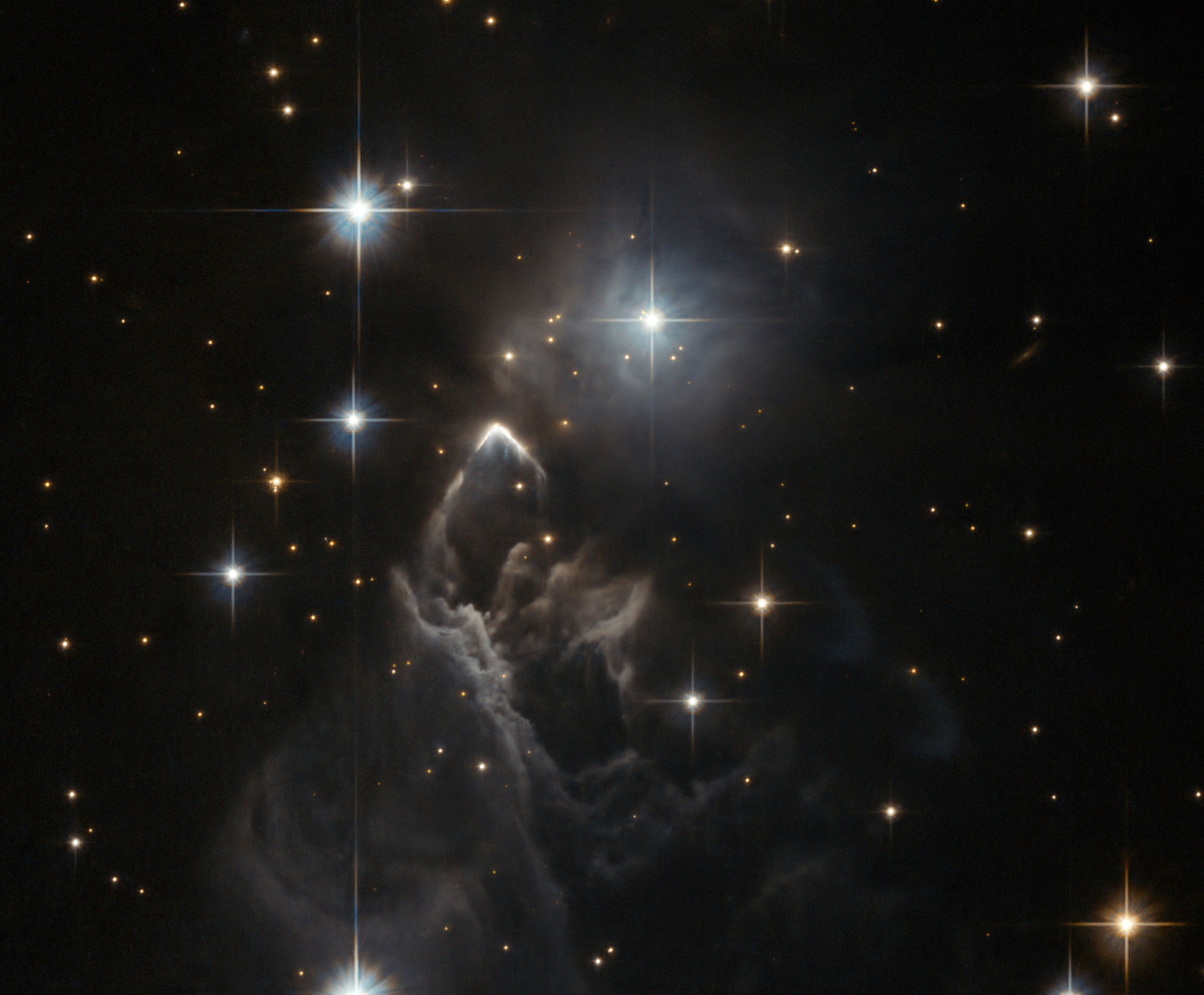
    This picture of little-known nebula IRAS 05437+2502 was created from images taken through yellow and near-infrared filters. It is located in the constellation of Taurus (the Bull), close to the central plane of our Milky Way galaxy. Credit: ESA/Hubble, R. Sahai and NASA

    The little-known nebula IRAS 05437+2502 billows out among the bright stars and dark dust clouds that surround it in this striking image from the Hubble Space Telescope. It is located in the constellation of Taurus (the Bull), close to the central plane of our Milky Way galaxy.

    Unlike many of Hubble’s targets, this object has not been studied in detail and its exact nature is unclear. At first glance, it appears to be a small, rather isolated region of star formation, and one might assume that the effects of fierce ultraviolet radiation from bright, young stars probably were the cause of the eye-catching shapes of the gas. However, the bright, boomerang-shaped feature may tell a more dramatic tale. The interaction of a high-velocity young star with the cloud of gas and dust may have created this unusually sharp-edged, bright arc. Such a reckless star would have been ejected from the distant young cluster where it was born and would travel at 200,000 kilometers per hour (124,000 miles per hour) or more through the nebula.

    This faint cloud was originally discovered in 1983 by the Infrared Astronomical Satellite (IRAS), the first space telescope to survey the whole sky in infrared light. IRAS was run by the United States, the Netherlands, and the United Kingdom and found huge numbers of new objects that were invisible from the ground.

    This image was taken with the Wide Field Channel of the Advanced Camera for Surveys on Hubble. It was part of a “snapshot” survey. These are observations that are fitted into Hubble’s busy schedule when possible, without any guarantee that the observation will take place — so it was fortunate that the observation was made at all. This picture was created from images taken through yellow and near-infrared filters.

    Never miss a breakthrough: Join the SciTechDaily newsletter.
    Follow us on Google and Google News.

    Astronomy Hubble Space Telescope
    Share. Facebook Twitter Pinterest LinkedIn Email Reddit

    Related Articles

    A Morphing Spiral Galaxy Amongst Friends

    Hubble Views Magnificent Lopsided Galaxy NGC 2276

    Hubble Captures Fantastic Detail of Eponymous Spiral Galaxy NGC 691

    Spectacular Image Captured by Hubble Shows a Strangely Contorted Spiral Galaxy

    A Distant Spiral in Virgo: Extraordinary Detail Seen in a Galaxy 150 Million Light-Years Away From Earth

    Magnetic Monsters: Hubble Tracks Down Location of Mysterious Radio Signals From Intergalactic Space

    A Menagerie of Galaxies: Hubble Captures a Cluster With Galaxies of All Shapes and Sizes

    How Habitable Are Planets That Orbit Red Dwarfs – The Most Common Type of Stars in the Galaxy?

    Cosmic Silver Lining: Hubble Spots V565 Surrounded by Four Prominent Diffraction Spikes

    Leave A Reply Cancel Reply

    • Facebook
    • Twitter
    • Pinterest
    • YouTube

    Don't Miss a Discovery

    Subscribe for the Latest in Science & Tech!

    Trending News

    Researchers Discover a Hidden Vitamin D Problem That Persists Year-Round

    Interstellar Comet 3I/ATLAS Reveals Strange Chemistry Beyond Our Solar System

    A Newly Found Cellular Shift May Explain Why Aging Leads to Disease

    Scientists Discover Gut Signal That Turns Off Sugar Cravings

    Scientists Discover Rogue Gene That Could Unlock New Cancer Treatments

    Constantly Tired? Scientists Say These Vitamin Deficiencies May Be Why

    A Surprising Discovery Inside Fish Could Change What We Know About the Ocean

    Scientists May Have Finally Solved the Mystery of the Strange Hum Heard Around the World

    Follow SciTechDaily
    • Facebook
    • Twitter
    • YouTube
    • Pinterest
    • Newsletter
    • RSS
    SciTech News
    • Biology News
    • Chemistry News
    • Earth News
    • Health News
    • Physics News
    • Science News
    • Space News
    • Technology News
    Recent Posts
    • The Kombucha Surprise: One Ingredient Dramatically Changes Its Chemistry and Health Potential
    • Hidden Solar Storms May Be Lighting Japan’s Skies With Massive Red Auroras
    • UCLA Scientists Uncover a “Hidden Weakness” in Some of the World’s Deadliest Cancers
    • Oak Trees Outsmart Caterpillars With a Brilliant Spring Trick
    • Scientists Discover a Hidden Disease Crisis Spreading Through Wild Snakes
    Copyright © 1998 - 2026 SciTechDaily. All Rights Reserved.
    • Science News
    • About
    • Contact
    • Editorial Board
    • Privacy Policy
    • Terms of Use

    Type above and press Enter to search. Press Esc to cancel.