
Close Menu
    Facebook X (Twitter) Instagram
    SciTechDaily
    • Biology
    • Chemistry
    • Earth
    • Health
    • Physics
    • Science
    • Space
    • Technology
    Facebook X (Twitter) Pinterest YouTube RSS
    SciTechDaily
    Home»Space»Hubble Space Telescope Views “El Gordo”
    Space

    Hubble Space Telescope Views “El Gordo”

    By SciTechDailyJanuary 8, 2018No Comments2 Mins Read
    Facebook Twitter Pinterest Telegram LinkedIn WhatsApp Email Reddit
    Share
    Facebook Twitter LinkedIn Pinterest Telegram Email Reddit
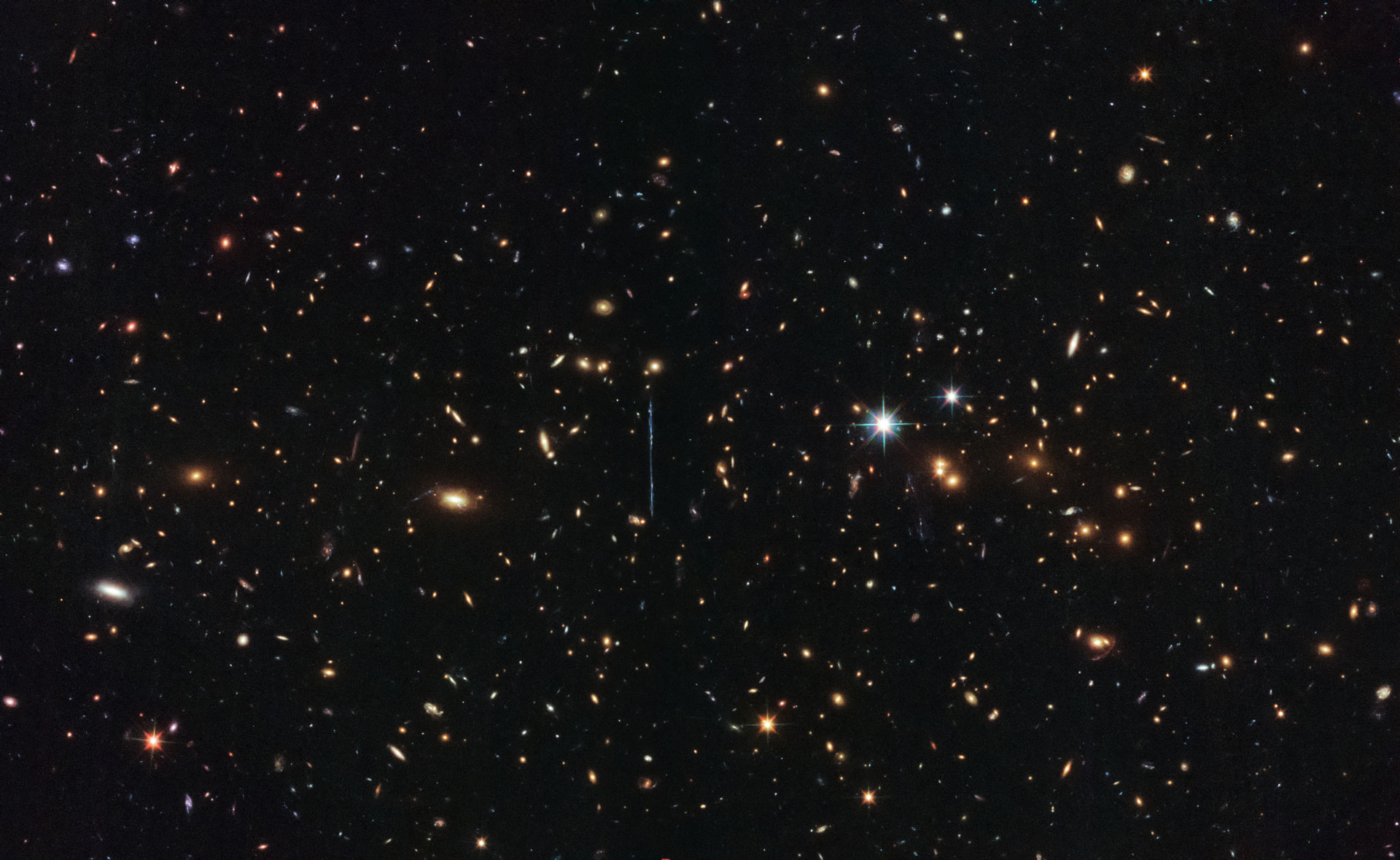
    Hubble Views El Gordo
    Hubble Space Telescope image of the massive galaxy cluster ACT-CLJ0102-4915, also known as “El Gordo.” Credit: ESA/Hubble & NASA, RELICS

    In 2014, astronomers using the NASA/ESA Hubble Space Telescope found that this enormous galaxy cluster contains the mass of a staggering three million billion Suns — so it’s little wonder that it has earned the nickname of “El Gordo” (“the Fat One” in Spanish)! Known officially as ACT-CLJ0102-4915, it is the largest, hottest, and X-ray brightest galaxy cluster ever discovered in the distant Universe.

    Galaxy clusters are the largest objects in the Universe that are bound together by gravity. They form over billions of years as smaller groups of galaxies slowly come together. In 2012, observations from ESO’s Very Large Telescope, NASA’s Chandra X-ray Observatory and the Atacama Cosmology Telescope showed that El Gordo is actually composed of two galaxy clusters colliding at millions of kilometers per hour.

    The formation of galaxy clusters depends heavily on dark matter and dark energy; studying such clusters can therefore help shed light on these elusive phenomena. In 2014, Hubble found that most of El Gordo’s mass is concealed in the form of dark matter. Evidence suggests that El Gordo’s “normal” matter — largely composed of hot gas that is bright in the X-ray wavelength domain — is being torn from the dark matter in the collision. The hot gas is slowing down, while the dark matter is not.

    This image was taken by Hubble’s Advanced Camera for Surveys and Wide-Field Camera 3 as part of an observing program called RELICS (Reionization Lensing Cluster Survey). RELICS imaged 41 massive galaxy clusters with the aim of finding the brightest distant galaxies for the forthcoming NASA/ESA/CSA James Webb Space Telescope (JWST) to study.

    Never miss a breakthrough: Join the SciTechDaily newsletter.
    Follow us on Google and Google News.

    Astronomy Hubble Space Telescope
    Share. Facebook Twitter Pinterest LinkedIn Email Reddit

    Related Articles

    A Morphing Spiral Galaxy Amongst Friends

    Hubble Views Magnificent Lopsided Galaxy NGC 2276

    Hubble Captures Fantastic Detail of Eponymous Spiral Galaxy NGC 691

    Spectacular Image Captured by Hubble Shows a Strangely Contorted Spiral Galaxy

    A Distant Spiral in Virgo: Extraordinary Detail Seen in a Galaxy 150 Million Light-Years Away From Earth

    Magnetic Monsters: Hubble Tracks Down Location of Mysterious Radio Signals From Intergalactic Space

    A Menagerie of Galaxies: Hubble Captures a Cluster With Galaxies of All Shapes and Sizes

    How Habitable Are Planets That Orbit Red Dwarfs – The Most Common Type of Stars in the Galaxy?

    Cosmic Silver Lining: Hubble Spots V565 Surrounded by Four Prominent Diffraction Spikes

    Leave A Reply Cancel Reply

    • Facebook
    • Twitter
    • Pinterest
    • YouTube

    Don't Miss a Discovery

    Subscribe for the Latest in Science & Tech!

    Trending News

    Popular Supplement Ingredient Linked to Shorter Lifespan in Men

    Scientists May Have Found a Way To Repair Nerve Damage in Multiple Sclerosis

    “Totally Unexpected” – Scientists Discover Pancreatic Cancer’s Fatal Addiction

    A Strange Quantum Effect May Explain One of Biology’s Greatest Mysteries

    James Webb Telescope Reveals the Universe’s Hidden Cosmic Web in Stunning Detail

    Scientists Identify Simple Supplement That Greatly Reduces Alzheimer’s Damage

    You May Have a Dangerous Type of Cholesterol Even if Your Tests Look Normal

    Your Blood Pressure Reading Could Be Wrong Because of One Simple Mistake

    Follow SciTechDaily
    • Facebook
    • Twitter
    • YouTube
    • Pinterest
    • Newsletter
    • RSS
    SciTech News
    • Biology News
    • Chemistry News
    • Earth News
    • Health News
    • Physics News
    • Science News
    • Space News
    • Technology News
    Recent Posts
    • Scientists Discover Testosterone Could Actually Protect Against Deadly Brain Cancer
    • Mediterranean Diet May Activate Secret Anti-Aging Proteins Inside Your Cells
    • Scientists Reveal That Eating Almonds Every Day Could Transform Your Gut, Metabolism, and Appetite
    • Researchers Found a Surprisingly Realistic Way To Mine Asteroids for Mars
    • Europe Just Unveiled a Serious Rival to SpaceX’s Starship
    Copyright © 1998 - 2026 SciTechDaily. All Rights Reserved.
    • Science News
    • About
    • Contact
    • Editorial Board
    • Privacy Policy
    • Terms of Use

    Type above and press Enter to search. Press Esc to cancel.