
Close Menu
    Facebook X (Twitter) Instagram
    SciTechDaily
    • Biology
    • Chemistry
    • Earth
    • Health
    • Physics
    • Science
    • Space
    • Technology
    Facebook X (Twitter) Pinterest YouTube RSS
    SciTechDaily
    Home»Space»Hubble Transforms Invisible Infrared Mysteries Into Visual Wonders
    Space

    Hubble Transforms Invisible Infrared Mysteries Into Visual Wonders

    By ESA/HubbleFebruary 12, 2024No Comments3 Mins Read
    Facebook Twitter Pinterest Telegram LinkedIn WhatsApp Email Reddit
    Share
    Facebook Twitter LinkedIn Pinterest Telegram Email Reddit
    IRAS 16562 3959
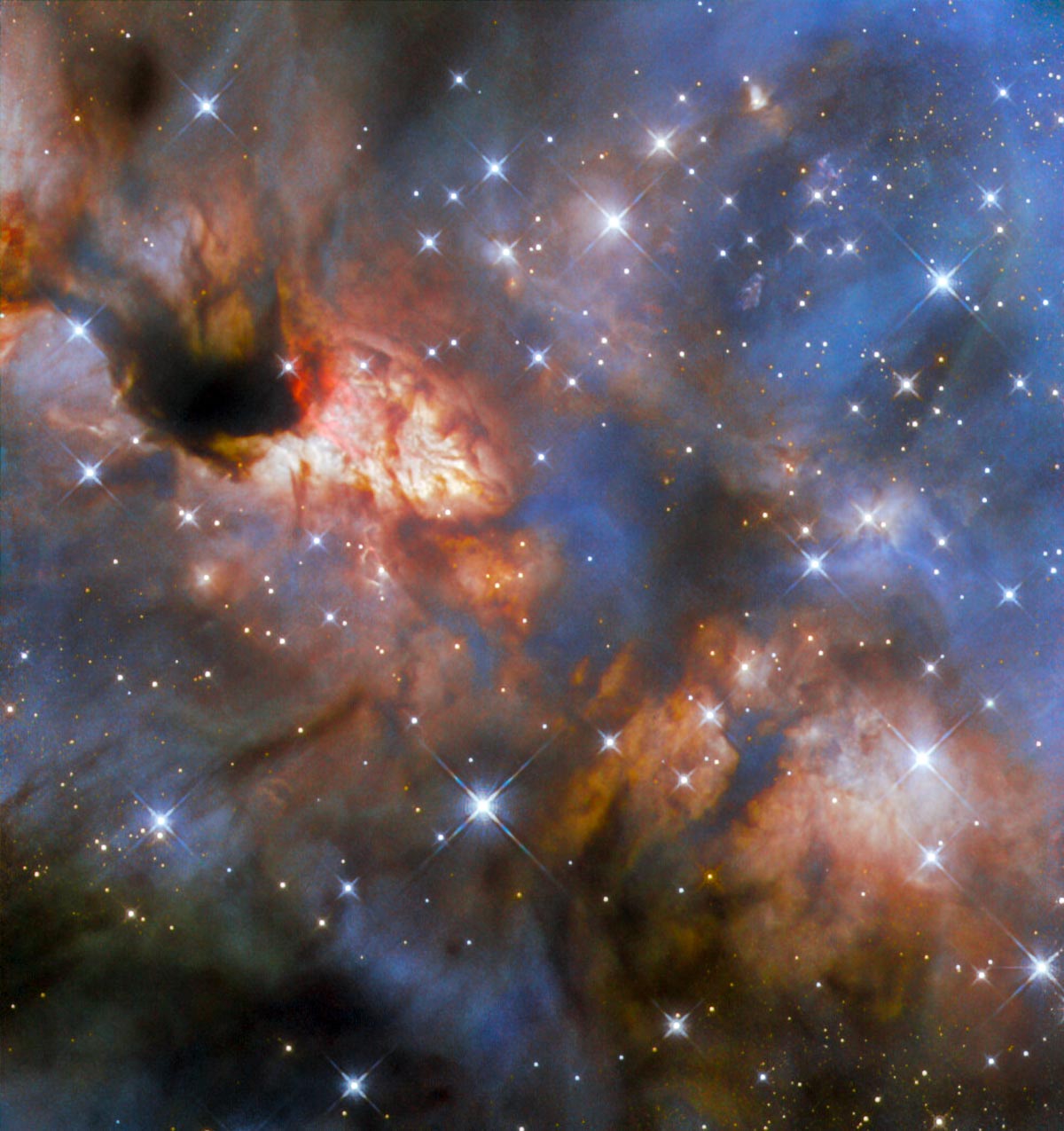
    The Hubble Telescope provides a stunning view of the star-forming region IRAS 16562-3959, offering insights into the formation of massive stars within the Milky Way. Credit: ESA/Hubble & NASA, R. Fedriani, J. Tan

    Hubble’s latest image reveals the colorful and dynamic star-forming region IRAS 16562-3959, showcasing the combination of technology and artistry in astronomy.

    If the Hubble Picture of the Week from two weeks ago was somewhat dim and subtle in appearance, then this week’s image is a veritable riot of color and activity! It features a relatively close-by star-forming region known as IRAS 16562-3959 that lies within the Milky Way in the constellation Scorpius, about 5900 light-years from Earth.

    The Role of Hubble’s Wide Field Camera 3

    This image was compiled using observations from Hubble’s Wide Field Camera 3 (WFC 3). The detailed nuances of color are possible because of the four separate filters that were used to collect the data. Filters are thin slivers of highly specialized material that only allow very specific wavelengths of light through. They can be slid in front of the part of the telescope that is sensitive to light, letting astronomers control which wavelengths of light the telescope collects with each observation. This is useful not only for specific scientific research, but also for the creation of images like this one.

    Artistry Meets Science

    Raw telescope observations are always monochrome, regardless of which filter was used. However, specially trained artists and image specialists can select colors that match the wavelength range covered by individual filters. Or, in the case where a direct match is not possible — such as for the data used in this image, which are all in the infrared regime, which human eyes are not sensitive to — the artist can select a color that sensibly represents what is taking place. For example, they might assign bluer colors to shorter wavelengths and redder colors to longer wavelengths, as is the case in the visible light range. Then, data from multiple filters can be combined to build up a multi-color image, that both looks beautiful and has scientific meaning.

    Unveiling the Secrets of Massive Star Formation

    At the center of the image, IRAS 16562-3959 is thought to host a massive star — about 30 times the mass of our Sun — that is still in the process of forming. At the near-infrared wavelengths to which Hubble is sensitive, the central region appears dark because there is so much obscuring dust in the way. However near-infrared light leaks out mainly on two sides — upper left and lower right — where a powerful jet from the massive protostar has cleared away the dust. Multi-wavelength images including this incredible Hubble scene will help us gain a better understanding of how the most massive, brightest stars in our galaxy are born.

    Never miss a breakthrough: Join the SciTechDaily newsletter.
    Follow us on Google and Google News.

    Astronomy European Space Agency Hubble Space Telescope
    Share. Facebook Twitter Pinterest LinkedIn Email Reddit

    Related Articles

    A Diamond Necklace of Cosmic Proportions

    Hubble Snaps a Stunning Close-Up of a Magnificent Spiral Galaxy

    Extraordinary Hubble Image: Light Bends From the Beyond

    Hubble Space Telescope Sees Volcanic Activity Reforming the Atmosphere on a Rocky Exoplanet

    Hubble Spies a Luminous Heart With Dark Tendrils

    Spectacular Return to the Veil Nebula

    Hubble Spots a Peculiar Sight: Unusual Spiral Galaxy With a Heavy Arm

    A Flash of Life: Hubble Spies an Unusual Planetary Nebula

    Through the Cosmic Clouds: Hubble Spots a Beautiful Stellar Nursery

    Leave A Reply Cancel Reply

    • Facebook
    • Twitter
    • Pinterest
    • YouTube

    Don't Miss a Discovery

    Subscribe for the Latest in Science & Tech!

    Trending News

    JWST Finds a “Star” 100 Billion Times Brighter Than Any Star Should Be

    Scientists Find a Hidden Biological Link Across Different Forms of Autism

    Astronomers Discover a Ghostly River of Stars That Could Reveal Dark Matter

    Why Is Colorectal Cancer Rising in People Under 50? New Clues Point to the Environment

    Quantum Fluctuations Break a Crystal’s Symmetry Rules

    Why Does an Irregular Heartbeat Strike 40 Years Early in Some People?

    Scientists Reveal How ADHD Could Fuel Creative Thinking

    Scientists Find Just 3 Minutes of Sprinting Can Transform Blood Chemistry

    Follow SciTechDaily
    • Facebook
    • Twitter
    • YouTube
    • Pinterest
    • Newsletter
    • RSS
    SciTech News
    • Biology News
    • Chemistry News
    • Earth News
    • Health News
    • Physics News
    • Science News
    • Space News
    • Technology News
    Recent Posts
    • Scientists Discover a Hidden Baobab Species in Madagascar
    • Dogs and Humans May Share a Surprising Biological Secret to Longevity
    • A 150-Million-Year-Old Dinosaur Flight Mystery May Finally Have an Answer
    • Giant Crocodylians Ruled South America’s Ancient Food Chain
    • 236-Million-Year-Old Fossil Reveals a Stunning Secret About the Origins of Mammal Birth
    Copyright © 1998 - 2026 SciTechDaily. All Rights Reserved.
    • Science News
    • About
    • Contact
    • Editorial Board
    • Privacy Policy
    • Terms of Use

    Type above and press Enter to search. Press Esc to cancel.