
Close Menu
    Facebook X (Twitter) Instagram
    SciTechDaily
    • Biology
    • Chemistry
    • Earth
    • Health
    • Physics
    • Science
    • Space
    • Technology
    Facebook X (Twitter) Pinterest YouTube RSS
    SciTechDaily
    Home»Space»Hubble Views a Herbig-Haro Object
    Space

    Hubble Views a Herbig-Haro Object

    By NASAFebruary 25, 2013No Comments2 Mins Read
    Facebook Twitter Pinterest Telegram LinkedIn WhatsApp Email Reddit
    Share
    Facebook Twitter LinkedIn Pinterest Telegram Email Reddit
    Hubble Views a Young Star
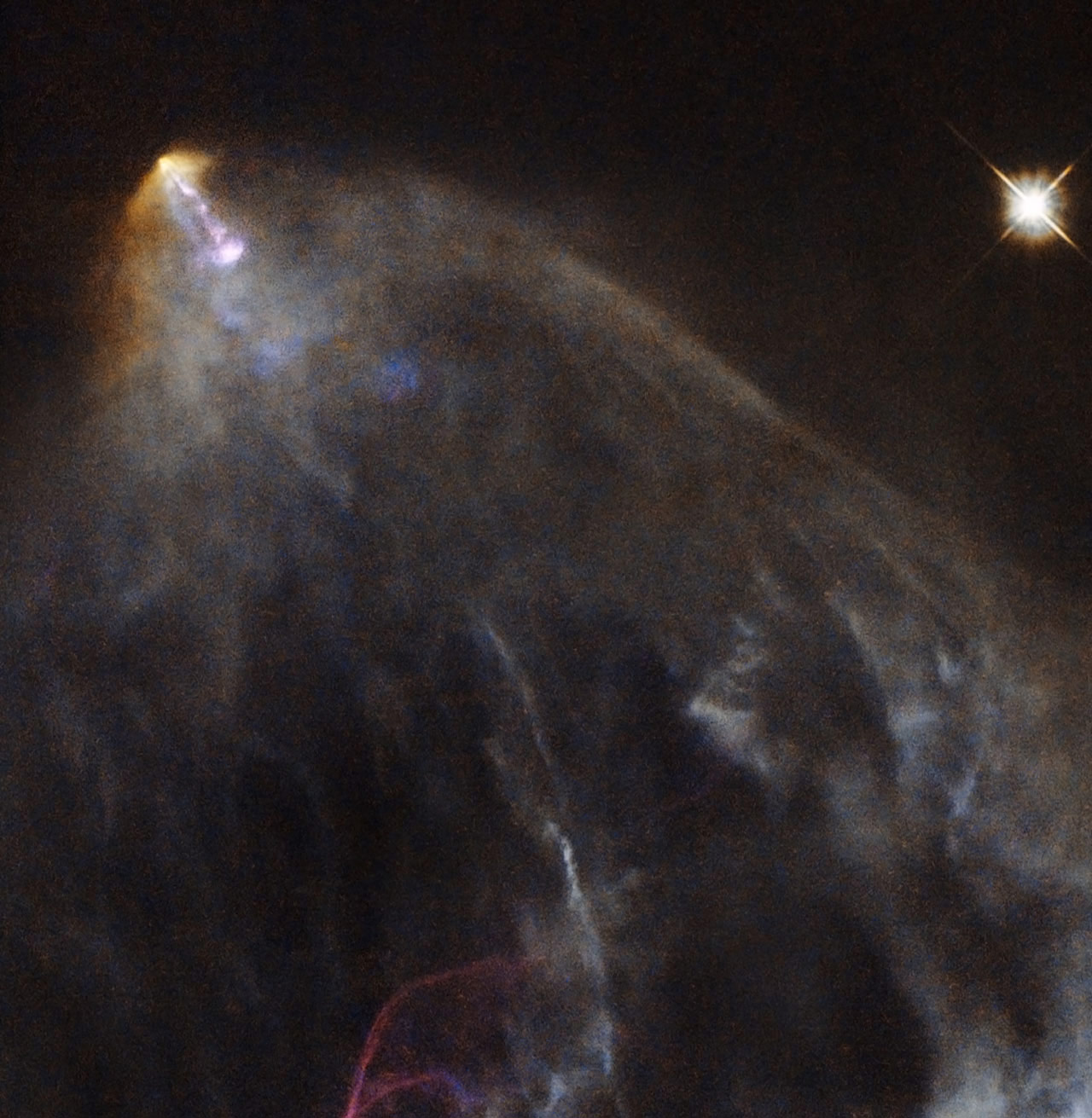
    Hubble Space Telescope image of Herbig-Haro object HH 151. Credit: ESA/Hubble & NASA

    This new Hubble image shows a Herbig-Haro object, a jet of glowing material trailed by an orange-hued plume of gas and dust.

    This image shows an object known as HH 151, a bright jet of glowing material trailed by an intricate, orange-hued plume of gas and dust. It is located some 460 light-years away in the constellation of Taurus (The Bull), near to the young, tumultuous star HL Tau.

    In the first few hundred thousand years of life, new stars like HL Tau pull in material that falls towards them from the surrounding space. This material forms a hot disc that swirls around the coalescing body, launching narrow streams of material from its poles. These jets are shot out at speeds of several hundred kilometers (or miles) per second and collide violently with nearby clumps of dust and gas, creating wispy, billowing structures known as Herbig-Haro objects — like HH 151 seen in the image.

    Such objects are very common in star-forming regions. They are short-lived, and their motion and evolution can actually be seen over very short timescales, on the order of years. They quickly race away from the newly-forming star that emitted them, colliding with new clumps of material and glowing brightly before fading away.

    Never miss a breakthrough: Join the SciTechDaily newsletter.
    Follow us on Google and Google News.

    Astronomy Hubble Space Telescope NASA
    Share. Facebook Twitter Pinterest LinkedIn Email Reddit

    Related Articles

    Hubble Reveals a Star Disk Three Times Hotter Than the Sun’s Surface

    A Star’s Unexpected Heatwave: FU Orionis Challenges Astrophysics Models

    NASA’s Hubble Reveals How the LMC Defied Galactic Destruction

    Legendary Star’s Smooth Disk Mystifies Astronomers, Challenges Planet Formation Theories

    Cosmic Horror Unveiled: NASA Reveals “Blood-Soaked Eyes” Staring From Deep Space [Video]

    Spanning 248 Billion Miles: Stunning Hubble Timelapse Captures a Star’s Violent Eruptions

    Jupiter’s Great Red Spot Enigma: Unexplained Oscillations Baffle Astronomers

    Unlocking Uranus: NASA’s Dual Observations Pave the Way to Discovering New Worlds

    Astronomers Baffled by Black Hole Jets Igniting Star Explosions

    Leave A Reply Cancel Reply

    • Facebook
    • Twitter
    • Pinterest
    • YouTube

    Don't Miss a Discovery

    Subscribe for the Latest in Science & Tech!

    Trending News

    The Strange “Spacetime Crystal” That Can Suddenly Turn Into a Black Hole

    The Surprising Way Asteroids May Have Helped Life Begin on Earth

    Vast Hidden Structure Discovered Under Miles of Ice in East Antarctica

    A Surprising Discovery Suggests Autism Is Not One Condition

    New Alzheimer’s Discovery Could Change How Scientists Fight the Disease

    Yale Discovery Overturns Long-Held “Evolutionary Dead End” Theory

    UCLA Scientists Uncover a “Hidden Weakness” in Some of the World’s Deadliest Cancers

    Humpback Whale Stuns Scientists With 15,000 Kilometer Journey Across Oceans

    Follow SciTechDaily
    • Facebook
    • Twitter
    • YouTube
    • Pinterest
    • Newsletter
    • RSS
    SciTech News
    • Biology News
    • Chemistry News
    • Earth News
    • Health News
    • Physics News
    • Science News
    • Space News
    • Technology News
    Recent Posts
    • Meet the Artemis III Astronauts Preparing for NASA’s Boldest Moon Mission Yet
    • Scientists Develop a New Way To Measure Gravitational Waves in the Expanding Universe
    • MIT’s New Dual-Mode Rocket System Could Send Tiny Satellites to Mars
    • Scientists Discover a Biological Clock Unlike Anything Seen Before
    • This “Zombie” Sea Creature Keeps Growing After Being Cut Apart
    Copyright © 1998 - 2026 SciTechDaily. All Rights Reserved.
    • Science News
    • About
    • Contact
    • Editorial Board
    • Privacy Policy
    • Terms of Use

    Type above and press Enter to search. Press Esc to cancel.