
Close Menu
    Facebook X (Twitter) Instagram
    SciTechDaily
    • Biology
    • Chemistry
    • Earth
    • Health
    • Physics
    • Science
    • Space
    • Technology
    Facebook X (Twitter) Pinterest YouTube RSS
    SciTechDaily
    Home»Space»Hubble Views Planetary Nebula IC 289
    Space

    Hubble Views Planetary Nebula IC 289

    By Hubble Space TelescopeJuly 15, 2013No Comments2 Mins Read
    Facebook Twitter Pinterest Telegram LinkedIn WhatsApp Email Reddit
    Share
    Facebook Twitter LinkedIn Pinterest Telegram Email Reddit
    Hubble Views Planetary Nebula IC 289
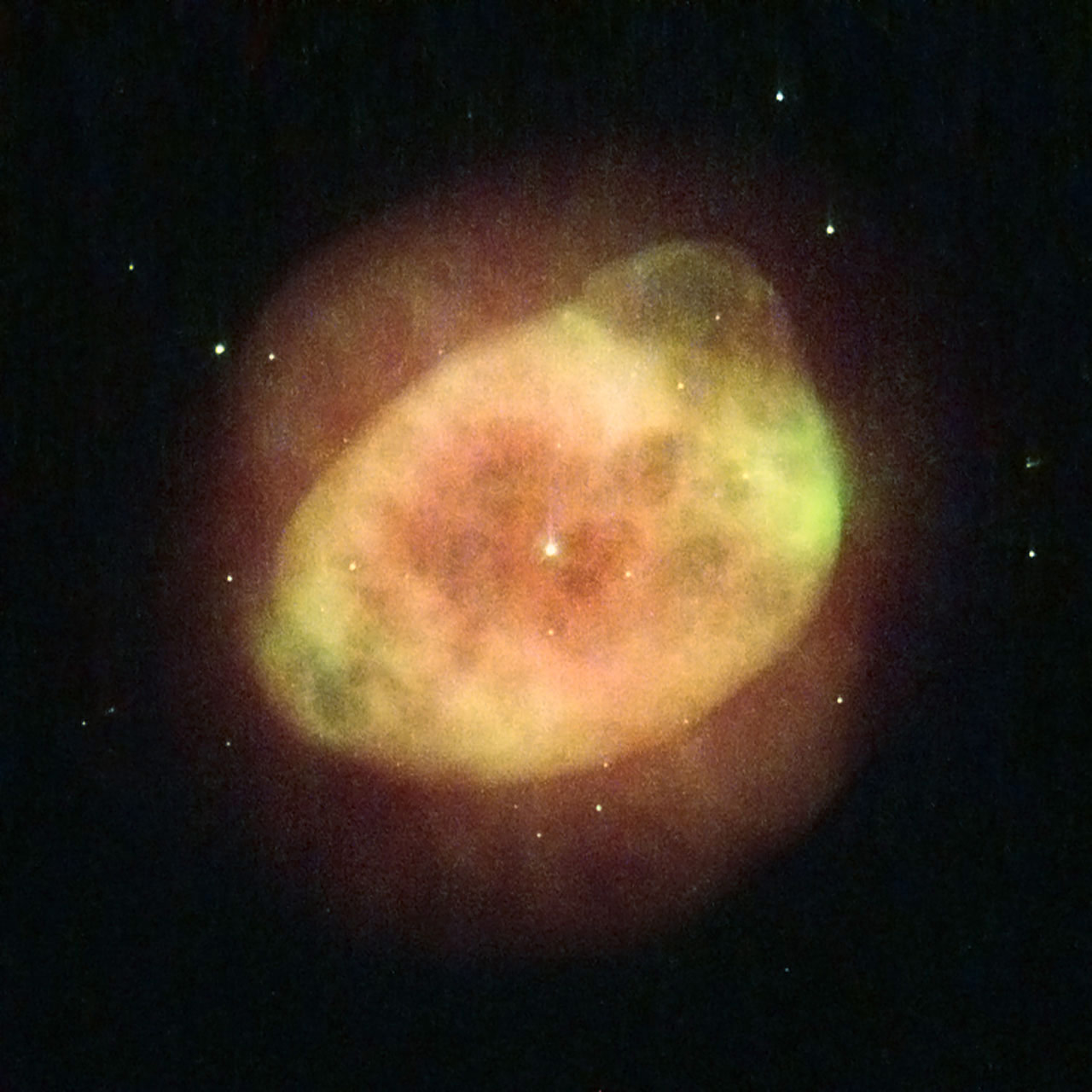
    Planetary nebula IC 289 is situated in the northern constellation of Cassiopeia. Credit: ESA/Hubble & NASA, Acknowledgment: Serge Meunier

    A newly released Hubble image shows the remains of a star known as planetary nebula IC 289.

    This NASA/ESA Hubble Space Telescope image shows the planetary nebula IC 289, located in the northern constellation of Cassiopeia. Formerly a star like our Sun, it is now just a cloud of ionized gas being pushed out into space by the remnants of the star’s core, visible as a small bright dot in the middle of the cloud.

    Weirdly enough, planetary nebulae have nothing to do with planets. Early observers, when looking through small telescopes, could only see undefined, smoky forms that looked like gaseous planets — hence the name. The term has stuck even though modern telescopes like Hubble have made it clear that these objects are not planets at all, but the outer layers of dying stars being thrown off into space.

    Stars shine as a result of nuclear fusion reactions in their cores, converting hydrogen to helium. All stars are stable, balancing the inward push caused by their gravity with the outwards thrust from the inner fusion reactions in their cores. When all the hydrogen is consumed the equilibrium is broken; the gravitational forces become more powerful than the outward pressure from the fusion process and the core starts to collapse, heating up as it does so.

    When the hot, shrinking core gets hot enough, the helium nuclei begin to fuse into carbon and oxygen and the collapse stops. However, this helium-burning phase is highly unstable, and huge pulsations build up, eventually becoming large enough to blow the whole star’s atmosphere away.

    A version of this image was entered into the Hubble’s Hidden Treasures image processing competition by contestant Serge Meunier.

    Never miss a breakthrough: Join the SciTechDaily newsletter.
    Follow us on Google and Google News.

    Astronomy Hubble Space Telescope NASA Nebula Stars
    Share. Facebook Twitter Pinterest LinkedIn Email Reddit

    Related Articles

    Hubble Spots Farthest Star Ever Seen Thanks to Lucky Cosmic Alignment – “We Almost Didn’t Believe It”

    Tour Stunning Hubble Images of Incredible Nebulae in This New NASA Video

    Hubble Find Surprises Astronomers: White Dwarfs Can Still Undergo Stable Thermonuclear Activity

    A Scattering of Stars Shows Us Something New About the Universe and the Hubble Space Telescope

    Hubble Solves Mystery of Monster Star’s Dimming – Red Hypergiant Is As Bright as 300,000 Suns

    ULLYSES: Hubble Embarks on Largest Observing Program of Its Career

    Hubble Space Telescope Captures a frEGGS-Plosion of Star Formation

    Hubble Captures New Image of Messier 9

    Hubble Observes Rare Blue Stars in Andromeda’s Core

    Leave A Reply Cancel Reply

    • Facebook
    • Twitter
    • Pinterest
    • YouTube

    Don't Miss a Discovery

    Subscribe for the Latest in Science & Tech!

    Trending News

    Scientists Just Discovered a Hidden Freshwater World Beneath the Great Salt Lake

    Why Your Daily Shower Could Be Worsening the Water Crisis

    Scientists Discover New “Magic Mushroom” Species That Rewrites Evolutionary History

    Mystery Deepens: Astrophysicists Say Dark Matter May Not Be One Thing

    Your BMI Might Be Wrong: Study Finds Millions Are Misclassified

    A Simple Blood Test Could Predict Dementia Risk 25 Years Early

    3.5-Billion-Year-Old Rocks Rewrite the Story of Plate Tectonics

    Why Aging Lungs Turn Mild Infections Into Life-Threatening Illness

    Follow SciTechDaily
    • Facebook
    • Twitter
    • YouTube
    • Pinterest
    • Newsletter
    • RSS
    SciTech News
    • Biology News
    • Chemistry News
    • Earth News
    • Health News
    • Physics News
    • Science News
    • Space News
    • Technology News
    Recent Posts
    • Antarctica’s Ancient Ice Cycles Once Controlled Life in Distant Oceans
    • Warming Waters Are Supercharging an Invasive Predator in Alaska
    • The Mediterranean Isn’t Safe: Scientists Warn of Inevitable Tsunami
    • This Deadly Parasite Stays Invisible by Shredding Its Own Genes
    • Researchers Uncover Hidden Genetic World Beneath Antarctic Seas
    Copyright © 1998 - 2026 SciTechDaily. All Rights Reserved.
    • Science News
    • About
    • Contact
    • Editorial Board
    • Privacy Policy
    • Terms of Use

    Type above and press Enter to search. Press Esc to cancel.