
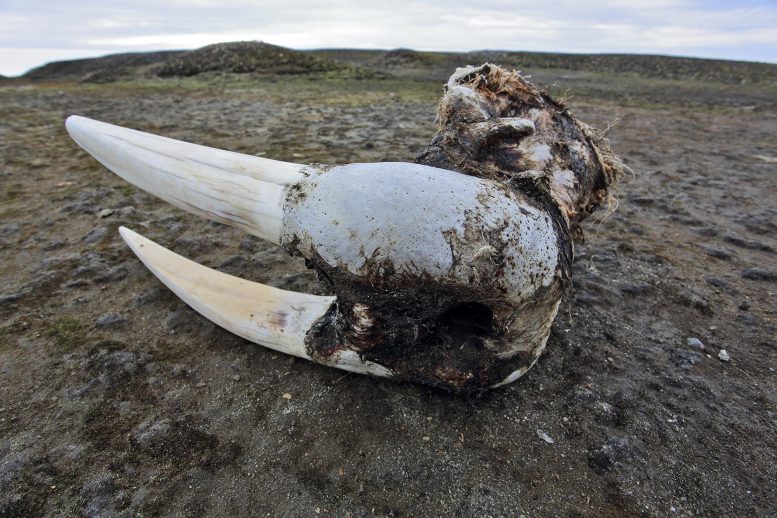
An international collaboration of scientists in Iceland, Denmark, and the Netherlands has for the first time used ancient DNA analyses and C14-dating to demonstrate the past existence of a unique population of Icelandic walrus that went extinct shortly after Norse settlement some 1100 years ago. Walrus hunting and ivory trade was probably the principal cause of extinction, being one of the earliest examples of commercially driven overexploitation of marine resources.
The presence of walruses in Iceland in the past and its apparent disappearance as early as in the Settlement and Commonwealth periods (870–1262 AD) has long puzzled the scientific world. In a study recently published in the journal Molecular Biology and Evolution scientists from Denmark, Iceland and Holland have addressed the question by analyzing ancient and contemporary DNA along with carbon-14 dating of walrus remains, supplemented with detailed studies of finding localities of the remains, place names and references to walrus hunting in the Icelandic Mediaeval literature, including the Icelandic Sagas.
“Natural History Museum collections provide a remarkable window into the past, which with modern-day technology allow us to explore the past effects of human activities and environmental change on species and ecosystems. This can be further put into context by studying the Icelandic Mediaeval literature, historic place names and zooarchaeological sites,” explains instigator of the research Hilmar J. Malmquist, Director of the Icelandic Museum of Natural History, Reykjavik, Iceland.
Walrus Facts
- The walrus (Odobenus rosmarus) grows up to three meters in length and live up to 40 years. The male weighs up to 1500 kilos (3,300 lbs), while the female is slightly smaller. Both males and females have tusks.
- The walrus occurs throughout the Arctic, divided into two subspecies, the Atlantic and Pacific walrus. The Atlantic walrus, to which the Icelandic belonged, numbers approximately 30.000 animals and occurs in north-eastern Canada, Greenland, Svalbard, and north-western Russia.
- The Norse of the Viking Age were the first people to settle permanently in Iceland around 870 AD, and later colonized Greenland, where they also hunted walruses for food and traded with walrus tusks and hides.
A long-term population of genetically unique walruses in Iceland
The scientists used carbon-14 dating of walrus remains found in Iceland to reveal that walruses inhabited Iceland for thousands of years, but disappeared shortly after the country’s settlement around 870 AD by the Norse. DNA was extracted from natural finding sites and archaeological excavations of walrus samples, and compared to data from contemporary walruses, documenting that the Icelandic walrus constituted a genetically unique lineage, distinct from all other historic and contemporary walrus populations in the North Atlantic.
“Our study provides one of the earliest examples of local extinction of a marine species following human arrival and overexploitation. It further adds to the debate about the role of humans in the extinction of megafauna, supporting a growing body of evidence that wherever humans turn up, the local environment and ecosystem suffers,” says Morten Tange Olsen, Assistant Professor at Globe Institute, University of Copenhagen.
Walrus ivory was a luxury good
Walrus ivory was a luxury good in high demand and widely traded across Viking Age and Medieval Europe with beautifully ornamented tusks documented as far away as the Middle East and India. Most examples of trade and human overexploitation and extinction of local marine resources are of much more recent date, such as overfishing, and commercial whaling for the past three centuries or so.
“We show that already in the Viking Age, more than 1000 years ago, commercial hunting, economic incentives, and trade networks were of sufficient scale and intensity to result in significant, irreversible ecological impacts on the marine environment, potentially exacerbated by a warming climate and volcanism. The reliance on marine mammal resources for both consumption and trade has so far been underestimated,” says lead author Xénia Keighley, who is completing a Ph.D. at the GLOBE Institute in Copenhagen and the Arctic Center in Groningen.
Reference: “Disappearance of Icelandic Walruses Coincided with Norse Settlement” by Xénia Keighley, Snæbjörn Pálsson, Bjarni F Einarsson, Aevar Petersen, Meritxell Fernández-Coll, Peter Jordan, Morten Tange Olsen and Hilmar J Malmquist, 12 September 2019, Molecular Biology and Evolution.
DOI: 10.1093/molbev/msz196
The research was conducted by Xénia Keighley (the University of Copenhagen and the University of Groningen), Snæbjörn Pálsson (University of Iceland), Bjarni F. Einarsson (Archaeological Office in Iceland), Aevar Petersen, Meritxell Fernández-Coll (Icelandic Museum of Natural History), Peter Jordan (University of Groningen), Morten Tange Olsen (University of Copenhagen), and Hilmar J. Malmquist (Icelandic Museum of Natural History).
It forms part of the ArchSci2020 Ph.D. Training Network which has received funding from the European Union’s Framework Programme for Research and Innovation Horizon 2020, as well as the National Science Foundation, USA. The study “Disappearance of Icelandic walruses coincided with Norse settlement” can be read in Molecular Biology and Evolution.
Never miss a breakthrough: Join the SciTechDaily newsletter.
Follow us on Google and Google News.