
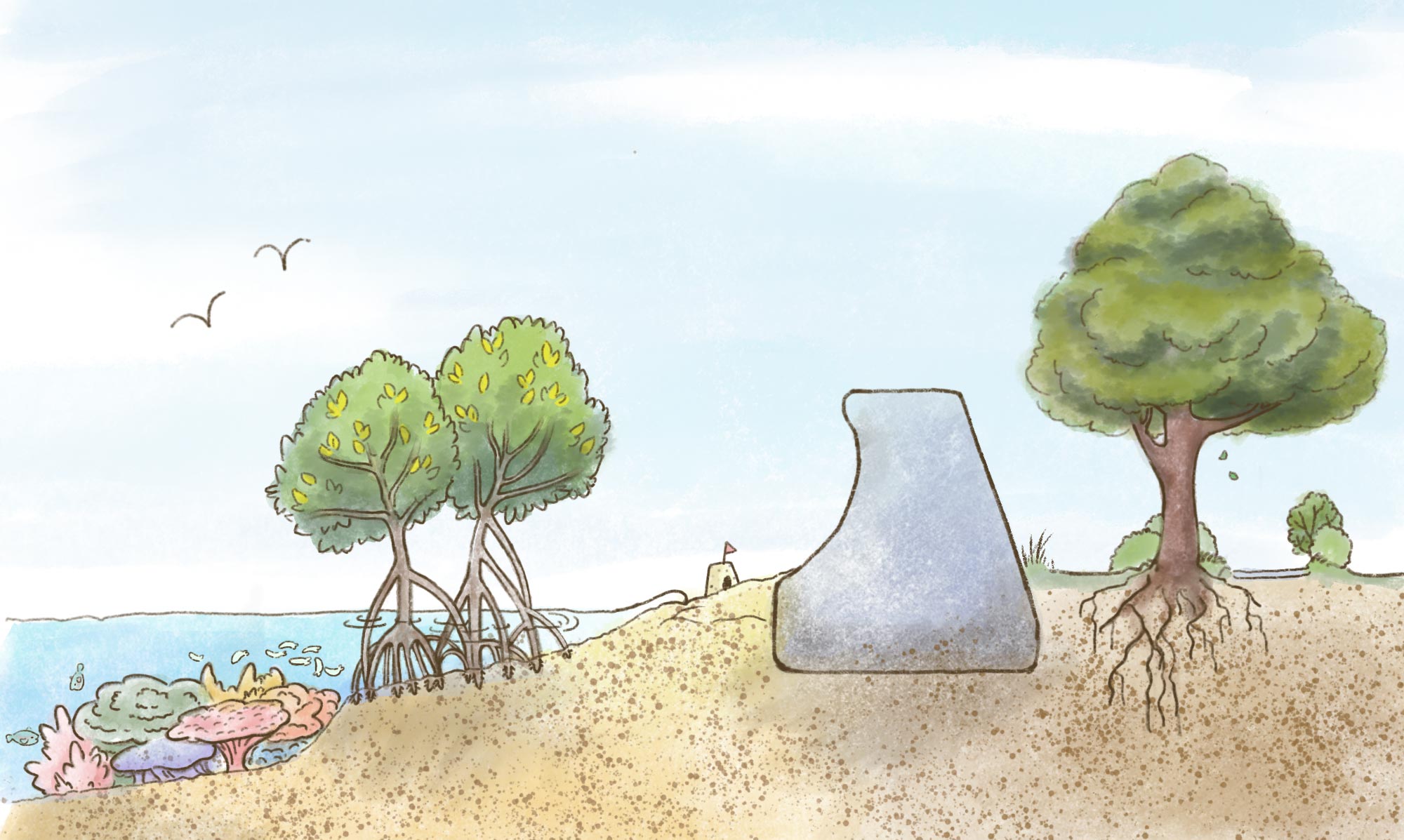
Hybrid solutions that combine nature with common “hard” coastal protection measures may offer more benefits in lower-risk areas.
Common “hard” coastal defenses, like concrete sea walls, might struggle to keep up with increasing climate risks. A new study shows that combining them with nature-based solutions could, in some contexts, create defenses that are better able to adapt.
Researchers reviewed 304 academic articles on the performance of coastal defenses around the world, including: natural environments; soft measures (which support or enrich nature); hard measures (such as concrete sea walls); and hybrids of the aforementioned. Soft and hybrid measures turned out to be more cost-effective than hard measures, and hybrid measures provided the highest hazard reduction overall in low-risk areas.
Although their comparative performance during extreme events that pose a high risk is not clear due to lack of data, these results still support the careful inclusion of nature-based solutions to help protect, support, and enrich coastal communities.
Japan’s dramatic natural coastline, with iconic views of Mount Fuji, wind-blown pines, and rocky beaches, has been captured and admired in paintings and prints for hundreds of years. But take a walk by the ocean nowadays and it can be hard to find a stretch that retains its pristine natural seascape.
By the early 1990s, a government survey found that around 40% of the coast had been altered with concrete sea walls, filled harbors, stacks of tetrapods, and more, adding swaths of gray to the blue-green landscape. Sprawling coastal cities and towns have grown to house most of the population, so protecting homes and businesses from the dangers of tsunamis, typhoon swells and sea-level rise has become an ever-increasing challenge.
Challenges of Traditional Coastal Defenses
“Sea walls, dikes, dams and breakwaters, the so-called traditional hard measures, despite being the most popular coastal defenses globally and with proven track records, are facing challenges to keep pace with increasing climate risks,” explained Lam Thi Mai Huynh, a doctoral student from the graduate program in sustainability science at the University of Tokyo and lead author of a new study on coastal defenses.
“These hard structures are expensive to build and require continuous upgrades and repairs as sea level rises and climatic hazards become stronger. Although they are good at mitigating certain coastal disaster risks, they can also cause significant disruption to coastal communities and have adverse environmental effects. Furthermore, they often significantly alter the seascape and sometimes alienate local communities from nature and the very environment we seek to protect.”
Exploring Nature-Based Solutions
To better understand the performance and benefits of different hard and nature-based coastal defenses, an international team compared the results of 304 academic studies. Nature-based coastal defenses included: “natural” ecosystems, for example, existing mangroves and coral reefs; “soft” measures, which restore, rehabilitate, reforest or nourish natural ecosystems; and “hybrid” measures that combine both nature-based components and hard structures, such as placing concrete breakwaters in front of mangroves.
“By incorporating such natural components, we can create coastal defenses that reduce risk and also offer substantial environmental benefits. We believe that such strategies are very promising in many parts of the world, but they are also not a ‘fix-all’ solution,” said Professor Alexandros Gasparatos from the Institute for Future Initiatives at the University of Tokyo.
Comprehensive Analysis of Coastal Defense Strategies
The researchers analyzed three key aspects of each type of defense: 1. risk reduction (how much the measure could reduce wave height and energy, and influence shoreline change); 2. climate change mitigation (including carbon storage and greenhouse gas emissions for nature-based measures); and 3. cost-effectiveness over a 20-year period.
“Our results indicate that among all coastal defense options in lower-risk areas, hybrid measures provide the highest risk reduction. Hybrid measures can harness the advantages of both hard and soft measures. They provide the immediacy of an engineered barrier while largely maintaining the ecological functionality of a permeable vegetated zone,” said Huynh. “All nature-based solutions are found to be effective in storing carbon, while both soft and hybrid measures are relatively more cost-effective than traditional hard measures over a 20-year period, though all have positive economic returns.”
Caution and Potential in Coastal Defense
These findings provide strong evidence for integrating and upscaling nature-based components into coastal defenses, but the team advised doing so with caution. “All types of coastal defenses have yet to be adequately tested through paired experiments in circumstances of extreme events and high-risk urgency,” warned Gasparatos. “Until there are many more such experiments focusing on this, we must caution against any universal assumptions about the comparative performance of coastal defense options, whether natural, soft or hybrid measures.”
While acknowledging the limits imposed by the lack of available research on extreme and high-risk situations, Huynh and Gasparatos still believe that this study supports the idea of investing in nature-based solutions for coastal defense in lower-risk areas. Research like this has important implications for policymakers, coastal planners, and communities looking to make evidence-based decisions.
“I firmly believe that we must think more carefully about the design and function of these barriers in this era of ever-accelerating climate change,” said Huynh. “Not only can nature-based solutions contribute to risk reduction and climate mitigation in many areas, but they can also help reconnect people with nature and support biodiversity. Greening our coastlines can create spaces which enhance quality of life, foster community well-being and inspire environmental stewardship.”
Reference: “Meta-analysis indicates better climate adaptation and mitigation performance of hybrid engineering-natural coastal defence measures” by Lam Thi Mai Huynh, Jie Su, Quanli Wang, Lindsay C. Stringer, Adam D. Switzer and Alexandros Gasparatos, 9 April 2024, Nature Communications.
DOI: 10.1038/s41467-024-46970-w
L.H acknowledges the support of Grant-in-Aid Research Fellowship for young Scientist offered by the Japan Society for the Promotion of Science (23KJ0544). A.G is supported by a Grant-in-Aid for Scientific Research A offered by the Japan Society for the Promotion of Science (22H00567). A.D.S. is supported by the Singapore Ministry of Education Academic Research Fund (MOE2019-T3-1-004 and MOET32022-0006).
Never miss a breakthrough: Join the SciTechDaily newsletter.
Follow us on Google and Google News.