
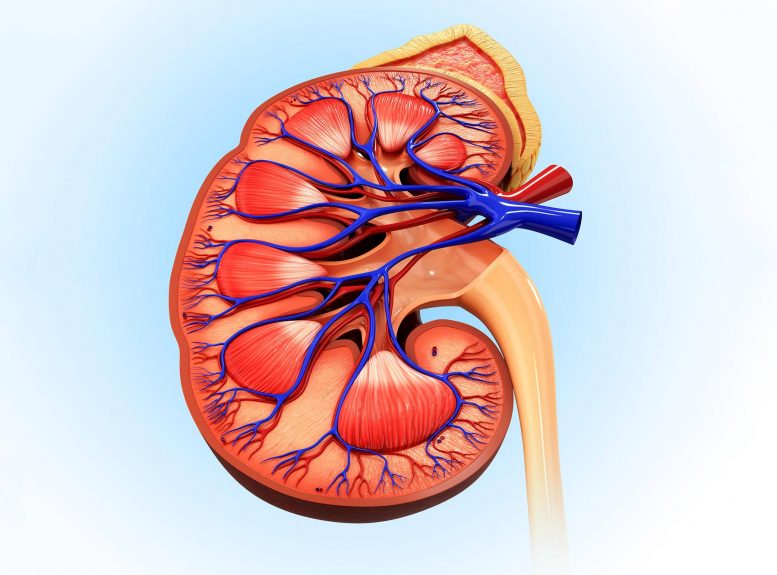
World’s largest study of the impact of temperature changes and kidney disease reveals that 7.4 percent of all hospitalizations for renal disease can be attributed to an increase in temperature.
Today, the world’s largest study of the impact of temperature changes and kidney disease reveals that 7.4 percent of all hospitalizations for renal disease can be attributed to an increase in temperature. In Brazil – where the study was focused – this equated to more than 202,000 cases of kidney disease from 2000-2015.
The study, led by Professor Yuming Guo and Dr. Shanshan Li, from Planetary Health at Monash University and published in The Lancet Regional Health – Americas journal, for the first time quantifies the risk and attributable burden for hospitalizations of renal diseases related to ambient temperature using daily hospital admission data from 1816 cities in Brazil.
The study comes as the world focuses on the impact of climate change at the COP26 conference in Glasgow from October 31, 2021.

In 2017, a landmark article in The Lancet declared renal diseases a global public health concern, estimating that almost 2.6 million deaths were attributable to impaired kidney function that year. Importantly the incidence of death from kidney disease had risen 26.6 percent compared to a decade previously, an increase that this study may indicate was, in part, caused by climate change.
The study looked at a total of 2,726,886 hospitalizations for renal diseases recorded during the study period. According to Professor Guo, for every 1°C (1.8°F) increase in daily mean temperature, there is an almost 1 percent increase in renal disease, with those most impacted being women, children under 4 years of age and those 80+ years of age.
Evidence for Heat-Related Health Policies
The associations between temperature and renal diseases were largest on the day of the exposure to extreme temperatures but remained for 1–2 days post-exposure.
In the paper, the authors – who are also from the University of Sao Paulo – argue that the study “provides robust evidence that more policies should be developed to prevent heat-related hospitalizations and mitigate climate change.”
“In the context of global warming, more strategies and policies should be developed to prevent heat-related hospitalizations.”
The authors advise interventions should be urgently incorporated into government policy on climate change, particularly targeting specific individuals, including females, children, adolescents, and the elderly, as they are more vulnerable to heat with regard to renal diseases.
“Moreover, attention should be paid to low- and middle-income countries like Brazil, where reliable heat warning systems and preventive measures are still in need,” Professor Guo added.
Reference: “Association between Ambient Temperature and Hospitalization for Renal Diseases in Brazil during 2000–2015: A Nationwide Case-Crossover Study” by Bo Wen, Rongbin Xu, Yao Wu, Micheline de Sousa Zanotti Stagliorio Coêlho, Paulo Hilario Nascimento Saldiva, Yuming Guo and Shanshan Li, 31 October 2021, The Lancet Regional Health – Americas.
DOI: 10.1016/j.lana.2021.100101
Never miss a breakthrough: Join the SciTechDaily newsletter.
Follow us on Google and Google News.
2 Comments
“Today the world’s largest study of the impact of temperature changes and kidney disease reveals that 7.4 percent of all hospitalizations for renal disease can be attributed to an increase in temperature.”
Let’s get real! The average global temperature is increasing about 0.1 deg C per decade. Most of the increase is in the daily lows, meaning at night and in the Winter when temperatures are lowest. The Arctic is apparently the fastest warming region on Earth, biasing the global increase upwards. In other words, there is little reason to believe that those living in Brazil are being heat-stressed significantly more than 15 years ago. I present evidence here that there is little basis for the claim that heat waves in the US, and by extension, elsewhere, are increasing:
https://wattsupwiththat.com/2019/09/06/the-gestalt-of-heat-waves/
I suspect that these researchers are being misled by spurious correlations. By being quick to blame global warming, it deters research into what might actually be responsible for an increase in renal disease.
The link to the article is invalid, so I can’t see what the authors actually said.
Please explain what heat has to do with kidney disease. I have had it for years due to blood pressure issues. I lived in Las Vegas NV 20 years. Now i am 83 and have lived to an age my parents did not. God decides life and death not the climate. He controls the earth not us.