
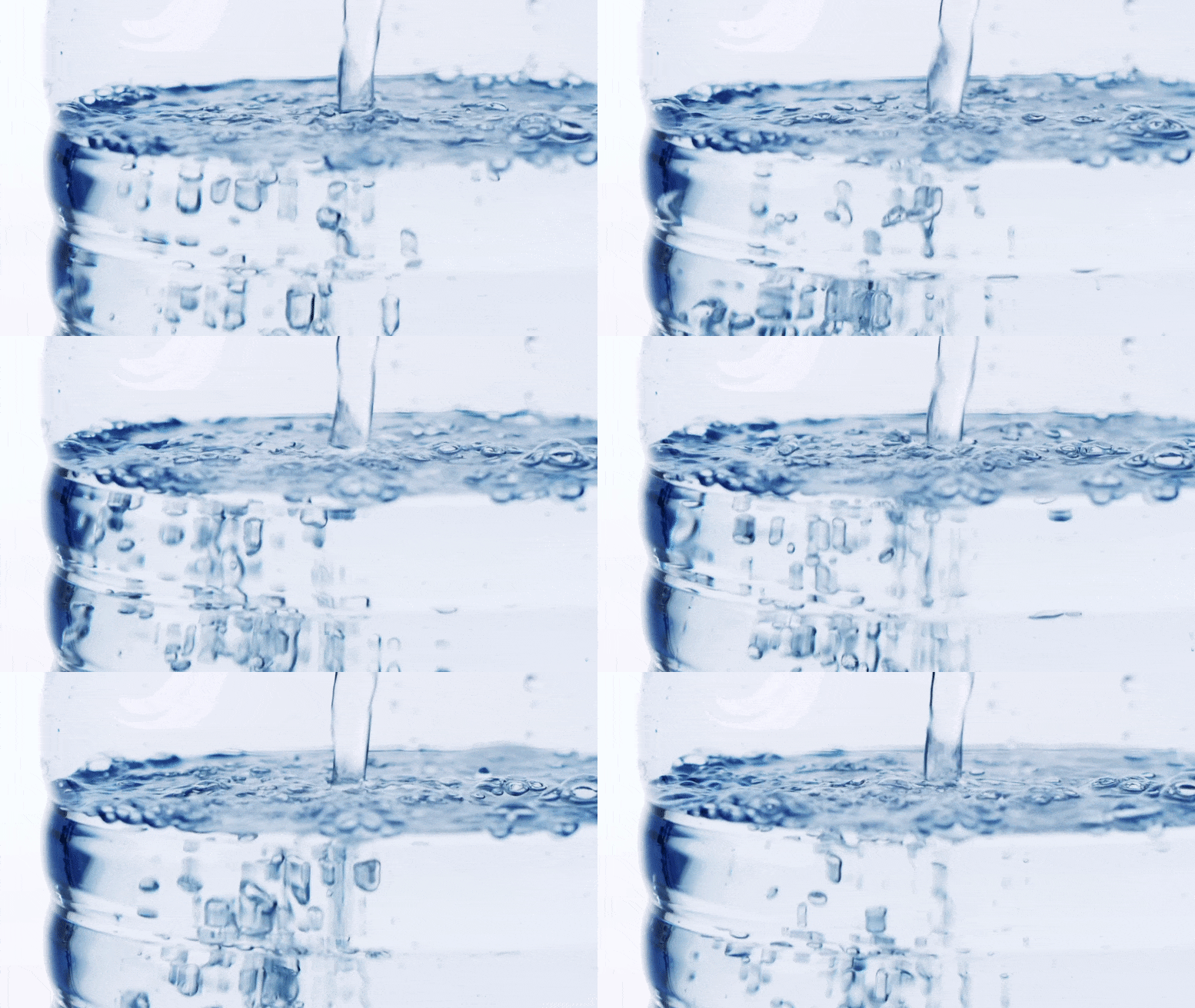
Important funding for the intersectoral research work of two INRS professors.
Patrick Drogui and My Ali El Khakani, professors at the Institut national de la recherche scientifique (INRS), and Sébastien Sauvé, professor at the Université de Montréal, have received a $338,688 grant from the Ministère de l’Économie et de l’Innovation through PRIMA Québec for an innovative project on water decontamination. The multidisciplinary team wishes to take advantage of the unique properties of nanomaterials to develop new advanced electro-catalytic processes (ECA).
The project aims to create innovative solutions to decontaminate waters containing harmful chemical compounds, such as perfluoroalkyl and polyfluoroalkyl substances (PFAS). They are found in cosmetics, cleaning products, fire-fighting foams and flame retardants. Above certain concentrations, their presence can be harmful to health.
Nanomaterials to Degrade Chemicals
The originality of this project lies in the development of electrodes based on new nanostructured materials and their integration into an ECA process for the degradation of chemical compounds. “We will use our 25 years of experience and know-how in this field to develop a new class of electrodes based on metal oxides. These will offer unmatched specific surfaces while preserving excellent electrical conductivity and chemical stability,” said Professor El Khakani of INRS’s Énergie Matériaux Télécommunications Research Centre.

“These ECA processes have great potential to decontaminate waters by removing persistent organic pollutants (POPs), such as PFAS. These POPs have been targeted by various Canadian, American and European legislations as endocrine disruptors responsible for numerous consequences on aquatic fauna,” says Professor Drogui of the INRS’s Eau Terre Environnement Research Centre.
“The chemistry of PFAS compounds is complex. High-resolution mass spectrometry tools are needed to properly identify and measure the hundreds of chemical forms that this family of compounds can take and to properly evaluate the effectiveness of decontamination processes,” adds Professor Sébastien Sauvé, from the Department of Chemistry at the Université de Montréal.
The new electrodes will be manufactured by the team in El Khakani’s laboratory and then transferred to Professor Drogui’s laboratory to be integrated into new generation ECA reactors in order to develop and optimize PFAS degradation processes. Finally, the analysis and monitoring of these contaminants and their degradation will be carried out under the direction of Professor Sébastien Sauvé at the Université de Montréal.
Promising Partnerships for Innovation and Training
This research is being conducted in close collaboration with two industrial partners, SANEXEN and Rio Tinto Fer et Titane (RTIT). SANEXEN is a member of the LOGISTEC family, experts in site remediation and the management of contaminated soil and residual materials. “With this project, we will not only respond to societal needs regarding concerns about polluted water, but also to the more specific interests of our industrial partners. This is fully in line with the fundamental mission of INRS,” says Professor Drogui.
“SANEXEN is at the forefront of innovation in the treatment of emerging contaminants in water, thanks in part to its proven ALTRA Solutions technology. INRS’ work in water decontamination is in line with our strategic vision,” said Martin Bureau, SANEXEN’s Vice President of Innovation.
RTIT’s contribution to this project is essential in terms of iron and titanium-based materials, since they will be used for the development of the electrodes. The partner will also provide the materials and expertise for monitoring the aging of the electrodes and their eventual scaling up. “We are pleased to contribute to this project, which will not only call upon our expertise in the field of iron and titanium materials, but which also aims to solve environmental problems of concern to society,” adds Yves Pépin, Director-TiO2 at the RTIT Technology Centre in Sorel-Tracy.
Collaboration for Training Purposes
This project will also offer the doctoral and post-doctoral members of the research team, from INRS and the Université de Montréal, an exceptional multidisciplinary training environment. Indeed, they will be able to acquire diversified scientific and technical knowledge in the field of nanomaterials, electrotechnology and analytical chemistry.
“This project illustrates the importance of establishing partnerships between industry and the research and higher education sectors to promote the growth of a green and sustainable economy in Quebec. Our government is proud to support this research and innovation project, which will contribute to the decontamination of water while stimulating the development of new green technologies,” said Benoit Charette, Minister of the Environment and the Fight Against Climate Change and Minister Responsible for the Fight Against Racism.
Cross-sectoral research is a priority at INRS, in part because the resulting work often leads to innovation. “For our professors, this is an opportunity to work in both the academic and industrial research environments, while addressing issues relevant to health and the environment,” says INRS Director General Luc-Alain Giraldeau.
In this project, the complementary expertise of the three principal investigators and their respective teams is a major asset for achieving the research objectives. “The prospect of applying our results to the resolution of a real and worrying problem is very rewarding! Especially because of the collaboration with our industrial partners,” concludes Professor El Khakani.
The research team has received a total of nearly $760,000 in funding, including $270,000 from the Natural Sciences and Engineering Research Council of Canada, $338,688 from PRIMA Québec, and $151,200 in contributions from its industrial partners. Professors Drogui and El Khakani are also pursuing research on water decontamination.
Never miss a breakthrough: Join the SciTechDaily newsletter.
Follow us on Google and Google News.