
The hunt for Planet Nine continues as new discoveries make the Solar System’s biggest mystery even harder to solve.
Is there a massive undiscovered planet on the outer reaches of the Solar System? The idea has been around since before the discovery of Pluto in the 1930s. Labeled as planet X, prominent astronomers had put it forward as an explanation for Uranus’s orbit, which drifts from the path of orbital motion that physics would expect it to follow. The gravitational pull of an undiscovered planet, several times larger than Earth, was seen as a possible reason for the discrepancy.
That mystery was ultimately explained by a recalculation of Neptune’s mass in the 1990s, but then a new theory of a potential planet nine was put forward in 2016 by astronomers Konstantin Batygin and Mike Brown at Caltech (the California Institute of Technology).

Their theory relates to the Kuiper Belt, a giant belt of dwarf planets, asteroids and other matter that lies beyond Neptune (and includes Pluto). Many Kuiper Belt objects – also referred to as trans-Neptunian objects – have been discovered orbiting the Sun, but like Uranus they don’t do so in a continuous expected direction. Batygin and Brown argued that something with a large gravitational pull must be affecting their orbit, and proposed planet nine as a potential explanation.
This would be comparable to what happens with our own Moon. It orbits the Sun every 365.25 days, in line with what you would expect in view of their distance apart. However, the Earth’s gravitational pull is such that the Moon also orbits the planet every 27 days. From the point of view of an outside observer, the Moon moves in a spiraling motion as a result. Similarly, many objects in the Kuiper Belt show signs of their orbits being affected by more than just the Sun’s gravity.
While astronomers and space scientists were initially skeptical about the planet nine theory, there has been mounting evidence thanks to increasingly powerful observations that the orbits of trans-Neptunian objects are indeed erratic. As Brown said in 2024:
“I think it is very unlikely that P9 does not exist. There are currently no other explanations for the effects that we see, nor for the myriad other P9-induced effects we see on the Solar System.”
In 2018, for example, it was announced that there was a new candidate for a dwarf planet orbiting the Sun, known as 2017 OF201. This object measures around 700km across (Earth is roughly 18x bigger) and has a highly elliptical orbit. This lack of a roughly circular orbit around the Sun suggested either an impact early in its lifetime that put it on this path, or gravitational influence from planet nine.
Problems With the Theory
On the other hand, if planet nine exists, why hasn’t anyone found it yet? Some astronomers question whether there’s enough orbital data from Kuiper objects to justify any conclusions about its existence, while alternative explanations get put forward for their motion, such as the effect of a ring of debris or the more fantastical idea of a small black hole.
The biggest issue, however, is that the outer Solar System just hasn’t been observed for long enough. For example, object 2017 OF201 has an orbital period of about 24,000 years. While an object’s orbital path around the Sun can be found in a short number of years, any gravitational effects probably need four to five orbits to notice any subtle changes.
New discoveries of objects in the Kuiper Belt have also presented challenges for the planet nine theory. The latest is known as 2023 KQ14, an object discovered by the Subaru telescope in Hawaii.
It is known as a “sednoid,” meaning it spends most of its time far away from the Sun, though within the vast area in which the Sun has a gravitational pull (this area lies some 5,000AU or astronomical units away, where 1AU is the distance from the Earth to the Sun). The object’s classification as a sednoid also means the gravitational influence of Neptune has little to no effect on it.
2023 KQ14’s closest approach to the Sun is around 71AU away, while its furthest point is about 433AU. By comparison, Neptune is about 30AU away from the Sun. This new object is another with a very elliptical orbit, but it is stabler than 2017 OF201, which suggests that no large planet, including a hypothetical planet nine, is significantly affecting its path. If planet nine exists, it would therefore perhaps have to be farther than 500AU away from the Sun.
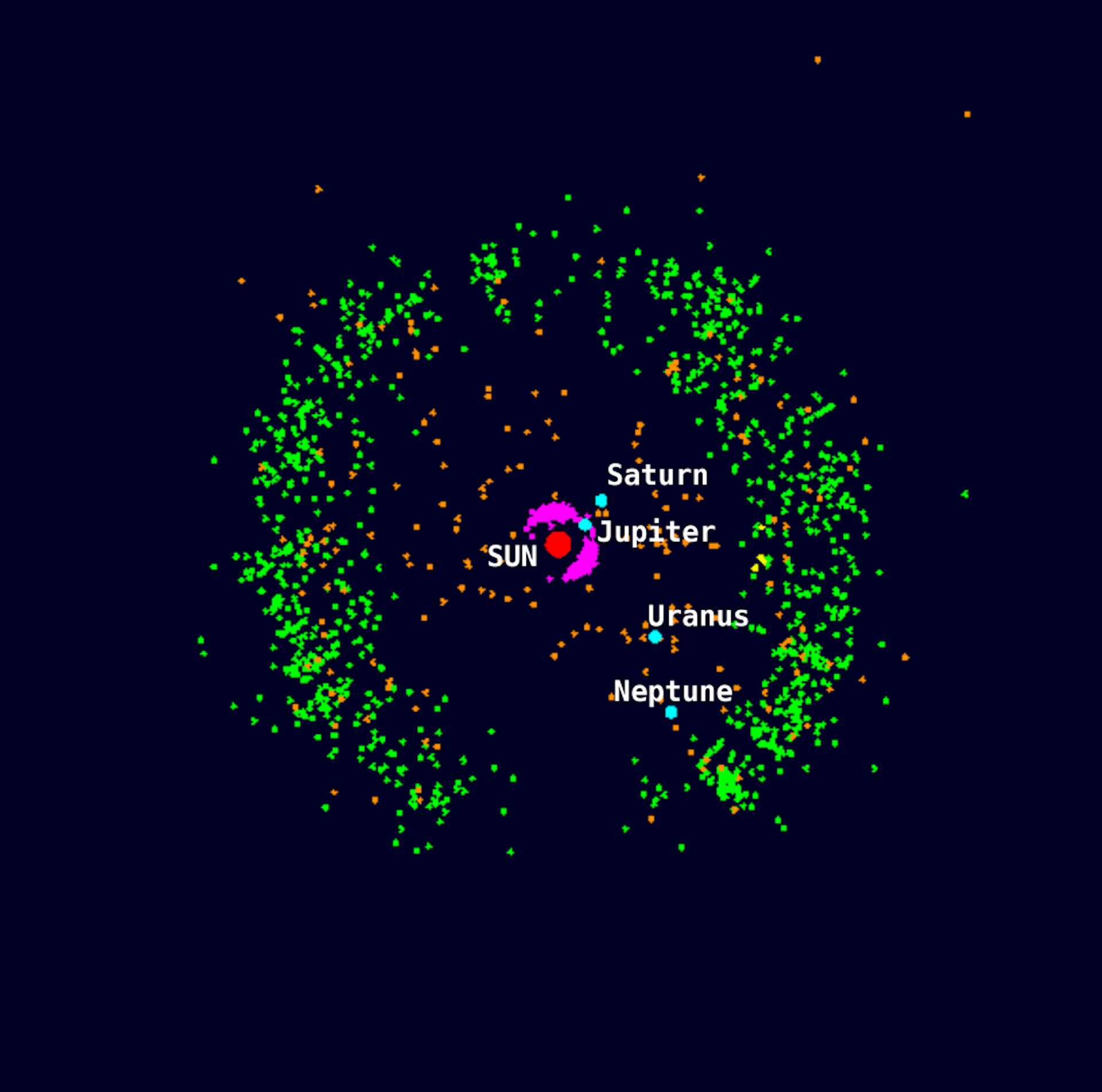
To make matters worse for the planet nine theory, this is the fourth sednoid to be discovered. The other three also exhibit stable orbits, similarly suggesting that any planet nine would have to be very far away indeed.
Nonetheless, the possibility remains there could still be a massive planet affecting the orbits of bodies within the Kuiper Belt. But astronomers’ ability to find any such planet remains somewhat limited by the restrictions of even unmanned space travel. It would take 118 years for a spacecraft to travel far enough away to find it, based on estimates from the speed of NASA’s New Horizons explorer.
This means we’ll have to continue to rely on ground- and space-based telescopes to detect anything. New asteroids and distant objects are being discovered all the time as our observing capabilities become more detailed, which should gradually shed more light on what might be out there. So watch this (very big) space, and let’s see what emerges in the coming years.
Never miss a breakthrough: Join the SciTechDaily newsletter.
Follow us on Google and Google News.
16 Comments
Planet nine most likely does exist. It has been talked about for hundreds of years. If found it most likely has beings on it far more advanced than we. Oh scientists say it would be too cold and uninhabitable. But they forget AI machines could make cities like we will have when pop the moon or mars.
The article notes that the P9 hypothesis was established 2016, not “hundreds of years”. That is likely confusing it with the historical line of looking for massive, disturbing planets, which the article also goes into and which was how Neptune was discovered.
“Neptune is not visible to the unaided eye and is the only planet in the Solar System that was not initially observed by direct empirical observation. Rather, unexpected changes in the orbit of Uranus led Alexis Bouvard to hypothesise that its orbit was subject to gravitational perturbation by an unknown planet. After Bouvard’s death, the position of Neptune was mathematically predicted from his observations, independently, by John Couch Adams and Urbain Le Verrier. Neptune was subsequently directly observed with a telescope on 23 September 1846[2] by Johann Gottfried Galle within a degree of the position predicted by Le Verrier.” – Wikipedia
Habitability is a requirement for evolution of life in the first place, life which later can potentially develop AI (like we did).
“not “hundreds of years”.” – not “hundreds of years” ago.
What has been talked about for hundreds of years on that subject was Pluto. We have already found planet 9.
Yes, they’re all androids ready to unleash Ghidorah upon us. Help us, Godzilla!!!
The article is a bit sketchy in some details.
The 2023 KQ14 discovery paper itself describes the sednoid as having a heliocentric distance of approximately 71.0 AU at the time of discovery while “the closest approach to the Sun” (perihelion) of 65.9 +/- 0.2 AU. And with the given orbit parameters its “furthest point” (aphelion) would be 438 AU, not 433 AU.
Further, article itself implies that it will take time to establish 2023 KQ13 orbit stability and the paper only claims that its “high perihelion suggests the potential for long-term orbital stability”.
The real reason they demoted Pluto as Planet Nine, was the reason to avoid any new planets getting the Planet X moniker. Pluto will get it’s revenge on a planetary scale.
Conspiracy theories are so utterly boring.
The reason to demote Pluto from standard planethood, as astronomers did with Ceres in the 19th century, was clearly stated at the time. “Pluto was discovered in 1930 by Clyde W. Tombaugh, making it the first known object in the Kuiper belt. It was immediately hailed as the ninth planet. However,[16]: 27 its planetary status was questioned when it was found to be much smaller than expected. These doubts increased following the discovery of additional objects in the Kuiper belt starting in the 1990s, particularly the more massive scattered disk object Eris in 2005. In 2006, the International Astronomical Union (IAU) formally redefined the term planet to exclude dwarf planets such as Pluto.” – Wikipedia
Classification is human labeling and will have fuzzy borders (c.f. species in biology), but labeling can be more or less useful. We have more dwarf planets than planets and too many other debris objects to name them all, which is a good reason for the relabeling. Another reason is that we now know of many thousands of exoplanets, and when young such systems have settled down they conveniently meet the solar planet criteria. (In fact, it is hard to observe ongoing planet formation because the protoplanetary disks have not yet cleared.)
On Ceres:
“Ceres was assigned a planetary symbol and remained listed as a planet in astronomy books and tables (along with Pallas, Juno, and Vesta) for over half a century.[37]” – Wikipedia
Wrong it was demoted for the purpose of elevating specific astronomer’s visibiltiy and career trajectories. What is boring are droll assertions that facts are conspiracy theories.
Pluto was discovered by accident. The models at the time showed there should be a supermassive planet there instead. Pluto just happened to be there.
That there are many planetary objects is a ridiculous and unscientific reason to deem these planetary objects not ‘true’ planets.
Do we put limits on individual insect species? Countries? Stars?
(‘We’ don’t have to routinely ID individuals of common insect species- and if that seems innapropriate for a comparison, well it illustrates my point to say, further, that we don’t have to give an individual traditional name all the observed stars, for most we merely designate an ID and it would certainly raise some eyebrows if similar sentiment was expressed about this ).
…In fact, if I could further debase the debate to the same level that certain media savvy researchers did back then, I would say “I wouldn’t trust a GP to make decisions on brain surgery” (considering it was astronomers who voted on the- innapropriately timed in terms of short notice among other things considering the gravity- decision, opposed by a large number of planetary scientists).
The fact that better arguments were put out there from either side behind the dumbed down public version of the debate (that, sadly, disgracefully, certain publicity minded astronomers and pop science figures seemed to relish) didn’t seem to take precident in an era where science seemed taken aback and clumsy by that dumbing down of pop science debate.
You are wasting your time trying to explain the logic to plutotards, but I do admire your patience and detailed posts.
Look at the green dots on the image, you m0r0n0id. Can you tell which one is your precious planet? No one gives a flying f about the “Planet X Moniker” except a few weird conspiracy cultists, including you, probably. Is that where your imaginary anunaki live? Is that why you are so triggered?
I BE MORE CONCERNED ABOUT 3 MAGNETIC POLESHIFTS IN 25 YRS
STILL IN PROGRESS. OUR WEATHER
CFJ
I’d be more concerned about spelling and grammatical skills.
thanks for this