
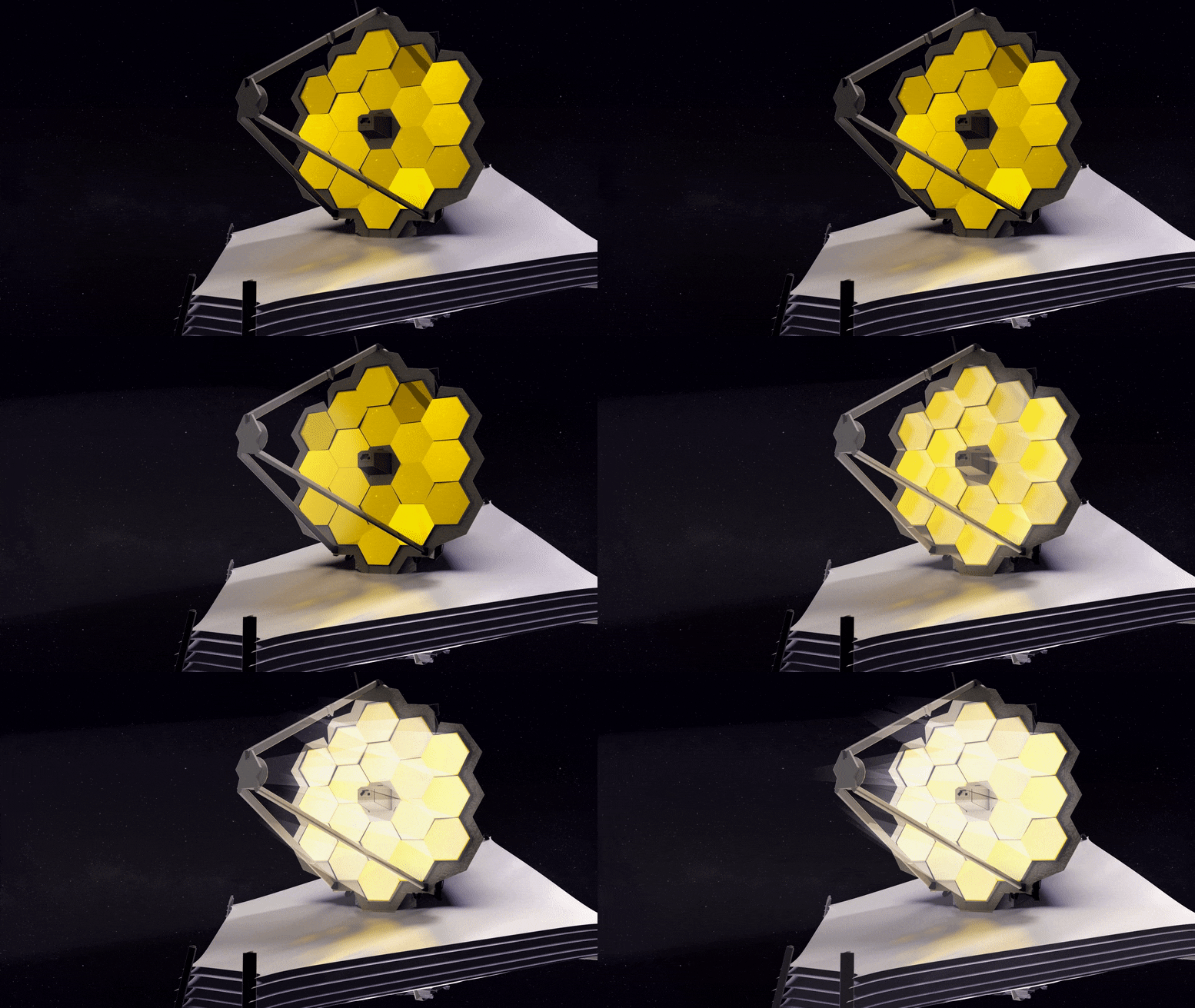
As the Webb telescope travels to L2, it undertakes crucial mirror deployments. These are managed with precise actuators for slow, detailed positioning, critical for mirror cooling and alignment.
With major deployments complete, Webb continues its journey to its final halo orbit around L2. In the meantime, there are several smaller deployments in the next couple of weeks, which constitute the beginning of a several-month phase of aligning the telescope’s optics. This week, we have started the process of moving the mirror segments (all primary plus secondary) out of their stowed launch positions. For more details, here is Marshall Perrin from the Space Telescope Science Institute, home of the Webb Mission Operations Center:
“To support the movable mirrors during the ride to space, each of them has on its back three rigid metal pegs which can nestle into matching holder sockets in the telescope structure. Before launch, the mirrors were all positioned with the pegs held snug in the sockets, providing extra support. (Imagine Webb holding its mirrors tucked up close to its telescope structure, keeping them extra safe during the vibrations and accelerations of launch.) Each mirror now needs to be deployed out by 12.5 millimeters (about half an inch) to get the pegs clear from the sockets. This will give the mirrors ‘room to roam’ and let them be readied in their starting positions for alignment.
“Getting there is going to take some patience: The computer-controlled mirror actuators are designed for extremely small motions measured in nanometers. Each of the mirrors can be moved with incredibly fine precision, with adjustments as small as 10 nanometers (or about 1/10,000th of the width of a human hair). Now we’re using those same actuators instead to move over a centimeter. So these initial deployments are by far the largest moves Webb’s mirror actuators will ever make in space.
“And we don’t do them all at once. The mirror control system is designed to operate only one actuator at a time. That way is both simpler (in terms of the complexity of the control electronics) and safer (since computers and sensors can closely monitor each individual actuator as it works). Furthermore, to limit the amount of heat put into Webb’s very cold mirrors from the actuator motors, each actuator can only be operated for a short period at a time. Thus, those big 12.5-millimeter moves for each segment are split up into many, many short moves that happen one actuator at a time. Scripts sent from the Mission Operations Center will direct this process under human supervision, slowly and steadily moving one actuator at a time, taking turns between segments. At full speed, it takes about a day to move all the segments by just 1 millimeter. It’s about the same speed at which grass grows!
“This may not be the most exciting period of Webb’s commissioning, but that’s OK. We can take the time. During the days that we’re slowly deploying the mirrors, those mirrors are also continuing to slowly cool off as they radiate heat away into the cold of space. The instruments are cooling, too, in a gradual and carefully controlled manner, and Webb is also continuing to gently coast outwards toward L2. Slow and steady does it, for all these gradual processes that get us every day a little bit closer to our ultimate goal of mirror alignment.”
—Marshall Perrin, deputy telescope scientist, Space Telescope Science Institute
Animation of the James Webb Space Telescope mirror alignment and phasing process. Credit: NASA’s Goddard Space Flight Center
Never miss a breakthrough: Join the SciTechDaily newsletter.
Follow us on Google and Google News.
4 Comments
So very cool!
Although the video indicates “coarse” and “fine” phasing, I suspect that it is a process with many iterations, getting finer and finer.
As advanced seniors, we applaud all who have made the Webb possible. While we may not be able
to comprehend the technical aspects of this telescope, we can fully understand the dedicton
and intellect that was necessary to achieve it. Huzzah to your generation from ours.
Multiple generations worked on this.
It’s even possible that some of the people are about your ages (not knowing them, I would not know).
And, of course, it was built upon the work of earlier generations.
Mirror, mirror in space, which the farthest of them all?