

Astronomers uncovered new details of gas flows that sculpt planet-forming disks and shape them over time, offering a glimpse into how our own solar system likely came to be.
Using NASA’s James Webb Space Telescope, astronomers have observed disk winds in protoplanetary disks with unprecedented detail, shedding light on star and planetary system formation. These findings may represent the forces that shaped our solar system billions of years ago, highlighting key processes like accretion and angular momentum loss critical in the evolution of young stars and planets.
Star Formation and Planetary Systems
Every second, over 3,000 stars are born throughout the visible universe. Many are encircled by what astronomers term a protoplanetary disk—a swirling “pancake” of hot gas and dust that serves as the birthplace of planets. However, the precise mechanisms that drive the formation of stars and planetary systems remain elusive.
A team of astronomers led by researchers from the University of Arizona has utilized NASA’s James Webb Space Telescope to capture some of the most detailed insights yet into the forces shaping these protoplanetary disks. Their observations provide a window into the appearance of our solar system 4.6 billion years ago.
Insights Into Protoplanetary Disk Dynamics
Specifically, the team was able to trace so-called disk winds in unprecedented detail. These winds are streams of gas blowing from the planet-forming disk out into space. Powered largely by magnetic fields, these winds can travel tens of miles in just one second. The researchers’ findings, published on October 4 in Nature Astronomy, help astronomers better understand how young planetary systems form and evolve.
According to the paper’s lead author, Ilaria Pascucci, a professor at the U of A Lunar and Planetary Laboratory, one of the most important processes at work in a protoplanetary disk is the star eating matter from its surrounding disk, which is known as accretion.
“How a star accretes mass has a big influence on how the surrounding disk evolves over time, including the way planets form later on,” Pascucci said. “The specific ways in which this happens have not been understood, but we think that winds driven by magnetic fields across most of the disk surface could play a very important role.”

Understanding Accretion and Angular Momentum
Young stars grow by pulling in gas from the disk that’s swirling around them, but in order for that to happen, gas must first shed some of its inertia. Otherwise, the gas would consistently orbit the star and never fall onto it. Astrophysicists call this process “losing angular momentum,” but how exactly that happens has proved elusive.
To better understand how angular momentum works in a protoplanetary disk, it helps to picture a figure skater on the ice: Tucking her arms alongside her body will make her spin faster, while stretching them out will slow down her rotation. Because her mass doesn’t change, the angular momentum remains the same.
For accretion to occur, gas across the disk has to shed angular momentum, but astrophysicists have a hard time agreeing on how exactly this happens. In recent years, disk winds have emerged as important players funneling away some gas from the disk surface – and with it, angular momentum – which allows the leftover gas to move inward and ultimately fall onto the star.
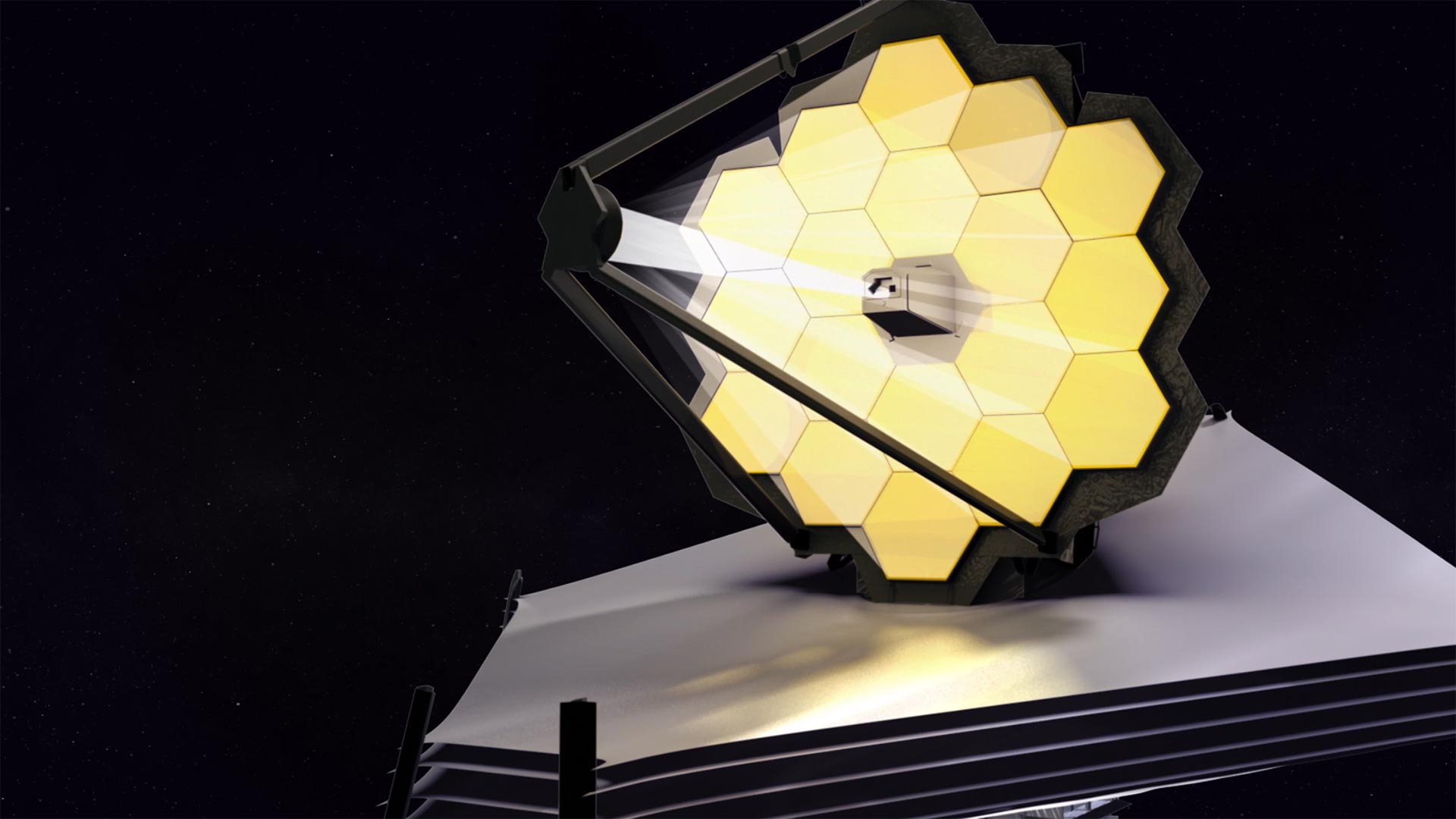
Advanced Observations With James Webb Space Telescope
Because there are other processes at work that shape protoplanetary disks, it is critical to be able to distinguish between the different phenomena, according to the paper’s second author, Tracy Beck at NASA’s Space Telescope Science Institute.
While material at the inner edge of the disk is pushed out by the star’s magnetic field in what is known as X-wind, the outer parts of the disk are eroded by intense starlight, resulting in so-called thermal winds, which blow at much slower velocities.
“To distinguish between the magnetic field-driven wind, the thermal wind and X-wind, we really needed the high sensitivity and resolution of JWST (the James Webb Space Telescope),” Beck said.
Unlike the narrowly focused X-wind, the winds observed in the present study originate from a broader region that would include the inner, rocky planets of our solar system – roughly between Earth and Mars. These winds also extend farther above the disk than thermal winds, reaching distances hundreds of times the distance between Earth and the sun.
“Our observations strongly suggest that we have obtained the first images of the winds that can remove angular momentum and solve the longstanding problem of how stars and planetary systems form,” Pascucci said.
Future Research Directions and Implications
For their study, the researchers selected four protoplanetary disk systems, all of which appear edge-on when viewed from Earth.
“Their orientation allowed the dust and gas in the disk to act as a mask, blocking some of the bright central star’s light, which otherwise would have overwhelmed the winds,” said Naman Bajaj, a graduate student at the Lunar and Planetary Laboratory who contributed to the study.
By tuning JWST’s detectors to distinct molecules in certain states of transition, the team was able to trace various layers of the winds. The observations revealed an intricate, three-dimensional structure of a central jet, nested inside a cone-shaped envelope of winds originating at progressively larger disk distances, similar to the layered structure of an onion. An important new finding, according to the researchers, was the consistent detection of a pronounced central hole inside the cones, formed by molecular winds in each of the four disks.
Next, Pascucci’s team hopes to expand these observations to more protoplanetary disks, to get a better sense of how common the observed disk wind structures are in the universe and how they evolve over time.
“We believe they could be common, but with four objects, it’s a bit difficult to say,” Pascucci said. “We want to get a larger sample with James Webb, and then also see if we can detect changes in these winds as stars assemble and planets form.”
Reference: “The nested morphology of disk winds from young stars revealed by JWST/NIRSpec observations” by Ilaria Pascucci, Tracy L. Beck, Sylvie Cabrit, Naman S. Bajaj, Suzan Edwards, Fabien Louvet, Joan R. Najita, Bennett N. Skinner, Uma Gorti, Colette Salyk, Sean D. Brittain, Sebastiaan Krijt, James Muzerolle Page, Maxime Ruaud, Kamber Schwarz, Dmitry Semenov, Gaspard Duchêne and Marion Villenave, 4 October 2024, Nature Astronomy.
DOI: 10.1038/s41550-024-02385-7
Funding for this work was provided by NASA and the European Research Council.
Never miss a breakthrough: Join the SciTechDaily newsletter.
Follow us on Google and Google News.