
Close Menu
    Facebook X (Twitter) Instagram
    SciTechDaily
    • Biology
    • Chemistry
    • Earth
    • Health
    • Physics
    • Science
    • Space
    • Technology
    Facebook X (Twitter) Pinterest YouTube RSS
    SciTechDaily
    Home»Space»Juno Spacecraft Set to Fly Over Jupiter’s Great Red Spot
    Space

    Juno Spacecraft Set to Fly Over Jupiter’s Great Red Spot

    By DC Agle / Guy Webster, Jet Propulsion LaboratoryJuly 3, 2017No Comments3 Mins Read
    Facebook Twitter Pinterest Telegram LinkedIn WhatsApp Email Reddit
    Share
    Facebook Twitter LinkedIn Pinterest Telegram Email Reddit
    NASA's Juno Spacecraft to Fly Over Jupiter's Great Red Spot July 10
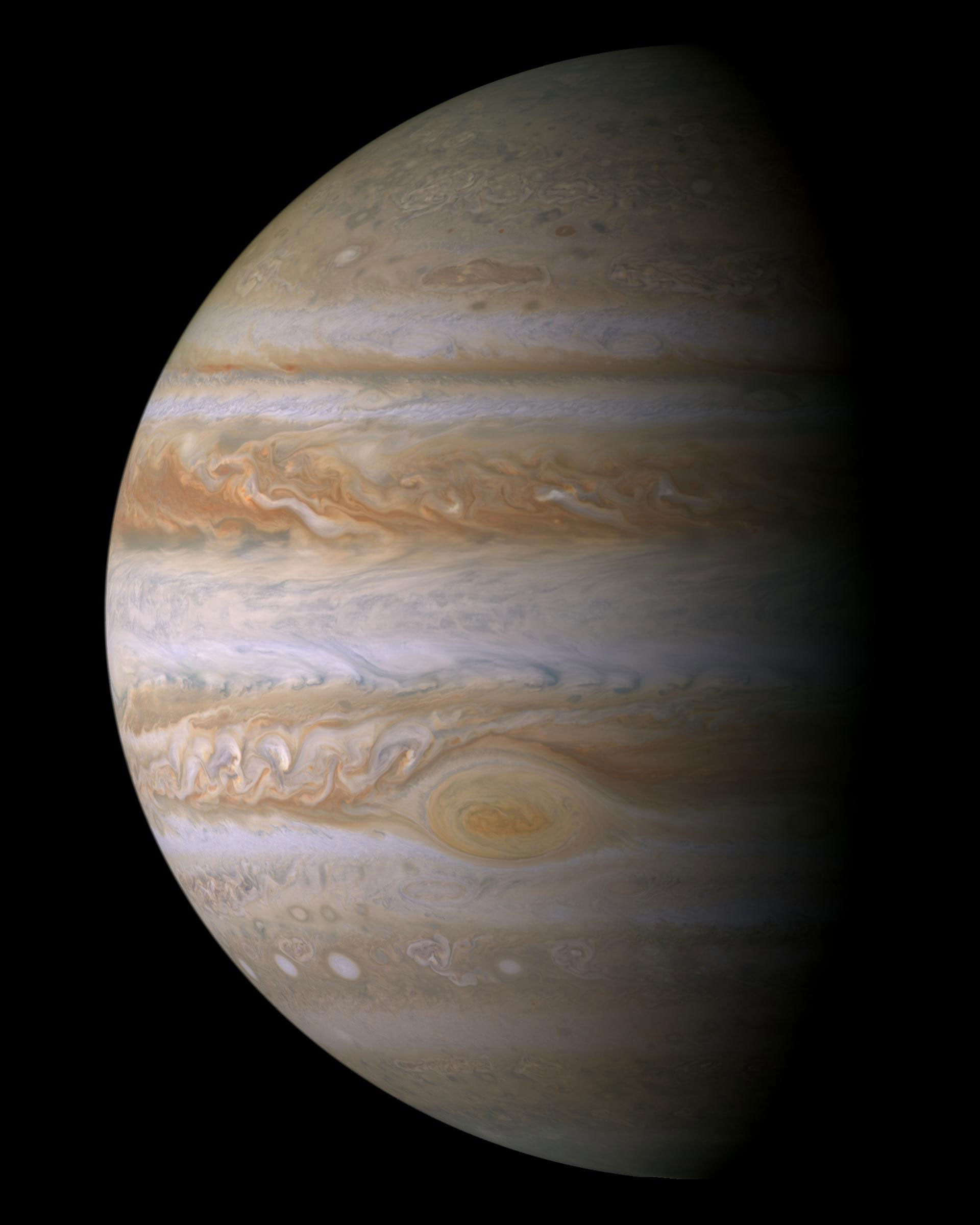
    This true color mosaic of Jupiter was constructed from images taken by the narrow angle camera onboard NASA’s Cassini spacecraft on December 29, 2000, during its closest approach to the giant planet at a distance of approximately 10 million kilometers (6.2 million miles). Credit: NASA/JPL/Space Science Institute

    NASA’s Juno Spacecraft will fly directly over Jupiter’s Great Red Spot on July 10th, helping astronomers better understand how this giant storm works and what makes it so special.

    Just days after celebrating its first anniversary in Jupiter orbit, NASA’s Juno Spacecraft will fly directly over Jupiter’s Great Red Spot, the gas giant’s iconic, 10,000-mile-wide (16,000-kilometer-wide) storm. This will be humanity’s first up-close and personal view of the gigantic feature — a storm monitored since 1830 and possibly existing for more than 350 years.

    “Jupiter’s mysterious Great Red Spot is probably the best-known feature of Jupiter,” said Scott Bolton, principal investigator of Juno from the Southwest Research Institute in San Antonio. “This monumental storm has raged on the solar system’s biggest planet for centuries. Now, Juno and her cloud-penetrating science instruments will dive in to see how deep the roots of this storm go, and help us understand how this giant storm works and what makes it so special.”

    The data collection of the Great Red Spot is part of Juno’s sixth science flyby over Jupiter’s mysterious cloud tops. Perijove (the point at which an orbit comes closest to Jupiter’s center) will be on Monday, July 10, at 6:55 p.m. PDT (9:55 p.m. EDT). At the time of perijove, Juno will be about 2,200 miles (3,500 kilometers) above the planet’s cloud tops. Eleven minutes and 33 seconds later, Juno will have covered another 24,713 miles (39,771 kilometers) and will be directly above the coiling crimson cloud tops of Jupiter’s Great Red Spot. The spacecraft will pass about 5,600 miles (9,000 kilometers) above the Giant Red Spot clouds. All eight of the spacecraft’s instruments as well as its imager, JunoCam, will be on during the flyby.

    On July 4 at 7:30 p.m. PDT (10:30 p.m. EDT), Juno will have logged exactly one year in Jupiter orbit. At the time, the spacecraft will have chalked up about 71 million miles (114.5 million kilometers) in orbit around the giant planet.

    “The success of science collection at Jupiter is a testament to the dedication, creativity and technical abilities of the NASA-Juno team,” said Rick Nybakken, project manager for Juno from NASA’s Jet Propulsion Laboratory in Pasadena, California. “Each new orbit brings us closer to the heart of Jupiter’s radiation belt, but so far the spacecraft has weathered the storm of electrons surrounding Jupiter better than we could have ever imagined.”

    Juno launched on August 5, 2011, from Cape Canaveral, Florida. During its mission of exploration, Juno soars low over the planet’s cloud tops — as close as about 2,100 miles (3,400 kilometers). During these flybys, Juno is probing beneath the obscuring cloud cover of Jupiter and studying its auroras to learn more about the planet’s origins, structure, atmosphere and magnetosphere.

    Early science results from NASA’s Juno mission portray the largest planet in our solar system as a turbulent world, with an intriguingly complex interior structure, energetic polar aurora, and huge polar cyclones.

    Never miss a breakthrough: Join the SciTechDaily newsletter.
    Follow us on Google and Google News.

    Astronomy Juno Spacecraft Jupiter Planetary Science
    Share. Facebook Twitter Pinterest LinkedIn Email Reddit

    Related Articles

    Juno Mission Prepares for Jupiter Flyby

    Juno Images Provide an Unprecedented View of Jupiter

    A Billion or More Jupiter-Like Worlds Could Be Orbiting Stars in the Milky Way

    First In-orbit View from NASA’s Juno Spacecraft

    Juno Spacecraft in Orbit Around Jupiter

    Hubble Telescope Views Vivid Auroras in Jupiter’s Atmosphere

    NASA Juno Mission Trailer – Jupiter: Into the Unknown

    ScienceCasts Video: Close Encounters with Jupiter

    NASA’s Juno Spacecraft Adjusts Flight Path for Jupiter

    Leave A Reply Cancel Reply

    • Facebook
    • Twitter
    • Pinterest
    • YouTube

    Don't Miss a Discovery

    Subscribe for the Latest in Science & Tech!

    Trending News

    Massive Study Warns Marijuana Use in Teens Is Linked to Serious Mental Illness

    Scientists Discover a Completely Unexpected Way T Cells Kill Cancer

    Scientists Just Found the Solar System’s Original “Planet Factory”

    Study Warns Widely Used Food Preservatives Linked to High Blood Pressure and Heart Disease

    New Treatment Could Reverse Osteoarthritis Within Weeks

    Physicists Have Measured “Negative Time” in Bizarre Quantum Experiment

    The Deadly Tapeworm Spreading Across America Has Reached the Pacific Northwest

    Could Low Vitamin D Be Making Your Pain Worse?

    Follow SciTechDaily
    • Facebook
    • Twitter
    • YouTube
    • Pinterest
    • Newsletter
    • RSS
    SciTech News
    • Biology News
    • Chemistry News
    • Earth News
    • Health News
    • Physics News
    • Science News
    • Space News
    • Technology News
    Recent Posts
    • Scientists Discover Mysterious Creature Living in the Great Salt Lake – and It Exists Nowhere Else on Earth
    • It’s Alive? Surprising Discovery Changes What We Know About Fog
    • Simple Family Routines May Be the Secret to a Smoother Start at School
    • Brain Study Overturns Long-Held Beliefs About How Humans Learn Speech
    • Ancient Goose Fossil Challenges Long-Held Theories About New Zealand Birds
    Copyright © 1998 - 2026 SciTechDaily. All Rights Reserved.
    • Science News
    • About
    • Contact
    • Editorial Board
    • Privacy Policy
    • Terms of Use

    Type above and press Enter to search. Press Esc to cancel.