
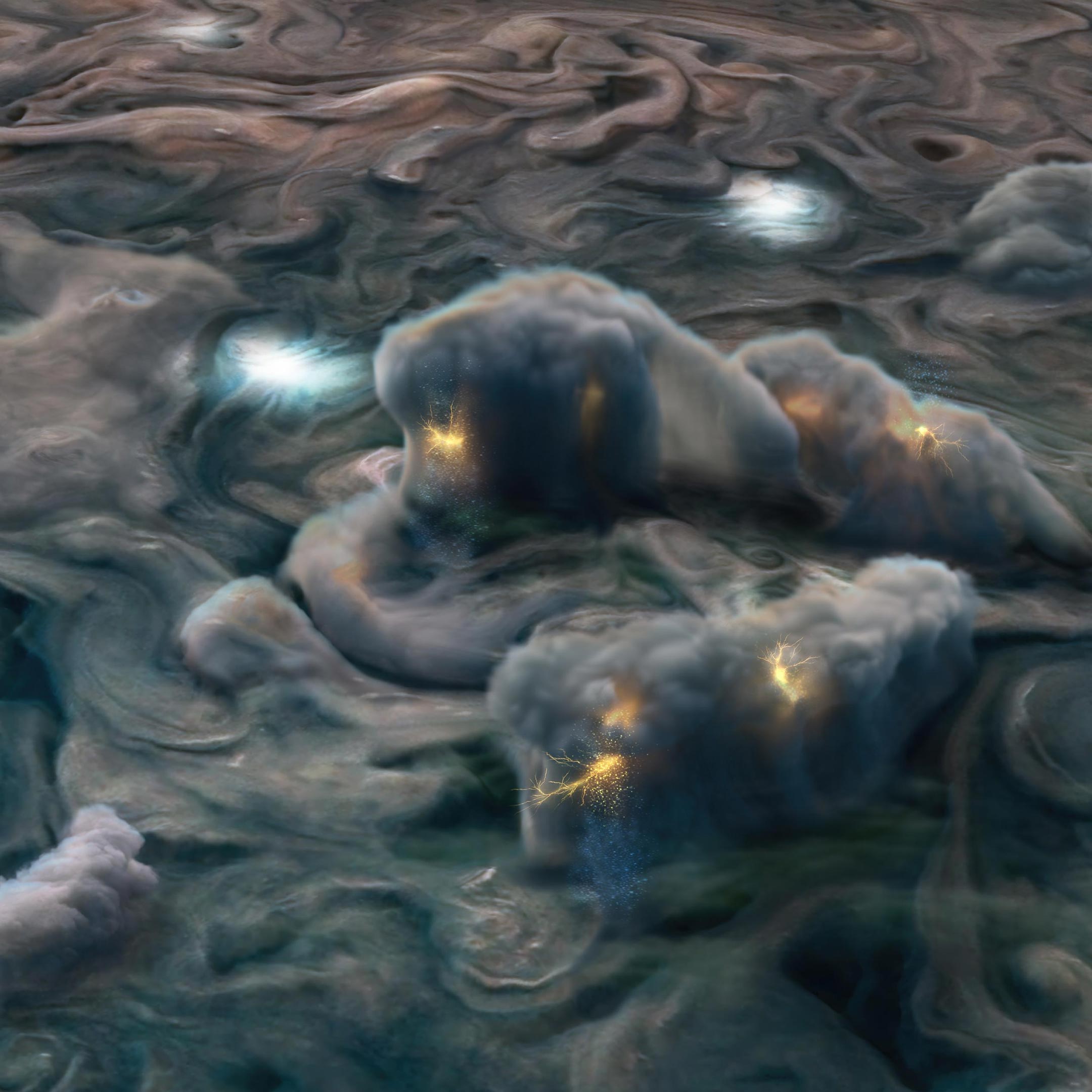
A bizarre hailstorm of icy “mushballs” — slushy mixtures of ammonia and water — has been confirmed on Jupiter, where intense lightning strikes illuminate these frozen slushballs as they rain from towering storms.
Using the first 3D visualizations of Jupiter’s troposphere, researchers revealed most weather is surprisingly shallow, yet deep convective systems punch through to unmix ammonia and water, dragging them far below cloud tops. This overturns the idea of a well‑mixed gas giant, with mushballs acting like subterranean conveyor belts that trap and transport chemicals, reshaping our understanding of giant‑planet atmospheres.
Mushball Slushstorms Unveiled
Picture a giant Slushee™ made of ammonia and water, wrapped in a hard shell of ice. Now imagine these icy slushballs — called “mushballs” — falling through Jupiter’s atmosphere like hailstones, lit up by powerful flashes of lightning.
According to planetary scientists at the University of California, Berkeley, this dramatic weather isn’t just science fiction—it’s actually happening on Jupiter. These mushball hailstorms, complete with lightning, may also occur on other gas giants in our solar system, such as Saturn, Uranus, and Neptune—and possibly on gas planets throughout the galaxy.
The concept of mushballs was first proposed in 2020 to explain puzzling variations in the levels of ammonia gas observed in Jupiter’s upper atmosphere. These irregularities were detected by NASA’s Juno spacecraft and confirmed by ground-based radio telescopes.
At the time, UC Berkeley graduate student Chris Moeckel and his advisor, Professor Emerita Imke de Pater, were skeptical. The theory required very specific and extreme atmospheric conditions to work.
From Skepticism to 3D Confirmation
“Imke and I both were like, ‘There’s no way in the world this is true,’” said Moeckel, who received his UC Berkeley Ph.D. last year and is now a researcher at UC Berkeley’s Space Sciences Laboratory. “So many things have to come together to actually explain this, it seems so exotic. I basically spent three years trying to prove this wrong. And I couldn’t prove it wrong.”
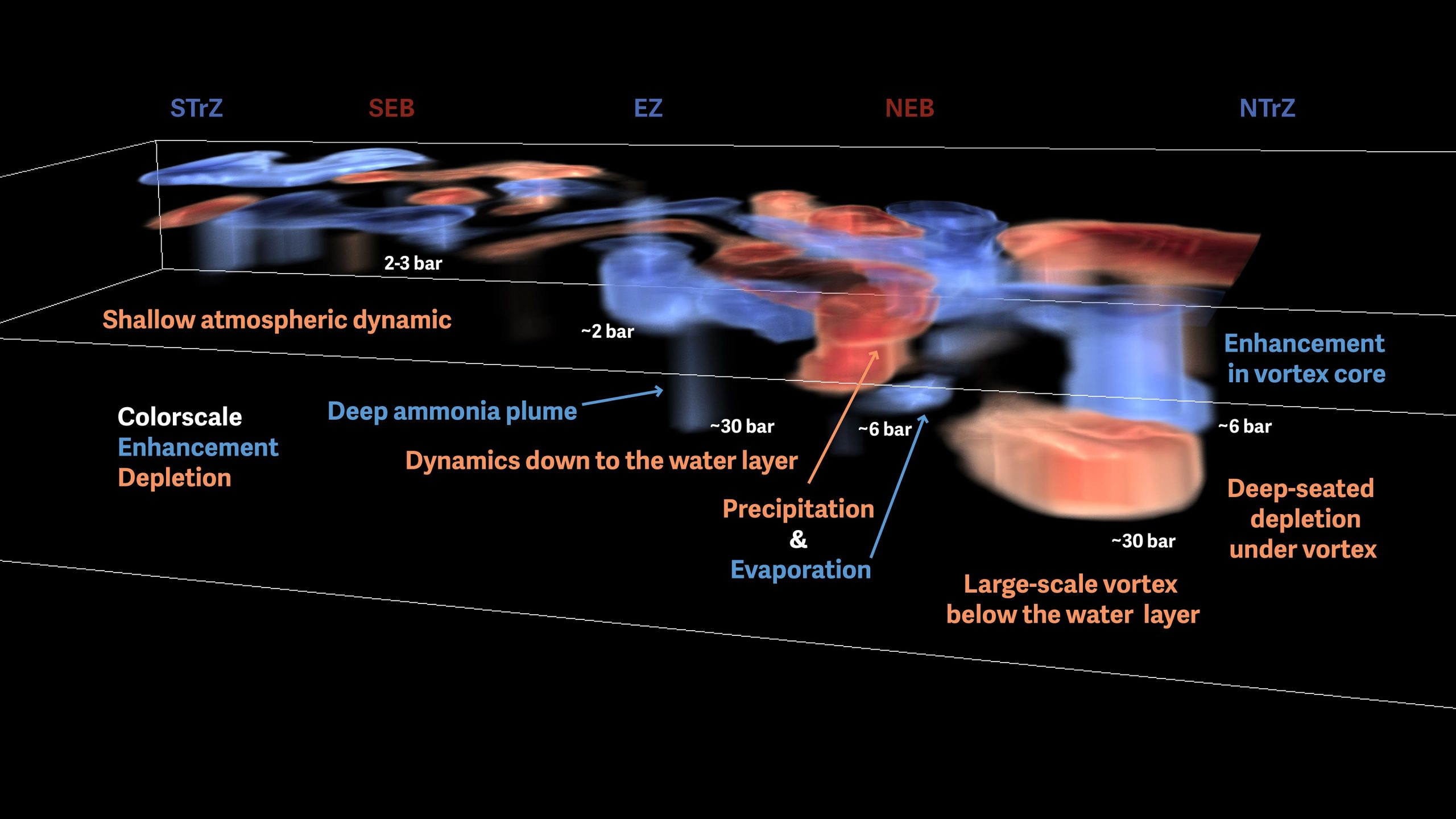
The confirmation, reported recently in the journal Science Advances, emerged together with the first 3D visualization of Jupiter’s upper atmosphere, which Moeckel and de Pater recently created and describe in a paper that is now undergoing peer review and is posted on the preprint server arXiv.
The 3D picture of Jupiter’s troposphere shows that the majority of the weather systems on Jupiter are shallow, reaching only 10 to 20 kilometers below the visible cloud deck or “surface” of the planet, which has a radius of 70,000 km. Most of the colorful, swirling patterns in the bands that encircle the planet are shallow.
Some weather, however, emerges much deeper in the troposphere, redistributing ammonia and water and essentially unmixing what was long thought to be a uniform atmosphere. The three types of weather events responsible are hurricane-like vortices, hotspots coupled to ammonia-rich plumes that wrap around the planet in a wave-like structure, and large storms that generate mushballs and lightning.
Shallow Bands vs. Deep Storms
“Every time you look at Jupiter, it’s mostly just surface level,” Moeckel said. “It’s shallow, but a few things — vortices and these big storms — can punch through.”
“Juno really shows that ammonia is depleted at all latitudes down to about 150 kilometers, which is really odd,” said de Pater, who discovered 10 years ago that ammonia was depleted down to about 50 km. “That’s what Chris is trying to explain with his storm systems going much deeper than we expected.”
Gas giants like Jupiter and Saturn and ice giants like Neptune and Uranus are a major focus of current space missions and large telescopes, including the James Webb Space Telescope, in part because they can help us understand the formation history of our solar system and ground truth observations of distant exoplanets, many of which are large and gaseous. Since astronomers can see only the upper atmospheres of faraway exoplanets, knowing how to interpret chemical signatures in these observations can help scientists infer details of exoplanet interiors, even for Earth-like planets.
Atmospheric Mixing and Misleading Cloud Tops
“We’re basically showing that the top of the atmosphere is actually a pretty bad representative of what is inside the planet,” Moeckel said.
That’s because storms like those that create mushballs unmix the atmosphere so that the chemical composition of the cloud tops does not necessarily reflect the composition deeper in the atmosphere. Jupiter is unlikely to be unique.
“You can just extend that to Uranus, Neptune — certainly to exoplanets as well,” de Pater said.
The atmosphere on Jupiter is radically different from that on Earth. It’s primarily made of hydrogen and helium gas with trace amounts of gaseous molecules, like ammonia and water, which are heavier than the bulk atmosphere. Earth’s atmosphere is mainly nitrogen and oxygen. Jupiter also has storms, like the Great Red Spot, that last for centuries. And while ammonia gas and water vapor rise, freeze into droplets, like snow, and rain down continually, there is no solid surface to hit. At what point do the raindrops stop falling?
Surface-less Rain and Vertical Mixing
“On Earth, you have a surface, and rain will eventually hit this surface,” Moeckel said. “The question is: What happens if you take the surface away? How far do the raindrops fall into the planet? This is what we have on the giant planets.”
That question has piqued the interest of planetary scientists for decades, because processes like rain and storms are thought to be the main vertical mixers of planetary atmospheres. For decades, the simple assumption of a well-mixed atmosphere guided inferences about the interior makeup of gas giant planets like Jupiter.
Observations by radio telescopes, much of it conducted by de Pater and colleagues, show that this simple assumption is false.
“The turbulent cloud tops would lead you to believe that the atmosphere is well mixed,” said Moeckel, invoking the analogy of a boiling pot of water. “If you look at the top, you see it boiling, and you would assume that the whole pot is boiling. But these findings show that even though the top looks like it’s boiling, below is a layer that really is very steady and sluggish.”
The Microphysics Behind Mushballs
On Jupiter, the majority of water rain and ammonia snow appears to cycle high up in the cold atmosphere and evaporate as it falls, Moeckel said. Yet, even before Juno’s arrival at Jupiter, de Pater and her colleagues reported an upper atmosphere lacking in ammonia. They were able to explain these observations, however, through dynamic and standard weather modeling, which predicted a rainout of ammonia in thunderstorms down to the water layer, where water vapor condenses into a liquid.
But radio observations by Juno traced the regions of poor mixing to much greater depths, down to about 150 km, with many areas puzzlingly depleted of ammonia and no known mechanism that could explain the observations. This led to proposals that water and ammonia ice must form hailstones that fall out of the atmosphere and remove the ammonia. But it was a mystery how hailstones could form that were heavy enough to fall hundreds of kilometers into the atmosphere.
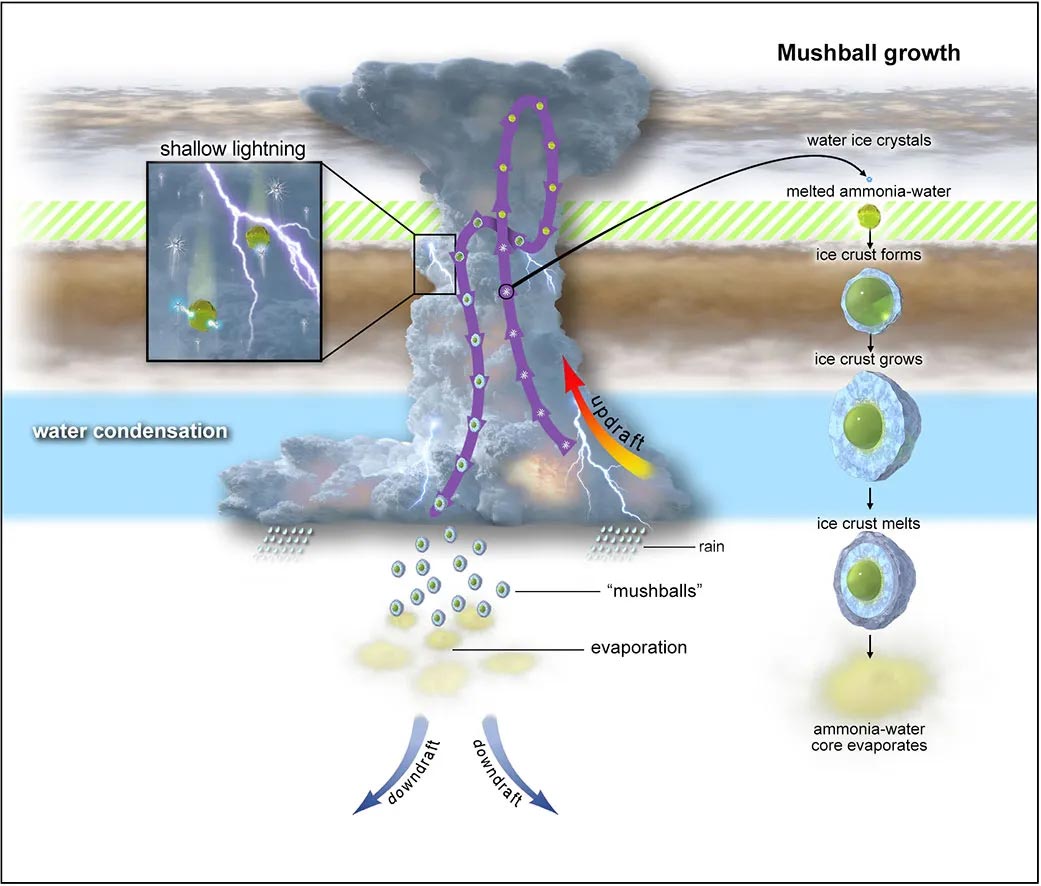
To explain why ammonia is missing from parts of Jupiter’s atmosphere, planetary scientist Tristan Guillot proposed a theory involving violent storms and slushy hailstones called mushballs. In this idea, strong updrafts during storms can lift tiny ice particles high above the clouds — more than 60 kilometers up. At those altitudes, the ice mixes with ammonia vapor, which acts like antifreeze and melts the ice into a slushy liquid. As the particles continue to rise and fall, they grow larger — like hailstones on Earth — eventually becoming mushballs the size of softballs.
Mushball Formation and Deep Descent
These mushballs can trap large amounts of water and ammonia with a 3 to 1 ratio. Because of their size and weight, they fall deep into the atmosphere — well below where the storm started — carrying the ammonia with them. This helps explain why ammonia appears to be missing from the upper atmosphere: it’s being dragged down and hidden deep inside the planet, where it leaves faint signatures to be observed with radio telescopes.
However, the process depends on a number of specific conditions. The storms need to have very strong updrafts, around 100 meters per second, and the slushy particles must quickly mix with ammonia and grow large enough to survive the fall.
“The mushball journey essentially starts about 50 to 60 kilometers below the cloud deck as water droplets. The water droplets get rapidly lofted all the way to the top of the cloud deck, where they freeze out and then fall over a hundred kilometers into the planet, where they start to evaporate and deposit material down there,” Moeckel said. “And so you have, essentially, this weird system that gets triggered far below the cloud deck, goes all the way to the top of the atmosphere and then sinks deep into the planet.”
Unique signatures in the Juno radio data for one storm cloud convinced him and his colleagues that this is, indeed, what happens.
Radio Evidence and Expert Confirmation
“There was a small spot under the cloud that either looked like cooling, that is, melting ice, or an ammonia enhancement, that is, melting and release of ammonia,” Moeckel said. “It was the fact that either explanation was only possible with mushballs that eventually convinced me.”
The radio signature could not have been caused by water raindrops or ammonia snow, according to paper co-author Huazhi Ge, an expert in cloud dynamics on giant planets and a postdoctoral fellow at the California Institute of Technology in Pasadena.
“The Science Advances paper shows, observationally, that this process apparently is true, against my best desire to find a simpler answer,” Moeckel said.
3D Tomography & Open Data Push
Scientists around the world observe Jupiter regularly with ground-based telescopes, timed to coincide with Juno’s closest approach to the planet every six weeks. In February 2017 and April 2019 — the periods covered by the two papers — the researchers used data from both the Hubble Space Telescope (HST) and the Very Large Array (VLA) in New Mexico to complement Juno observations in an attempt to create a 3D picture of the troposphere. The HST, at visible wavelengths, provided measurements of reflected light off the cloud tops, while the VLA, a radio telescope, probed tens of kilometers below the clouds to provide global context. Juno’s Microwave Radiometer explored the deep atmosphere of Jupiter over a limited region of the atmosphere.
“I essentially developed a tomography method that takes the radio observations and turns them into a three-dimensional rendering of that part of the atmosphere that is seen by Juno,” Moeckel said.
The 3D picture of that one swath of Jupiter confirmed that most of the weather is happening in the upper 10 kilometers.
“The water condensation layer plays a crucial role in controlling the dynamics and the weather on Jupiter,” Moeckel said. “Only the most powerful storms and waves can break through that layer.
Moeckel noted that his analysis of Jupiter’s atmosphere was delayed by the lack of publicly available calibrated data products from the Juno mission. Given the current level of data released, he was forced to independently reconstruct the mission team’s data processing methods — tools, data and discussions that, if shared earlier, could have significantly accelerated independent research and broadened scientific participation. He has since made these resources publicly available to support future research efforts.
Reference: “Tempests in the troposphere: Mapping the impact of giant storms on Jupiter’s deep atmosphere” by Chris Moeckel, Huazhi Ge and Imke de Pater, 28 March 2025, Science Advances.
DOI: 10.1126/sciadv.ado9779
The work was funded in part by a Solar System Observations (SSO) award from NASA (80NSSC18K1003).
Never miss a breakthrough: Join the SciTechDaily newsletter.
Follow us on Google and Google News.