
Close Menu
    Facebook X (Twitter) Instagram
    SciTechDaily
    • Biology
    • Chemistry
    • Earth
    • Health
    • Physics
    • Science
    • Space
    • Technology
    Facebook X (Twitter) Pinterest YouTube RSS
    SciTechDaily
    Home»Space»NASA’s Juno spacecraft Detects Jupiter’s Highest-Energy Ions
    Space

    NASA’s Juno spacecraft Detects Jupiter’s Highest-Energy Ions

    By Morgan Rehnberg, EosJuly 13, 2021No Comments4 Mins Read
    Facebook Twitter Pinterest Telegram LinkedIn WhatsApp Email Reddit
    Share
    Facebook Twitter LinkedIn Pinterest Telegram Email Reddit
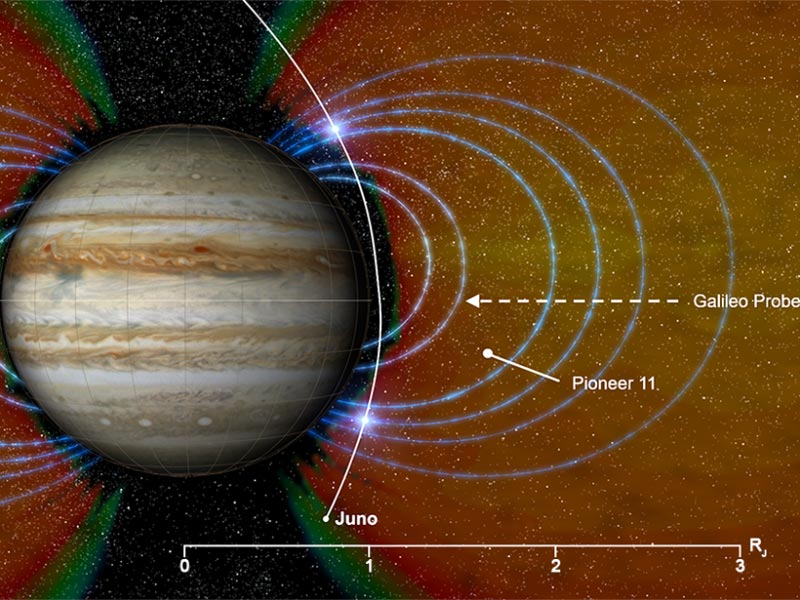
    Jupiter Highly Energetic Ions
    Juno has discovered a new population of highly energetic ions (bright blue spots) at midlatitudes within the inner edge of Jupiter’s relativistic electron belt, a region not previously explored. Juno’s stellar reference unit star camera records bright streaks in its images when these penetrating ions strike its sensor. The closest approach of Pioneer 11 to the planet and the path of the Galileo probe are also shown. Credit: M. Stetson, D. Santos-Costa, J. Arballo, H. N. Becker, CC BY-NC 4.0

    Trapped ions discovered at midlatitudes can have energies exceeding 100 megaelectron volts per nucleon. Their detection adds to our understanding of the powerful radiation environment around Jupiter.

    Jupiter’s planetary radiation environment is the most intense in the solar system. NASA’s Juno spacecraft has been orbiting the planet closer than any previous mission since 2016, investigating its innermost radiation belts from a unique polar orbit. The spacecraft’s orbit has enabled the first complete latitudinal and longitudinal study of Jupiter’s radiation belts. Becker et al. leverage this capability to report the discovery of a new population of heavy, high-energy ions trapped at Jupiter’s mid-latitudes.

    The authors applied a novel technique for detecting this population; rather than using a particle detector or spectrometer to observe and quantify the ions, they used Juno’s star-tracking camera system. Star trackers, or stellar reference units (SRUs), are high-resolution navigational cameras whose primary mission is to use observations of the sky to compute the spacecraft’s precise orientation. The SRU on board the Juno spacecraft is among the most heavily shielded components, afforded 6 times more radiation protection than the spacecraft’s other systems in its radiation vault.


    This animation shows the Juno spacecraft’s stellar reference unit (SRU) star camera (left) as it is hit by high-energy particles in Jupiter’s inner radiation belts. The signatures from these hits appear as dots, squiggles, and streaks (right) in the images collected by the SRU. Credit: NASA/JPL-Caltech

    Despite its heavy protection, ions, and electrons with very high energies still occasionally penetrate the shielding and strike the SRU sensor (see animation above). This study focuses on 118 unusual events that struck with dramatically higher energy than typical penetrating electrons. Using computer modeling and laboratory experiments, the authors determined that these ions deposited 10 and 100 times more energy than deposited by penetrating protons and electrons, respectively.

    To identify potentially responsible ion species, the authors examined the morphology of the sensor strikes. Although most strikes trigger only several pixels, a few events with a low incidence angle can create streaks in which energy is deposited as the particle penetrates successive pixels. Simulation software can predict the energy deposition of various particles moving through matter, providing candidates for the ions encountered by Juno. Ion species as light as helium or as heavy as sulfur could account for at least some of the observed strikes, the authors said. Species from helium through oxygen could account for all the strikes, provided they have energies in excess of 100 megaelectron volts per nucleon.

    Finally, the study attributes these ions to the inner edge of the synchrotron emission region, located at radial distances of 1.12–1.41 Jupiter radii and magnetic latitudes ranging from 31° ­to 46°. This region has not been explored by prior missions, and this population of ions was previously unknown. With total energies measured in gigaelectron volts, they represent the highest-energy particles yet observed by Juno.

    Reference: “High Latitude Zones of GeV Heavy Ions at the Inner Edge of Jupiter’s Relativistic Electron Belt” by Heidi N. Becker, James W. Alexander, John E. P. Connerney, Martin J. Brennan, Alexandre Guillaume, Virgil Adumitroaie, Meghan M. Florence, Peter Kollmann, Barry H. Mauk and Scott J. Bolton, 10 May 2021, Journal of Geophysical Research: Planets.
    DOI: 10.1029/2020JE006772

    Never miss a breakthrough: Join the SciTechDaily newsletter.
    Follow us on Google and Google News.

    Atmospheric Science Juno Spacecraft Jupiter NASA Planets Popular Space Weather
    Share. Facebook Twitter Pinterest LinkedIn Email Reddit

    Related Articles

    Webb Spots Mysterious Lightshow on Jupiter That Baffles Scientists

    Breathtaking Majesty: NASA’s Juno Captures Jupiter’s Colorful Chaos in Stunning Detail

    NASA’s Juno Spacecraft Discovers Jupiter’s Winds Penetrate the Planet in Cylindrical Layers

    Stunning Image of Jupiter’s Atmosphere Captured by NASA’s Juno Spacecraft Reveals High-Altitude Hazes

    NASA’s Juno Spacecraft Spies Powerful Vortices Near Jupiter’s North Pole

    Jupiter’s Complex Colors Revealed in Stunning Images From NASA’s Juno Spacecraft

    Ganymede Casts a Massive Shadow Across Jupiter in Spectacular New Image From NASA’s Juno Spacecraft

    Amazing Look at Jupiter’s Incredible Storms Using Ground and Space Observations

    Jupiter Water Mystery Updated With Findings From NASA’s Juno Spacecraft

    Leave A Reply Cancel Reply

    • Facebook
    • Twitter
    • Pinterest
    • YouTube

    Don't Miss a Discovery

    Subscribe for the Latest in Science & Tech!

    Trending News

    Monster Storms on Jupiter Unleash Lightning Beyond Anything on Earth

    Scientists Create “Liquid Gears” That Spin Without Touching

    The Simple Habit That Could Help Prevent Cancer

    Millions Take These IBS Drugs, But a New Study Finds Serious Risks

    Scientists Unlock Hidden Secrets of 2,300-Year-Old Mummies Using Cutting-Edge CT Scanner

    Bread Might Be Making You Gain Weight Even Without Eating More Calories

    Scientists Discover Massive Magma Reservoir Beneath Tuscany

    Europe’s Most Active Volcano Just Got Stranger – Here’s Why Scientists Are Rethinking It

    Follow SciTechDaily
    • Facebook
    • Twitter
    • YouTube
    • Pinterest
    • Newsletter
    • RSS
    SciTech News
    • Biology News
    • Chemistry News
    • Earth News
    • Health News
    • Physics News
    • Science News
    • Space News
    • Technology News
    Recent Posts
    • Scientists Were Wrong About This Strange “Rule-Breaking” Particle
    • Webb Space Telescope Uncovers Unexpected Ice Clouds on a Jupiter-Like World
    • 289-Million-Year-Old Reptile Mummy Reveals Origin of Human Breathing System
    • New Brain Discovery Challenges Long-Held Theory of Teenage Brain Development
    • Sharks Are Overheating as Warming Oceans Push Them to the Edge
    Copyright © 1998 - 2026 SciTechDaily. All Rights Reserved.
    • Science News
    • About
    • Contact
    • Editorial Board
    • Privacy Policy
    • Terms of Use

    Type above and press Enter to search. Press Esc to cancel.