
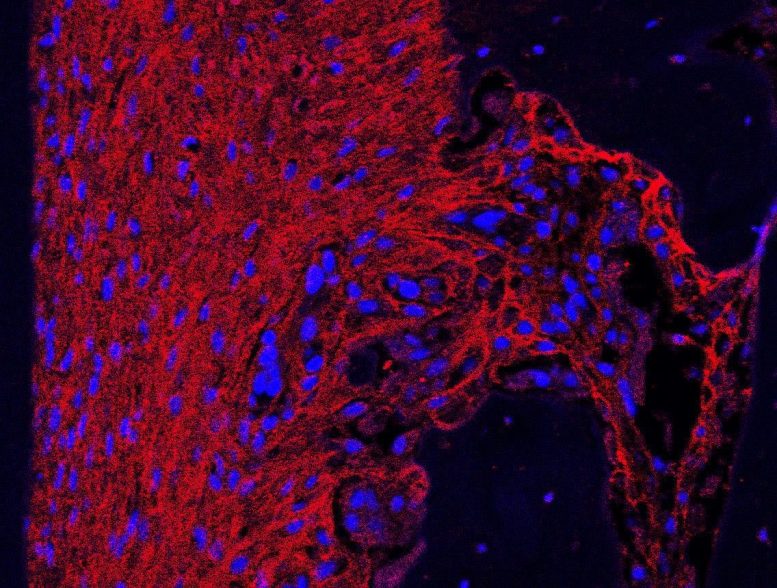
New research published in the Journal of Dental Research has shed light on the science behind the formation of the periodontal ligament.
Our teeth take thousands of bites per day, and understanding exactly what holds them in place and how is key to helping people live with their own teeth for longer.
Now new research published in the Journal of Dental Research has shed light on the science behind the formation of the periodontal ligament, which helps keep the tooth stable in the jawbone. This improved understanding will also help scientists work towards regenerating the tissues that support teeth.
The study, led by the Universities of Plymouth and Geneva, shows how a * signaling pathway called Notch, which is known to be activated in stem cells and cancer, is important for periodontal ligament development.
*A signaling pathway describes how a group of molecules in a cell work together to control one or more cell functions, such as cell division or cell death. After the first molecule in a pathway receives a signal, it activates another molecule. This process is repeated until the last molecule is activated and the cell function is carried out.
Abnormal activation or inhibition of certain signaling pathways can lead to cancer and other conditions, including problems with tissue regeneration.
A key finding in the new study, which was conducted in rodent teeth, is that Lamin A, a cell nuclear protein, is a direct target of the Notch pathway.
Lamin A is best known for its mutated form progerin, which causes the fatal ‘early aging’ disease, Progeria syndrome – but by uncovering its involvement in periodontal ligament formation, scientists have better insight into how molecules function during tissue regeneration, and how the process could be affected during disease.
Corresponding author Dr. Bing Hu, Associate Professor of Oral and Dental Health Research in Peninsula Dental School at the University of Plymouth, said:
“The periodontal ligament starts to properly hold the tooth in the jawbone when a tooth breaks out and becomes functional. Understanding the mechanisms of how periodontal ligaments develop and the molecules that assist the tissue becoming mature is really important for our understanding of tissue regeneration and repair. The next steps are for us to see if and how the molecules we have identified in this study can be translated into a human-only model and, in turn, how they are affected in both healthy and diseased conditions.”
Dr. Hu is also part of the University’s Institute of Translational and Stratified Medicine (ITSMed).
This research is a part of the MD-Ph.D. thesis of Dr. Balázs Dénes of the University of Geneva, entitled Post-emergent tooth eruption: eruption rate, periodontal ligament maturation and cell signaling, directed by Professor Stavros Kiliaridis. Dr. Denes said:
“We believe that our findings are an important stepping stone to better dental treatments in situations involving the periodontal ligament, such as gum disease (periodontitis), tooth restoration by dental implants or orthodontic tooth movement.”
Reference: “Notch coordinates periodontal ligament maturation through regulating Lamin A“ by B.J. Denes, C. Bolton, C.S. Illsley, W.L. Kok, J.V. Walker, A. Poetsch, C. Tredwin, S. Kiliaridis and B. Hu, 28 August 2019, Journal of Dental Research
DOI: 10.1177/0022034519871448
This study was supported by the Swiss National Science Foundation; the European Union Marie Skłodowska-Curie Actions; the European Regional Development Fund and the Biotechnology and Biological Sciences Research Council (BBSRC).
Never miss a breakthrough: Join the SciTechDaily newsletter.
Follow us on Google and Google News.