
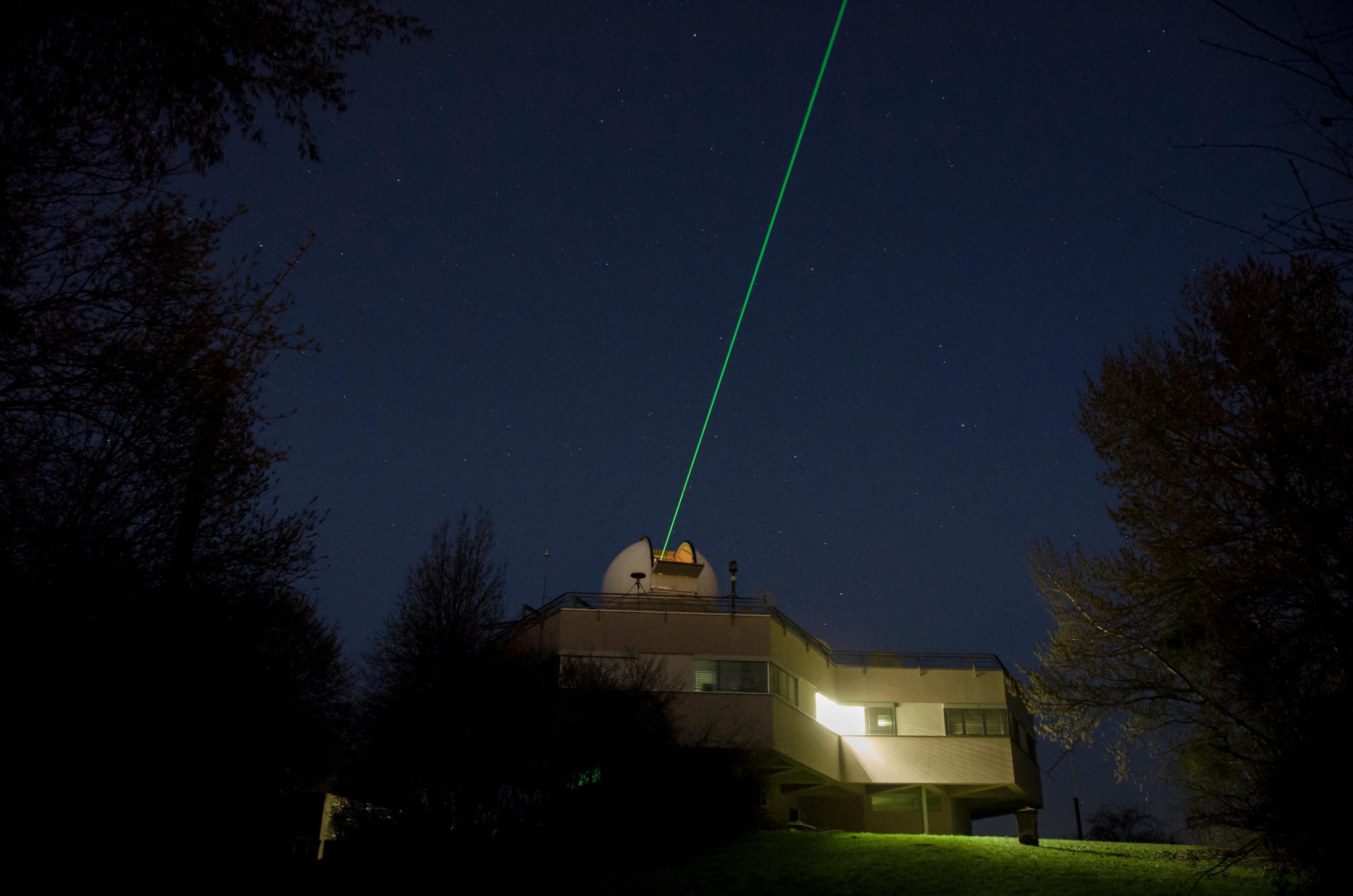
Scientists are using laser-based tracking and gravity data to improve how we monitor both satellites and space debris. By blending these methods, they can now predict orbits more precisely and gather insights on Earth’s gravity and water masses.
How are the Earth’s gravitational field and the paths of satellites and space debris connected? Earth’s gravitational field shapes the orbits of satellites and debris, and shifts in these orbits can reveal changes in the gravitational field, which also offers insights into water mass distribution on Earth.
In the COVER project, researchers at TU Graz’s Institute of Geodesy have enhanced gravity field calculations by combining satellite gravity measurements with satellite laser ranging (SLR). This approach not only improves gravity field models but also refines tracking and predictions for objects in orbit. These advancements are now available in the Gravity Recovery Object-Oriented Programming System (GROOPS) software—an open-source tool the Institute provides on GitHub.
Improving Long-Wave Gravity Field Resolution
“The satellite missions Grace, Grace Follow-on and previously GOCE have provided really valuable data for calculating the Earth’s gravity field. However, the long-wavelength of the gravity field, which covers masses of continental size, can not be resolved very well by using these missions,” says Sandro Krauss from the Institute of Geodesy at TU Graz.
Measurements with SLR, on the other hand, can resolve this long-wavelength part very precisely. To do this, a network of SLR stations points a laser at a satellite with retro-reflectors that reflect the emitted laser light. By measuring the travel time, the position of the satellites can be determined to within centimeters and, through multiple measurements, variations in the orbit resulting from changes in mass on the Earth’s surface can also be detected.
“If you combine SLR with the other satellite measurement methods, the gravity field can be calculated much more accurately, as you can precisely resolve all wavelengths of the gravity field. This allows us to determine the water masses present on Earth in greater detail. At the same time, we can use the data obtained from the measurements to predict the position of satellites and space debris much better, locate them, map them with SLR and predict their future orbits very precisely, which contributes to more safety in orbit.”
Tracking Space Debris for Safer Orbits
There are currently around 40,000 pieces of space debris objects with a size of more than ten centimeters orbiting the Earth; there are around 1 million pieces one centimeter or larger. They are traveling at around 30,000 km/h (~20,000 mph) and are not all flying in the same direction.
A collision would therefore have quite a large impact and would destroy satellites and endanger human lives in space stations or other manned spacecraft. This makes it all the more important to locate the orbits of all objects and predict their future trajectories as accurately as possible.
Moving from Kilometers to Centimeter Precision
Radar measurements are currently used to monitor all space debris objects, but their accuracy is limited. And the existing orbit forecasts also suffered from the fact that they were only accurate to within a few kilometers. This subsequently made it more difficult to locate them. Together with the Satellite Laser Ranging Station of the Austrian Academy of Sciences’ Space Research Institute at the Lustbühel Observatory, decisive progress has been made here.
The Institute of Geodesy used its own force models, which can be used to determine the position of a satellite or debris to an accuracy of around 100 meters. This made it easier to track and record them precisely with the surveying laser. Further measurements during subsequent flybys provided an even more accurate picture of how the orbit behaves, which enabled the researchers to improve the predictions.
Advancing Orbit Prediction with Force Modeling
“For orbit prediction, we have to model all the forces on the satellites,” says Torsten Mayer-Gürr from the Institute of Geodesy at TU Graz. “This also includes the Earth’s gravitational force, which is influenced by the presence of masses such as water. The combination of our orbit modeling with SLR measurements now allows much more accurate calculations in our GROOPS software, which is freely accessible to everyone.
“As far as we know, we are the only ones to offer such a comprehensive package for gravity field determination, orbit determination, and SLR processing free of charge. This open-source access has the advantage for us that we get feedback very quickly if something needs to be improved.”
Reference: “Bridging the gap between GRACE and GRACE Follow-On by combining high–low satellite-to-satellite tracking data and satellite laser ranging” by Matthias Weigelt, Adrian Jäggi, Ulrich Meyer, Daniel Arnold, Torsten Mayer-Gürr, Felix Öhlinger, Krzysztof Sośnica, Sahar Ebadi, Steffen Schön and Holger Steffen, 13 September 2024, Journal of Geodesy.
DOI: 10.1007/s00190-024-01888-5
Never miss a breakthrough: Join the SciTechDaily newsletter.
Follow us on Google and Google News.