
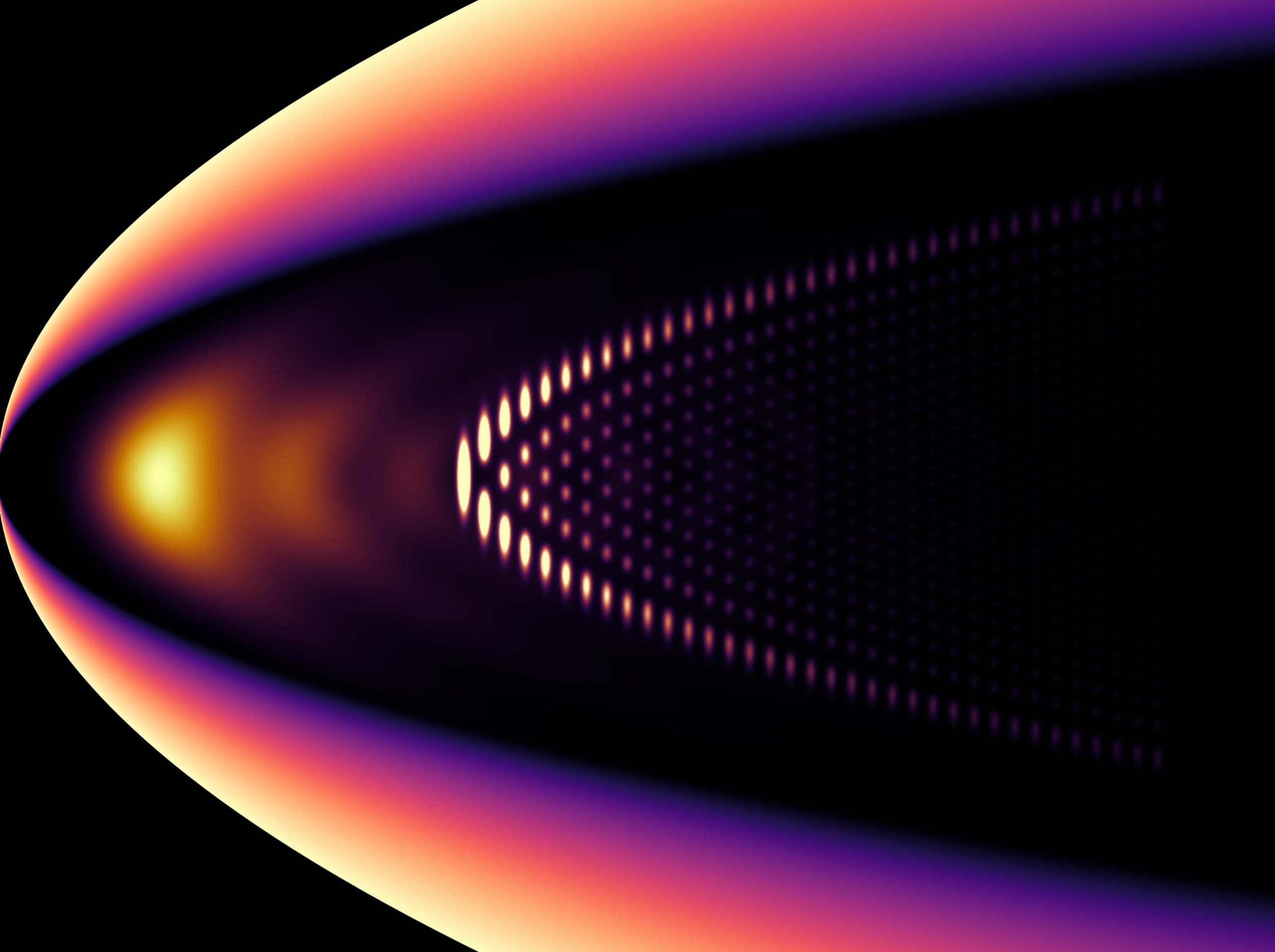
Researchers have developed a one-dimensional gas of light, enabling studies of quantum effects and the behavior of photon gases in various dimensions.
Using a dye solution and laser-induced photons, they explored how photon gases condense and react to dimensional changes, finding that one-dimensional gases show unique fluctuations and lack a distinct condensation point, insights that could lead to advancements in quantum optical applications.
One-Dimensional Light Gas
Imagine you are standing at a swimming pool and come up with the idea of filling it with even more water. You grab a garden hose and use it to generate a jet of water that curves in a high arc to fall onto the surface of the pool. The water level increases briefly at the point where the jet of water hits the pool but this change in water level is only minimal because the falling water is quickly distributed across the entire expanse of water.
The effect is different, however, if you fill up a gutter with your jet of water. The jet creates a wave of water at the point where you aim the hose. This is because the walls of the gutter ensure that the water cannot flow out across a surface but can only be distributed in the direction of the gutter. The narrower the gutter, the higher the amplitude of the wave and thus the “more one-dimensional” it becomes.

Creating Gases From Light Particles
Physicists from the Institute of Applied Physics (IAP) at the University of Bonn in cooperation with colleagues at the RPTU have now investigated whether similar effects of dimensionality can also be achieved with gases made out of light particles.
“To create these types of gases, we need to concentrate lots of photons in a confined space and cool them simultaneously,” explains Dr. Frank Vewinger from the IAP, who is also a member of the transdisciplinary research area “Matter” at the University of Bonn.

Experimentation With Photon Gases
In their experiment, the researchers filled a tiny container with a dye solution and excited it using a laser. The resulting photons bounced back and forth between the reflective walls of the container. Whenever they collided with a dye molecule, they were cooled until ultimately the photon gas condensed.
The dimensionality of the gas can be influenced by modifying the surface of the reflective surfaces. The researchers at the IAP cooperated with the research group headed by Prof. Dr. Georg von Freymann from the RPTU on this study. A high-resolution structuring method was adapted so that it could be applied to the reflective surfaces of the photon container for this experiment. “We were able to apply a transparent polymer to the reflective surfaces to create microscopically small protrusions,” explains Julian Schulz from the RPTU. “These protrusions allow us to trap the photons in one or two dimensions and condense them.”
“These polymers act like a type of gutter, but in this case for light,” says Kirankumar Karkihalli Umesh, lead author of the study. “The narrower this gutter is, the more one-dimensionally the gas behaves.”

Quantum Fluctuations in One-Dimensional Systems
In two dimensions, there is a precise temperature limit at which condensation occurs – similar to how water freezes at precisely zero degrees Celsius. Physicists call this a phase transition. “However, things are a little different when we create a one-dimensional gas instead of a two-dimensional one,” says Vewinger. “So-called thermal fluctuations take place in photon gases but they are so small in two dimensions that they have no real impact. However, in one dimension these fluctuations can – figuratively speaking – make big waves.”
These fluctuations destroy the order of one-dimensional systems so that different regions within the gas no longer behave the same. As a result, the phase transition, which is still precisely defined in two dimensions, becomes increasingly “smeared out” the more one-dimensional the system becomes. However, its properties are still governed by quantum physics, as in the case of two-dimensional gases, and these types of gas are called degenerate quantum gases. It is as if water were to turn into a form of icy water at low temperatures without ever completely freezing when cooling down. “We have now been able to investigate this behavior at the transition from a two-dimensional to a one-dimensional photon gas for the first time,” explains Vewinger.
Conclusion and Future Research
The research groups were able to demonstrate that one-dimensional photon gases do not actually have a precise condensation point. By making tiny changes to the polymer structures, it will now be possible to investigate phenomena that occur at the transition between different dimensionalities in great detail. This is still considered basic research at the moment but it is possible that it could open up new areas of application for quantum optical effects.
Reference: “Dimensional crossover in a quantum gas of light” by Kirankumar Karkihalli Umesh, Julian Schulz, Julian Schmitt, Martin Weitz, Georg von Freymann and Frank Vewinger, 6 September 2024, Nature Physics.
DOI: 10.1038/s41567-024-02641-7
The following institutions participated in the study: the IAP at the University of Bonn, the Fraunhofer Institute for Industrial Mathematics (ITWM) in Kaiserslautern and the University of Kaiserslautern-Landau (RPTU). The study was funded by the European Research Council (ERC) of the European Union and the German Research Foundation (DFG) as part of Collaborative Research Centre TRR 185.
Never miss a breakthrough: Join the SciTechDaily newsletter.
Follow us on Google and Google News.
3 Comments
Since Einstein took the then concurrent new number constant presented by Max Planck and multiplied into the light wave lengths – which gives more number dynamics for math (as it is one number multiplied by another), and responded to questions by saying it meant “packets of energy” and which were named Photons later by Lewis, famous of the Lewis chem-charts, just what are your “Photons”?
Even the slightest mistake can lead to a thousand miles of error.
The universe is a superposition, deflection, and entanglement of geometric shapes. It is the interaction and synchronization effect of countless topological vortices and their fractal structures. The formation of energy gaps between topological vortices is crucial for the evolution of spatiotemporal motion from low dimensional spacetime to high-dimensional spacetime. Please ask the researchers to think deeply:
How do you confirm that the physical phenomenon you observed in the experiment is indeed 1D?
Scientific research guided by correct theories can help humanity avoid detours, failures, and pomposity. Please witness the exemplary collaboration between theoretical physicists and experimentalists ( https://scitechdaily.com/microscope-spacecrafts-most-precise-test-of-key-component-of-the-theory-of-general-relativity/#comment-854286 ).
Too lazy to use all three, eh?