
Data from heavy ion collisions provide new insights into the electromagnetic properties of quark-gluon plasma “deconfined” from protons and neutrons.
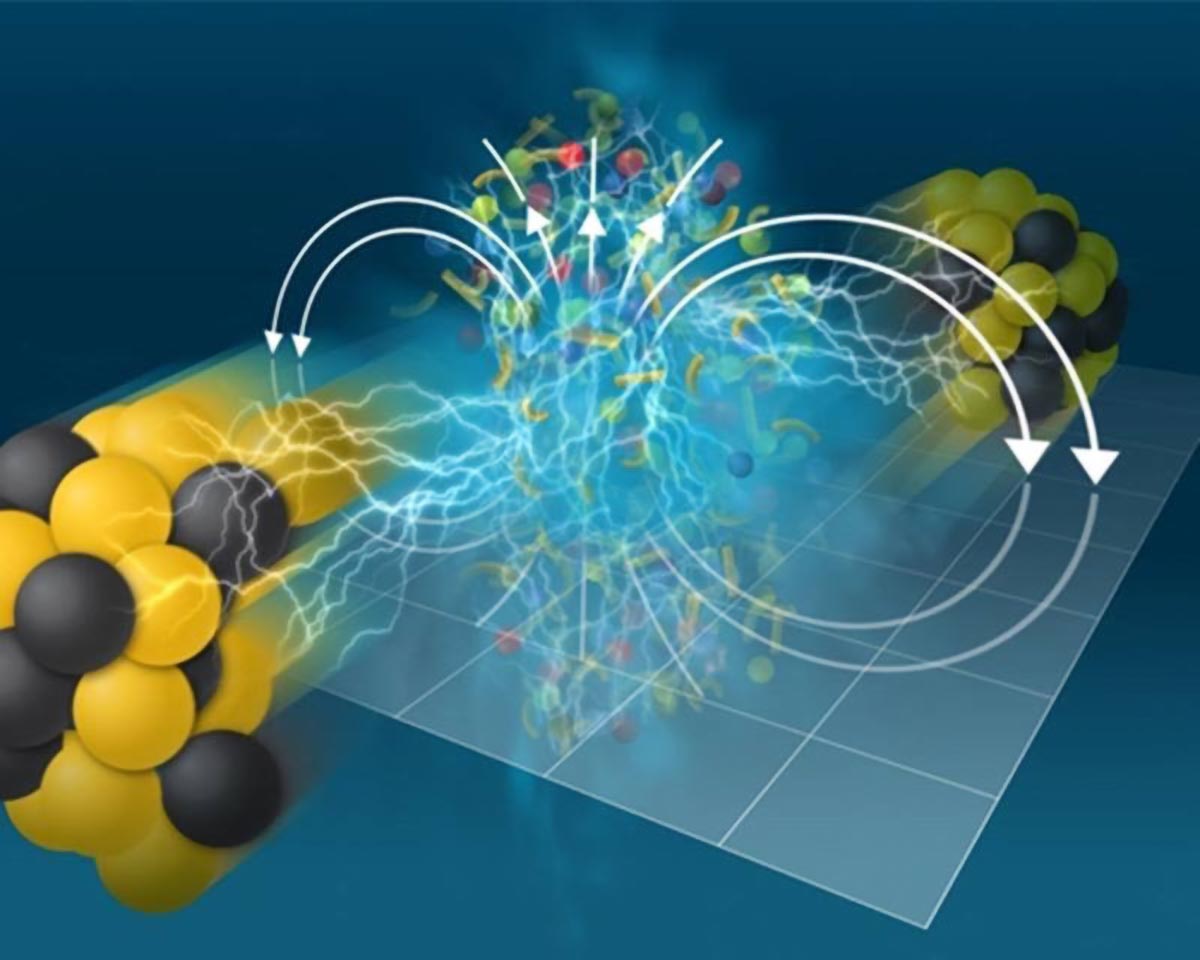
Scientists have uncovered the first direct evidence that the powerful magnetic fields created in off-center collisions of atomic nuclei induce an electric current in “deconfined” nuclear matter. This is a plasma “soup” of quarks and gluons that have been set free, or “deconfined,” from nuclear matter—protons and neutrons—in the particle collisions.
Although the magnetic fields in deconfined nuclear matter are a billion times stronger than a typical refrigerator magnet, their effects can be hard to detect. This new study’s evidence is from measuring the way particles with an electric charge are deflected when they emerge from the collisions. The study provides proof that the powerful magnetic fields exist. It also offers a new way to measure the electrical conductivity in the quark-gluon plasma (QGP).
Measuring Electrical Conductivity
Physicists can infer the value of the QGP’s electrical conductivity from how much the electromagnetic field deflects charged particles such as electrons, quarks, and protons. The stronger a particular type of deflection is, the stronger the conductivity. Conductivity is an important property of matter, but scientists have not been able to measure it in QGP before.
Understanding the electromagnetic properties of the QGP may help physicists unravel the mysteries of the phase transition between QGP and ordinary nuclear matter made of protons and neutrons. The work will also aid in explorations of other magnetic effects in the QGP.
Challenges in Magnetic Field Measurement
Off-center collisions of atomic nuclei at the Relativistic Heavy Ion Collider (RHIC), a Department of Energy particle accelerator user facility at Brookhaven National Laboratory, should generate powerful magnetic fields. That’s because some of the non-colliding positively charged protons are set swirling as the nuclei sideswipe one another at close to the speed of light. The fields are expected to be stronger than those of neutron stars and much more powerful than Earth’s.
However, measuring magnetic fields in the QGP is challenging because this deconfined nuclear matter doesn’t last very long. So, instead, researchers measure the QGP’s properties indirectly, for example by using RHIC’s STAR detector to track the impact of the magnetic field on charged particles streaming from the collisions.
Discovery of Induced Electric Current
The STAR physicists saw a pattern of charged-particle deflection that could only be caused by an electromagnetic field and current induced in the QGP. This was clear evidence that the magnetic fields exist. The degree of deflection is directly related to the strength of the induced current.
Scientists will now use this method to measure the conductivity of the QGP. That, in turn, may help them unravel mysteries of the phase transition between deconfined quarks and gluons and composite particles such as protons and neutrons.
Reference: “Observation of the Electromagnetic Field Effect via Charge-Dependent Directed Flow in Heavy-Ion Collisions at the Relativistic Heavy Ion Collider” by 23 February 2024, Physical Review X.
DOI: 10.1103/PhysRevX.14.011028
This research was funded by the Department of Energy Office of Science, the National Science Foundation, and a range of international organizations and agencies listed in the scientific paper. The STAR team used computing resources at the Scientific Data and Computing Center at Brookhaven National Laboratory, the National Energy Research Scientific Computing Center (NERSC) at Lawrence Berkeley National Laboratory, and the Open Science Grid consortium.
Never miss a breakthrough: Join the SciTechDaily newsletter.
Follow us on Google and Google News.