
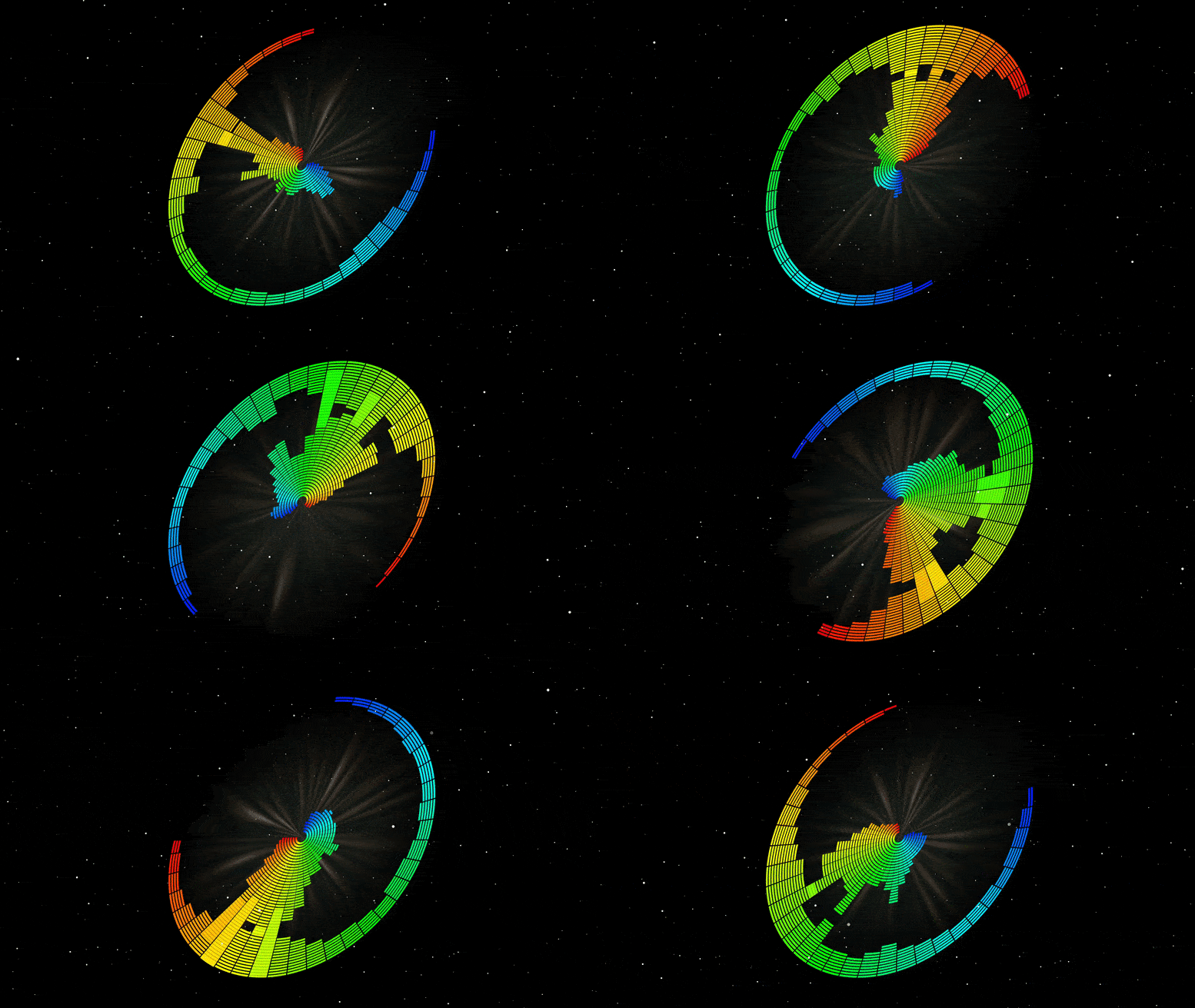
The experiment is the first to demonstrate strong topological order for sound stemming from time modulations, paving the way for improvements in ultrasound imaging, sonar, and electronic systems that use surface acoustic wave technology.
In a breakthrough for physics and engineering, researchers from the Photonics Initiative at the Advanced Science Research Center at The Graduate Center, CUNY (CUNY ASRC), and Georgia Tech have presented the first demonstration of topological order based on time modulations. This advancement allows the researchers to propagate sound waves along the boundaries of topological metamaterials without the risk of waves traveling backward or being thwarted by material defects.
The new findings, which appear in the journal Science Advances, will pave the way for cheaper, lighter devices that use less battery power, and which can function in harsh or hazardous environments. Andrea Alù, founding director of the CUNY ASRC Photonics Initiative and Professor of Physics at The Graduate Center, CUNY, and postdoctoral research associate Xiang Ni were authors on the paper, together with Amir Ardabi and Michael Leamy from Georgia Tech.
The field of topology examines the properties of an object that are not affected by continuous deformations. In a topological insulator, electrical currents can flow along the object’s boundaries, and this flow is resistant to being interrupted by the object’s imperfections. Recent progress in the field of metamaterials has extended these features to control the propagation of sound and light following similar principles.
In particular, previous work from the labs of Alù and City College of New York Physics Professor Alexander Khanikaev used geometrical asymmetries to create topological order in 3D-printed acoustic metamaterials. In these objects, sound waves were shown to be confined to travel along the object’s edges and around sharp corners, but with a significant drawback: These waves weren’t fully constrained — they could travel either forward or backward with the same properties. This effect inherently limited the overall robustness of this approach to topological order for sound. Certain types of disorder or imperfections would indeed reflect backward the sound propagating along the boundaries of the object.
This latest experiment overcomes this challenge, showing that time-reversal symmetry breaking, rather than geometrical asymmetries, can be also used to induce topological order. Using this method, sound propagation becomes truly unidirectional, and strongly robust to disorder and imperfections
“The result is a breakthrough for topological physics, as we have been able to show topological order emerging from time variations, which is different, and more advantageous, than the large body of work on topological acoustics based on geometrical asymmetries,” Alù said. “Previous approaches inherently required the presence of a backward channel through which sound could be reflected, which inherently limited their topological protection. With time modulations we can suppress backward propagation and provide strong topological protection.”
The researchers designed a device made of an array of circular piezoelectric resonators arranged in repeating hexagons, like a honeycomb lattice, and bonded to a thin disk of polylactic acid. They then connected this to external circuits, which provide a time-modulated signal that breaks time-reversal symmetry.
As a bonus, their design allows for programmability. This means they can guide waves along a variety of different reconfigurable paths, with minimal loss. Ultrasound imaging, sonar, and electronic systems that use surface acoustic wave technology could all benefit from this advance, Alù said.
Reference: “Reconfigurable Floquet elastodynamic topological insulator based on synthetic angular momentum bias” by Amir Darabi, Xiang Ni, Michael Leamy and Andrea Alù, 17 July 2020, Science Advances.
DOI: 10.1126/sciadv.aba8656
Never miss a breakthrough: Join the SciTechDaily newsletter.
Follow us on Google and Google News.
4 Comments
Why isn’t there a link to the paper? come on…
Sorry about that. The article has been updated to include a link to the paper at the end.
What is the title of the paper?
The citation was overlooked, but now there is a link to the Science Advances paper at the end of the article. It is entitled “Reconfigurable Floquet elastodynamic topological insulator based on synthetic angular momentum bias.”