
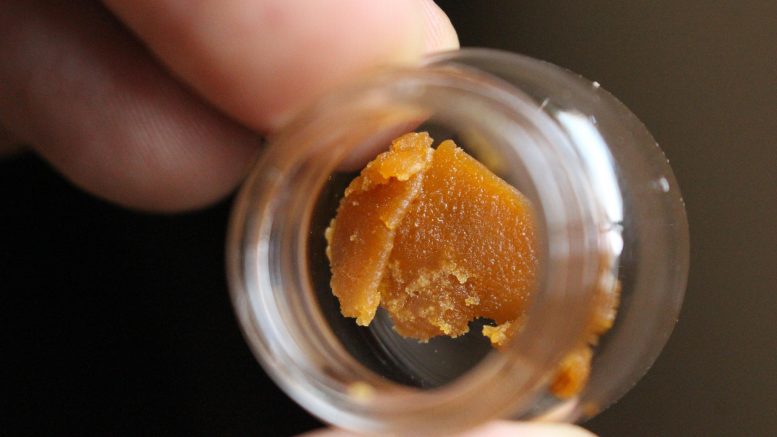
Smoking high-potency marijuana concentrates boosts blood levels of THC more than twice as much as smoking conventional weed, but it doesn’t necessarily get you higher, according to a new study of regular users published today by University of Colorado Boulder researchers.
“Surprisingly, we found that potency did not track with intoxication levels,” said lead author Cinnamon Bidwell, an assistant professor in the Institute of Cognitive Science. “While we saw striking differences in blood levels between the two groups, they were similarly impaired.”
The paper, published June 10 in JAMA Psychiatry, is the first to assess the acute impact of cannabis among real-world users of legal market products. It could inform everything from roadside sobriety tests to decisions about personal recreational or medicinal use.
But the study also raises concerns that using concentrates could unnecessarily put people at greater long-term risk of side effects.
“It raises a lot of questions about how quickly the body builds up tolerance to cannabis and whether people might be able to achieve desired results at lower doses,” said Bidwell.
While 33 states have legalized medicinal marijuana use, and 11 have legalized recreational use, both uses remain illegal at the federal level. Researchers are also prohibited from handling or administering marijuana. Some previous studies have used strains supplied by the government, but those strains contain far less THC than real-world products.
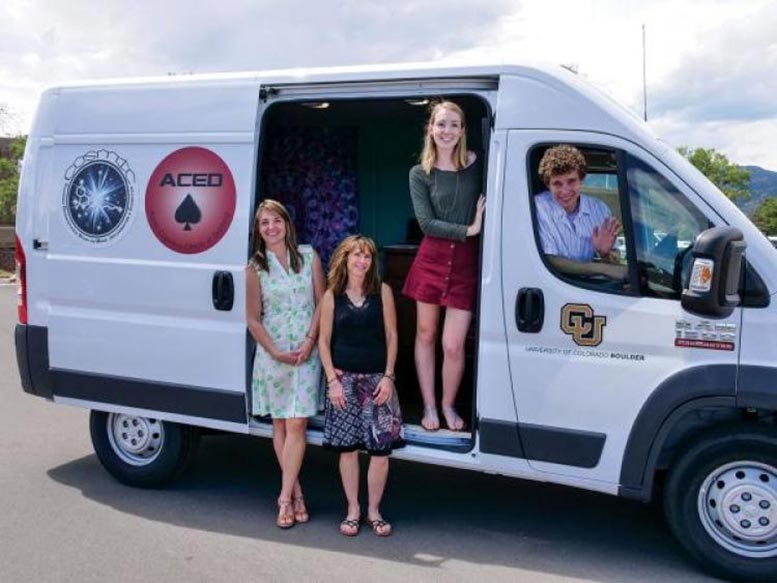
In order to study what people really use, Bidwell and her colleagues utilize two white Dodge Sprinter vans, also known as the “cannavans,” as mobile laboratories. They drive the vans to the residences of study subjects who use cannabis they purchase on their own inside their homes and then walk out for tests.
“We cannot bring legal market cannabis into a university lab, but we can bring the mobile lab to the people,” she said.
For the current study, the team assessed 121 regular cannabis users. Half typically used concentrates (oils and waxes that include the active ingredients without the leaves and stems). The other half typically used flower from the plant. Flower users purchased a product containing either 16% or 24% [tetrahydrocannabinol (THC)], the main psychoactive ingredient in marijuana. Concentrate users were assigned to a product containing either 70% or 90% THC.
On test day, researchers drew the subjects’ blood, measured their mood and intoxication level and assessed their cognitive function and balance at three time points: before, directly after, and one hour after they used.
Those who used concentrates had much higher THC levels at all three points, with levels spiking to 1,016 micrograms per milliliter in the few minutes after use, while flower users spiked at 455 micrograms per milliliter. (Previous studies have shown that THC levels hover around 160 to 380 micrograms per milliliter after marijuana use).
Regardless of what type or potency of cannabis participants used, their self-reports of intoxication, or “feeling high,” were remarkably similar, as were their measures of balance and cognitive impairment.
“People in the high concentration group were much less compromised than we thought they were going to be,” said coauthor Kent Hutchison, a professor of psychology and neuroscience at CU Boulder who also studies alcohol addiction. “If we gave people that high a concentration of alcohol it would have been a different story.”
The study also found that, among all users, balance was about 11% worse after using cannabis, and memory was compromised. But within about an hour, that impairment faded.
“This could be used to develop a roadside test, or even to help people make personal decisions,” said Bidwell.
The researchers aren’t sure how the concentrate group could have such high THC levels without greater intoxication, but they suspect a few things are at play: Regular users of concentrates likely develop a tolerance over time. There may be genetic or biological differences that make some people metabolize THC more quickly. And it may be that once compounds in marijuana, called cannabinoids, fill receptors in the brain that spark intoxication, additional cannabinoids have little impact.
“Cannabinoid receptors may become saturated with THC at higher levels, beyond which there is a diminishing effect of additional THC,” they write.
The authors caution that the study examined regular users who have learned to meter their use based on the desired effect, and does not apply to inexperienced users. Those users should still be extremely cautious with concentrates, said Hutchison.
Ultimately, the researchers hope to learn what, if any, long-term health risks concentrates truly pose.
“Does long-term, concentrated exposure mess with your cannabinoid receptors in a way that could have long-term repercussions? Does it make it harder to quit when you want to?” said Hutchison. “We just don’t know yet.”
Reference: “Association of Naturalistic Administration of Cannabis Flower and Concentrates With Intoxication and Impairment” by L. Cinnamon Bidwell, Ph.D.; Jarrod M. Ellingson, Ph.D.; Hollis C. Karoly, Ph.D.; Sophie L. YorkWilliams, MA; Leah N. Hitchcock, Ph.D.; Brian L. Tracy, Ph.D.; Jost Klawitter, Ph.D.; Cristina Sempio, Ph.D.; Angela D. Bryan, Ph.D. and Kent E. Hutchison, Ph.D., 10 Juen 2020, .
DOI:
Never miss a breakthrough: Join the SciTechDaily newsletter.
Follow us on Google and Google News.
4 Comments
Quote (emphasis added):
“measured their mood and inTOXICation level”
Quote (emphasis added):
“fill receptors in the brain that spark inTOXICation”
Alcohol is a toxin, i.e. poison. The Magic Green Healing Herb is NOT.
It is not clear in this article whether the word “intoxication” and the concept it refers to is used by the researchers, but if it is, their bias and mis-understanding deeply affect the basis their research, as in the following quote:
““People in the high concentration group were much less compromised than we thought they were going to be,” said coauthor Kent Hutchison, a professor of psychology and neuroscience at CU Boulder who also studies alcohol addiction. “If we gave people that high a concentration of alcohol it would have been a different story.””
The above quote and the one below also demonstrates that the “researchers” don’t have a clue to start out with regarding what they are dealing with:
“The researchers aren’t sure how the concentrate group could have such high THC levels without greater intoxication, but they suspect a few things are at play: …..”
Ah, duh, it IS called tolerance. Those folks who quit smoking/consuming this Magic Green Herb for a few weeks will find they only need a teeny tiny smidgen to have the same effect as when they were smoking multiple “fat joints” at a time…just ask any regular user.
If the author/publisher of this article introduced the word “intoxication”, they have no business writing a science article.
The sinister people who have been demonizing this herb to have an excuse to criminalize and jail Black People who’s LIVES DO MATTER since the end of the prohibition of alcohol (a very sick drug), and then later to criminalize and jail Vietnam War Protesters, but also to end the use of hemp fiber so Nylon could take over, so paper is made from the old growth trees from forests that have been clearcut, so vehicles run on petroleum that takes large industries that are controlled by a small group of people instead of hemp oil that would empower framers worldwide, etc., etc., have >>>>>brainwashed<<<<< the public into comparing the two. Alcohol and the Magic Green Herb have virtually nothing in common.
P.S. I have never had my balance affected, even when "blasted" after smoking cigar sized "joints" (something I did as a teen in the 1980s, and never find interesting now)
Whoops, typo (and no edit):
“hemp oil that would empower framers”
should be “farmers,” not “framers”
….
and NO, I have smoked Nothing. I just type poorly.
“Free the people” right on brotha right on.
proud of having left the west , truely the lowest culture in the world specially to grow up childrens