
Quantum mechanics and the general theory of relativity form the bedrock of the current understanding of physics — yet the two theories don’t seem to work together. Physical phenomena rely on the relationship of motion between the observed and the observer. Certain rules hold true across types of observed objects and those observing, but those rules tend to breakdown at the quantum level, where subatomic particles behave in strange ways.
An international team of researchers developed a unified framework that would account for this apparent break down between classical and quantum physics, and they put it to the test using a quantum satellite called Micius. They published their results ruling out one version of their theory on September 19th, 2019, in Science.
Micius is part of a Chinese research project called Quantum Experiments at Space Scale (QUESS), in which researchers can examine the relationship between quantum and classical physics using light experiments. In this study, the researchers used the satellite to produce and measure two entangled particles.
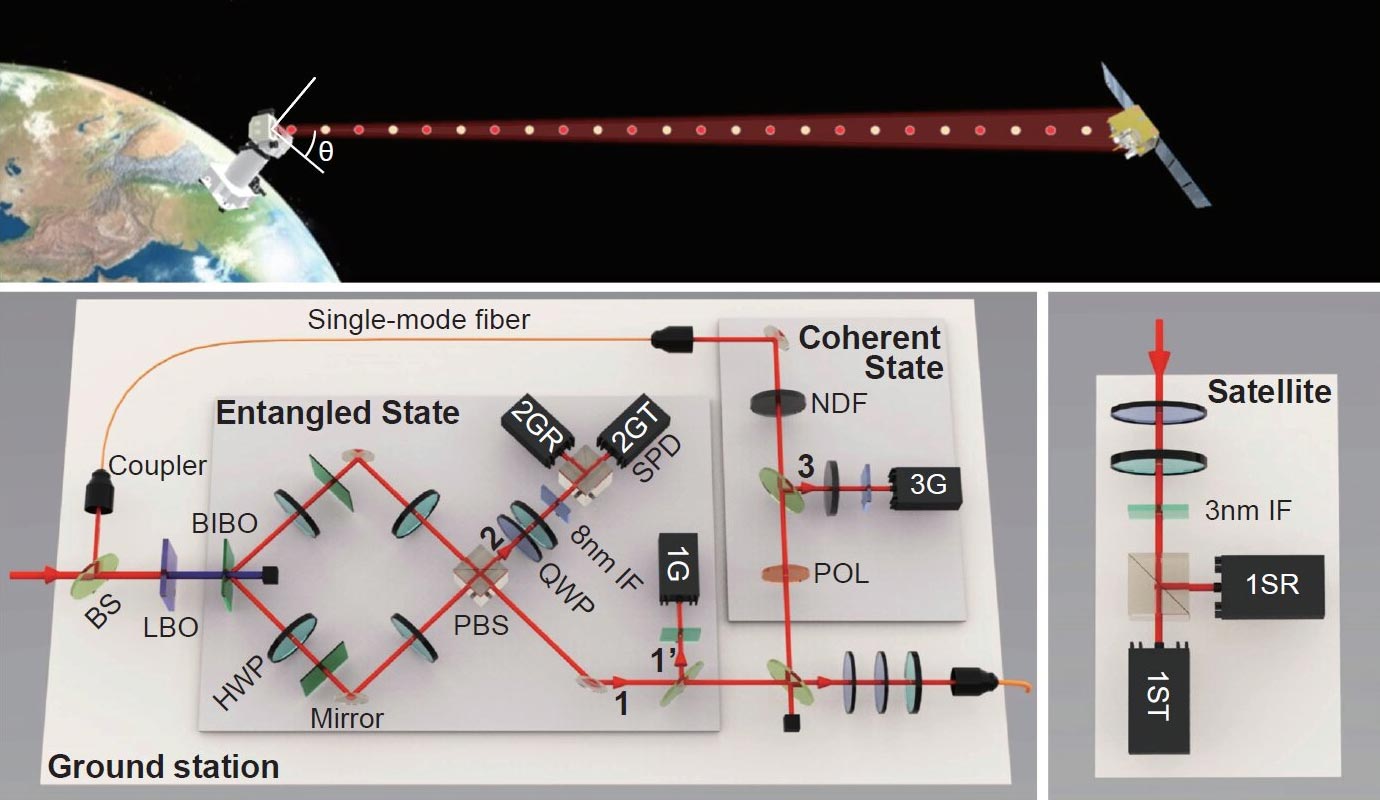
Thanks to the advanced technologies made available by Micius, for the first time in human history, we managed to perform a meaningful quantum optical experiment testing the fundamental physics between quantum theory and gravity, said Jian-Wei Pan, paper author and director of the CAS Center for Excellence in Quantum Information and Quantum Physics at the University of Science and Technology of China.
The theory Pan and the team tested was that the particles would decorrelate from one another as they passed through separate gravitational regions of Earth. The different gravitational pulls would force a quantum interaction that behaved as classical relativism would – the particle in less gravity would move with less constraint than the one in stronger gravity.
According to Pan, this event formalism attempts to present a coherent description of quantum fields as they exist in exotic spacetime, which contains closed time-like curves, and ordinary spacetime. Event formalism standardized behavior across quantum and classical physics.
If we did observe the deviation, it would mean that event formalism is correct, and we must substantially revise our understanding of the interplay between quantum theory and gravity theory, Pan said. However, in our experiment, we ruled out the strong version of event formalism, but there are other versions to test.
The researchers did not see the particles deviate from the expected interactions predicted by the quantum understanding of gravity, but they plan to test a version of their theory that allows for a little more flexibility.
We ruled out the strong version of event formalism, but a modified model remains an open question, Pan said.
To test this version, Pan and the team will launch a new satellite that will orbit 20 to 60 times higher than Micius to test a wider field of gravity strength.
###
Other authors include Ping Xu, Ji-Gang Ren, Hai-Lin Yong, Sheng-Kai Liao, Juan Yin, Wei-Yue Liu, Wen-Qi Cai, Xuan Han, Hui-Nan Wu, Wei-Yang Wang, Feng-Zhi Li, Meng Yang, Li Li, Nai-Le Liu, Yu-Ao Chen, Chao-Yang Lu, Jingyun Fan and Cheng-Zhi Peng, all of whom are affiliated with the Hefei National Laboratory for Physical Sciences at Microscale and Department of Modern Physics at the University of Science and Technology of China and the Chinese Academy of Science Center for Excellence and Synergetic Innovation Center in Quantum Information and Quantum Physics, also at the University of Science and Technology of China. Yiqiu Ma and Yanbei Chen, both of Theoretical Astrophysics at the California Institute of Technology, Timothy C. Ralph of the Center for Quantum Computation and Communication Technology at the School of Mathematics and Physics at The University of Queensland and Feng-Li Lin of the Department of Physics of the National Taiwan Normal University also contributed.
This work was supported by the Strategic Priority Research Program on Space Science of the Chinese Academy of Sciences and the National Natural Science Foundation of China.
Reference: “Satellite testing of a gravitationally induced quantum decoherence model” by Ping Xu, Yiqiu Ma, Ji-Gang Ren, Hai-Lin Yong, Timothy C. Ralph, Sheng-Kai Liao, Juan Yin, Wei-Yue Liu, Wen-Qi Cai, Xuan Han, Hui-Nan Wu, Wei-Yang Wang, Feng-Zhi Li, Meng Yang, Feng-Li Lin, Li Li, Nai-Le Liu, Yu-Ao Chen, Chao-Yang Lu, Yanbei Chen, Jingyun Fan, Cheng-Zhi Peng and Jian-Wei Pan, 19 September 2019, Science.
DOI: 10.1126/science.aay5820
Never miss a breakthrough: Join the SciTechDaily newsletter.
Follow us on Google and Google News.