
Physicists theorize a novel way to explore the nature of dark matter with lasers.
Dark matter is only known by its effect on massive astronomical bodies, but has yet to be directly observed or even identified. A theory about what dark matter might be suggests that it could be a particle called an axion and that these could be detectable with laser-based experiments that already exist. These laser experiments are gravitational-wave observatories.
The hunt is on for dark matter. There are many theories as to what manner of thing it might turn out to be, but many physicists believe dark matter is a weakly interacting massive particle, or WIMP. What this means is that it does not interact easily with ordinary matter. We know this to be true because it hasn’t been seen directly yet. But it must also have at least some mass as its presence can be inferred by its gravitational attraction.
There have been enormous efforts to detect WIMP dark matter, including with the Large Hadron Collider in Switzerland, but WIMPs haven’t been observed yet. An alternative candidate particle gaining attention is the axion.
“We assume the axion is very light and barely interacts with our familiar kinds of matter. Therefore, it is considered a good candidate for dark matter,” said Assistant Professor Yuta Michimura from the Department of Physics at the University of Tokyo. “We don’t know the mass of axions, but we usually think it has a mass less than that of electrons. Our universe is filled with dark matter and it’s estimated there are 500 grams of dark matter within the Earth, about the mass of a squirrel.”
Axions seem like a good candidate for dark matter, but since they may only interact very weakly with ordinary matter, they are extraordinarily difficult to detect. So physicists devise increasingly intricate ways to compensate for this lack of interaction in the hope of revealing the telltale signature of dark matter, which makes up over a quarter of the visible universe.
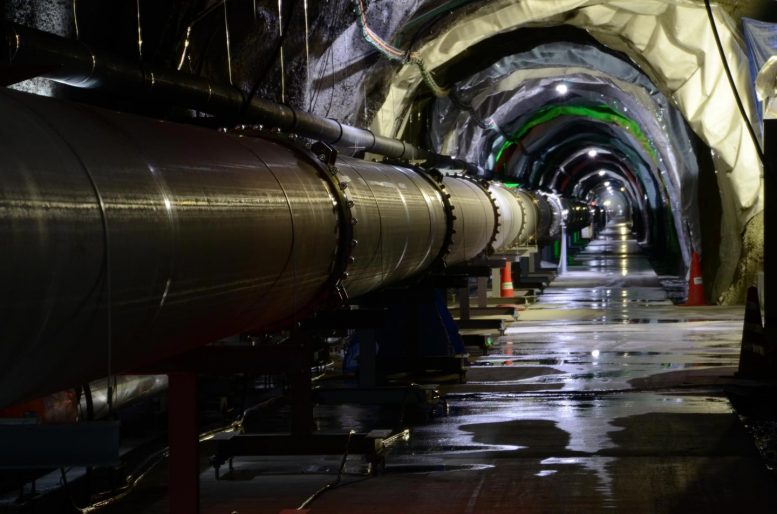
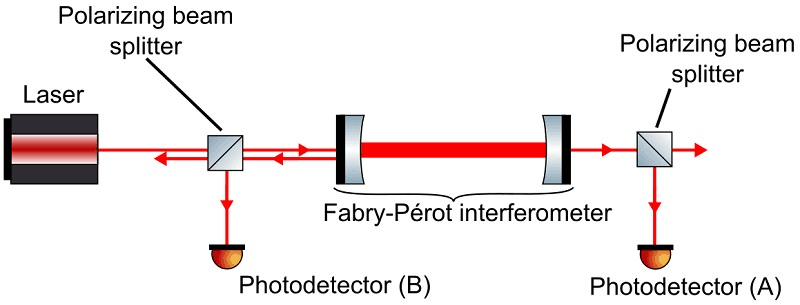
“Our models suggest axion dark matter modulates light polarization, which is the orientation of the oscillation of electromagnetic waves,” explained Koji Nagano, a graduate student at the Institute for Cosmic Ray Research at the University of Tokyo. “This polarization modulation can be enhanced if the light is reflected back and forth many times in an optical cavity composed of two parallel mirrors apart from each other. The best-known examples of these kinds of cavities are the long tunnel arms of gravitational-wave observatories.”
Dark matter research does not get as much attention or funding as other more applicable areas of scientific research, so great efforts are made to find ways to make the hunt cost-effective.
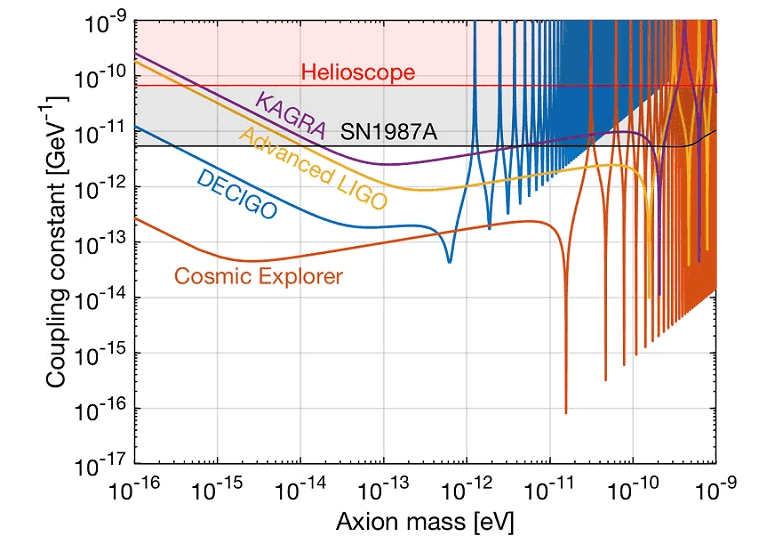
This is relevant as other theoretical ways to observe axions involve extremely strong magnetic fields which incur a great expense. Here, researchers suggest that existing gravitational-wave observatories such as the Laser Interferometer Gravitational-Wave Observatory (LIGO) in the USA, Virgo in Italy, or KAGRA in Japan could be cheaply modified to hunt for axions without detriment to their existing functions.
“With our new scheme, we could search for axions by adding some polarization optics in front of photodiode sensors in gravitational-wave detectors,” described Michimura. “The next step I would like to see is the implementation of optics to a gravitational-wave detector like KAGRA.”
“There is overwhelming astrophysical and cosmological evidence that dark matter exists, but the question ‘What is dark matter?’ is one of the biggest outstanding problems in modern physics.” — Koji Nagano
This idea has promise because the upgrades to the gravitational-wave facilities would not reduce the sensitivity they rely on for their primary function, which is to detect distant gravitational waves. Attempts have been made with experiments and observations to find the axion, but thus far no positive signal has been found. The researchers’ proposed method would be far more precise.
“There is overwhelming astrophysical and cosmological evidence that dark matter exists, but the question ‘What is dark matter?’ is one of the biggest outstanding problems in modern physics,” said Nagano. “If we can detect axions and say for sure they are dark matter, it would be a truly exciting event indeed. It’s what physicists like us dream for.”
Reference: “Axion Dark Matter Search with Interferometric Gravitational Wave Detectors” by Koji Nagano, Tomohiro Fujita, Yuta Michimura and Ippei Obata, 13 September 2019, Physical Review Letters.
DOI: 10.1103/PhysRevLett.123.111301
Never miss a breakthrough: Join the SciTechDaily newsletter.
Follow us on Google and Google News.
10 Comments
No need for dark matter Dark matter was like the cartoon story of two scams who sewed invisible, lighter-than-air clothing for a naive king.
If you look closely at the nature of gravity in the theory of relativity, you will notice that the gravity factor becomes independent of its source of production, and if the target body gets closer to it, it receives more gravitational force, which means by moving two objects. , The backward object receives more force, which by simply inserting it into Newton’s gravity equation, is enough to convert the apparent distance between two moving objects to the true distance, thus expressing the new equation by departing from The center of the galaxy is accelerated so that the gravity between the objects increases, which is the result of the theory of gravity. It is a movement, and of course it can answer many of the questions and ambiguities in cosmology:
Predicting the future of the cosmic structure based on kinetic gravity theory
Explaining why Mercury partially deviates from its orbit based on the theory of kinetic gravity
Full explanation of the nature of dark energy based on kinetic gravity theory
Introducing three main structures for galaxy stability based on kinetic gravity theory
Predicting the automatic rotation of galaxies based on kinetic gravity theory
See the following blog for more information
https://motiongravity.blogsky.com
Dark matter is a supersolid that fills ’empty’ space, strongly interacts with ordinary matter and is displaced by ordinary matter. What is referred to geometrically as curved spacetime physically exists in nature as the state of displacement of the supersolid dark matter. The state of displacement of the supersolid dark matter is gravity.
The supersolid dark matter displaced by a galaxy pushes back, causing the stars in the outer arms of the galaxy to orbit the galactic center at the rate in which they do.
Displaced dark matter is curved spacetime.
Yes. A crystal solid composed of Higgs charge. From which everything is made.
That the Earth moves through and displaces. Which pushes back and exerts pressure toward the Earth, causing gravity.
That particles of ordinary matter move through and displace, causing it to wave. Which is what waves in wave-particle duality.
That galaxy cluster collisions cause to ripple and what waves in a double-slit experiment, relating general relativity and quantum mechanics.
Evaporated water molecules
Actually dark matter is everywhere and has been used by human beings for more than a hundred years already because it is the medium to deliver all electromagnetic forces and convey all electromagnetic waves including light, which is the direct conclusion from the disproof of special relativity (see peer-reviewed published papers available free of charge at: https://www.researchgate.net/publication/297527784_Challenge_to_the_Special_Theory_of_Relativity and https://www.researchgate.net/publication/297528348_Clock_Time_Is_Absolute_and_Universal ).
There has been evidence of dark matter since the early 1700’s when the first double-slit experiment was performed as it is the dark matter that waves.
Wave-particle duality is a moving particle *and* its associated wave in the dark matter.
In the following video the vibrating silicon substrate represents the chaotic dark matter. In the video, in the double-slit experiment example, the particle travels through a single slit and the associated wave passes through both.
‘Yves Couder . Explains Wave/Particle Duality via Silicon Droplets [Through the Wormhole]’
https://youtu.be/W9yWv5dqSKk
In a double-slit experiment the particle always travels through a single slit and the associated wave in the dark matter passes through both. As the wave exits the slits it creates wave interference which alters the direction the particle travels as it exits a single slit. Over time the particles form an interference pattern. Strongly detecting the particle exiting a single slit destroys the cohesion between the particle and its associated wave, the particle continues on the trajectory it was traveling and does not form an interference pattern.
Yes, it’s dark matter’s (i.e. aether’s) wave that is shown in the particle-wave duality because all particles are bathed in aether and any motion of a particle is accompanied by the wave of aether.
+1
my friend, mike is vary interested in a new form of energy using dark matter lasers