
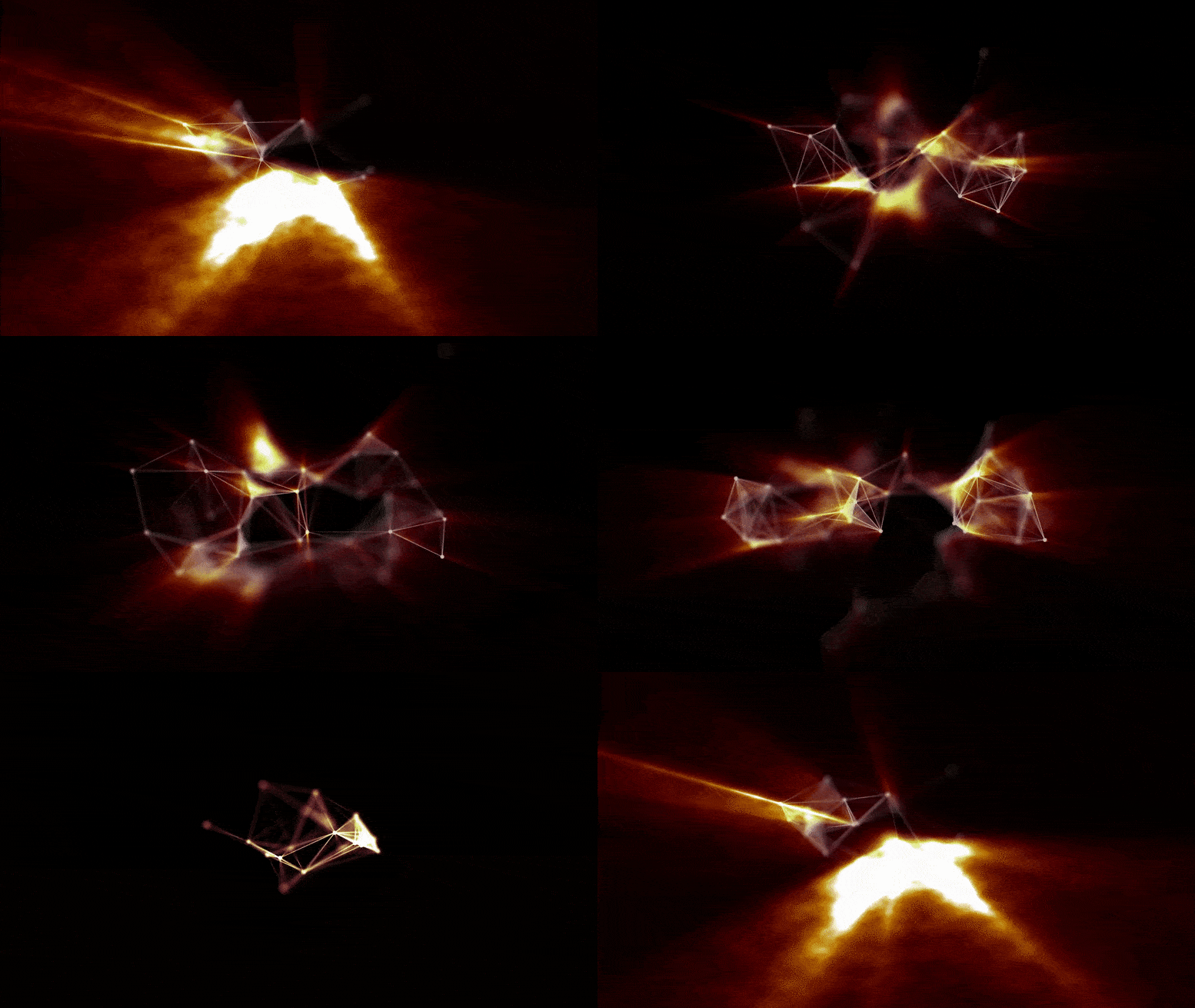
New research findings from the IAS, University of Michigan, and UC Berkeley.
In a new study of axion motion, researchers propose a scenario known as “kinetic misalignment” that greatly strengthens the case for axion/dark matter equivalence. The novel concept answers key questions related to the origins of dark matter and provides new avenues for ongoing detection efforts. This work, published in Physical Review Letters, was conducted by researchers at the Institute for Advanced Study, University of Michigan, and UC Berkeley.
The existence of dark matter has been confirmed by several independent observations, but its true identity remains a mystery. According to this study, axion velocity provides a key insight into the dark matter puzzle. Previous research efforts have successfully accounted for the abundance of dark matter in the universe; however certain factors, such as the underproduction of axions with stronger ordinary matter interactions, remained unexplored.
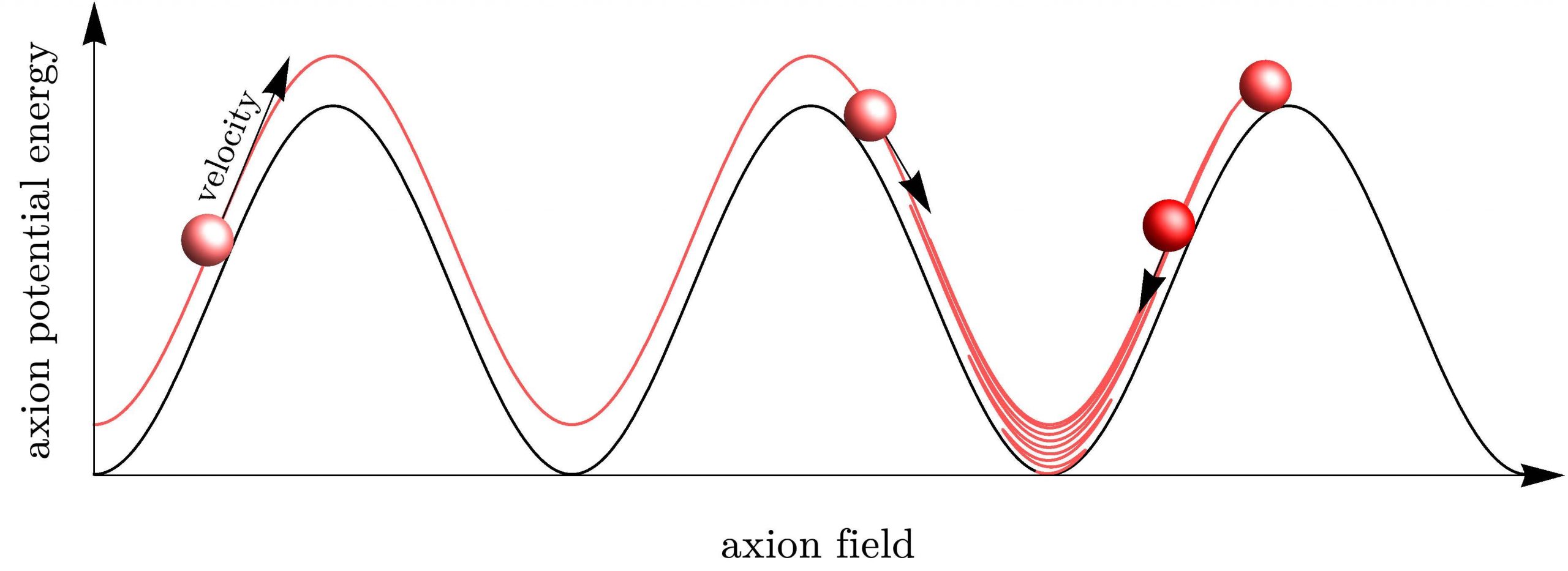
By assigning a nonzero initial velocity to the axion field, the team discovered a mechanism—termed kinetic misalignment—producing far more axions in the early universe than conventional mechanisms. The motion, generated by breaking of the axion shift symmetry, significantly modifies the conventional computation of the axion dark matter abundance. Additionally, these dynamics allow axion dark matter to react more strongly with ordinary matter, exceeding the prediction of the conventional misalignment mechanism.
“The extensive literature on the axion was built upon the assumption that the axion field is initially static in the early universe,” stated Keisuke Harigaya of the Institute for Advanced Study. “Instead, we discovered that the axion field may be initially dynamic as a consequence of theories of quantum gravity with axions.”
Two members of the research team, Keisuke Harigaya and Raymond Co, previously explored the concept of axion dynamics in the study “Axiogenesis,” which explained how the excess of matter over antimatter could be due to a nonzero initial velocity of the QCD axion field. This study also provided a framework for generating new insights into the questions surrounding dark matter.
“This new kinetic misalignment mechanism predicts an axion with a larger interaction strength and may be discovered in planned experimental searches,” stated Raymond Co of the University of Michigan. “Our discovery of new axion dynamics thus opens up unexplored research avenues for theoretical and experimental particle physics and cosmology.”
To date, the axion has proven incredibly versatile. The particle was originally proposed to solve the mystery of why neutrons do not interact with an electric field despite having charged constituents. Former IAS Professor Frank Wilczek, who coined the term axion, published his landmark findings in 1978 in Physical Review Letters while a Member of the Institute for Advanced Study’s School of Natural Sciences.
Reference: “Axion Kinetic Misalignment Mechanism” by Raymond T. Co, Lawrence J. Hall and Keisuke Harigaya, 26 June 2020, Physical Review Letters.
DOI: 10.1103/PhysRevLett.124.251802
Never miss a breakthrough: Join the SciTechDaily newsletter.
Follow us on Google and Google News.
5 Comments
The existence of dark matter hasn’t been proved yet. It’s just one of several competing hypotheses.
The axion is still a theoretical concept, with this view of it making it more suitable as the mysterious Dark Matter.
Another possibility, from a view of String Theory, is that Dark Matter appears to us as an effect of string/anti-string annihilations. As you may know, quantum mechanics requires that strings must be formed as pairs in the quantum foam – a string and an anti-string – that immediately annihilate each other. Quantum mechanics also requires both the string and anti-string to be surrounded by “jitters” that reduce their monstrous vibrating energies. What if this jitter remains for a fraction of an instant after their string/anti-string annihilations? This temporary jitter would be seen by us as matter for that instant before it too returns to the foam. That’s why we never see it – the “mass” lasts only for that instant but is repeated over and over and over, all over. Specifics on this can be found in my YouTube at https://www.youtube.com/watch?v=24WyRKT8t4w
What a load of baloney. Gotta keep scammin’ for those CERN bux, I guess.
Is dark matter Einsteintonian spacetime
Don`t say that this is “a study of axion motion”. No one has any idea if axions exist.