
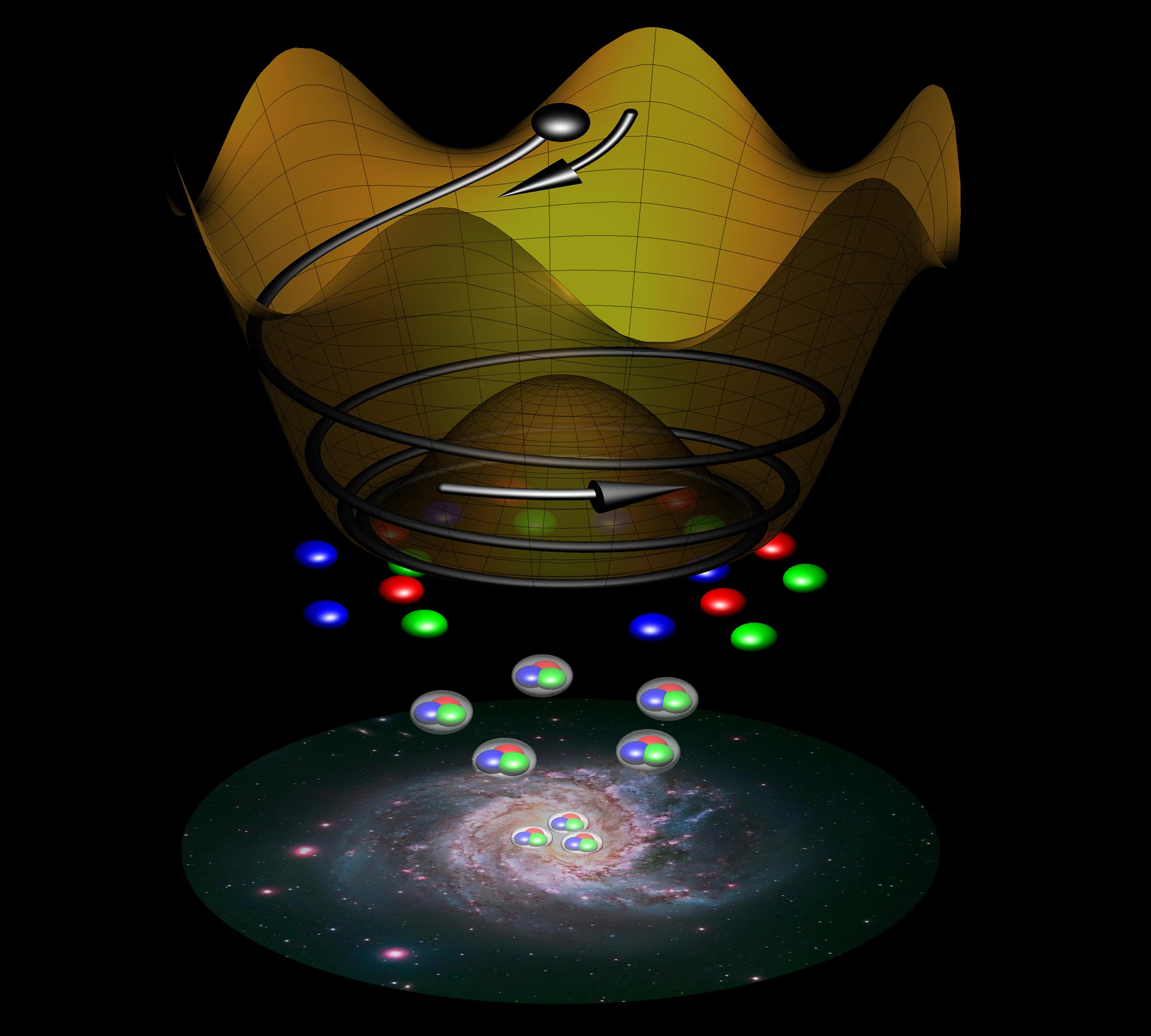
A new study, conducted to better understand the origin of the universe, has provided insight into some of the most enduring questions in fundamental physics: How can the Standard Model of particle physics be extended to explain the cosmological excess of matter over antimatter? What is dark matter? And what is the theoretical origin of an unexpected but observed symmetry in the force that binds protons and neutrons together?
In the paper “Axiogenesis,” scheduled to be published in Physical Review Letters on March 17, 2020, researchers Keisuke Harigaya, Member in the School of Natural Sciences at the Institute for Advanced Study, and Raymond T. Co of the University of Michigan, have presented a compelling case in which the quantum chromodynamics (QCD) axion, first theorized in 1977, provides several important answers to these questions.
“We revealed that the rotation of the QCD axion can account for the excess of matter found in the universe,” stated Harigaya. “We named this mechanism axiogenesis.”
Infinitesimally light, the QCD axion—at least one billion times lighter than a proton—is nearly ghost-like. Millions of these particles pass through ordinary matter every second without notice. However, the subatomic level interaction of the QCD axion can still leave detectable signals in experiments with unprecedented sensitivities. While the QCD axion has never been directly detected, this study provides added fuel for experimentalists to hunt down the elusive particle.
“The versatility of the QCD axion in solving the mysteries of fundamental physics is truly amazing,” stated Co. “We are thrilled about the unexplored theoretical possibilities that this new aspect of the QCD axion can bring. More importantly, experiments may soon tell us whether the mysteries of nature truly hint towards the QCD axion.”
Harigaya and Co have reasoned that the QCD axion is capable of filling three missing pieces of the physics jigsaw puzzle simultaneously. First, the QCD axion was originally proposed to explain the so-called strong CP problem—why the strong force, which binds protons and neutrons together, unexpectedly preserves a symmetry called the Charge Parity (CP) symmetry. The CP symmetry is inferred from the observation that a neutron does not react with an electric field despite its charged constituents. Second, the QCD axion was found to be a good candidate for dark matter, offering what could be a major breakthrough in understanding the composition of approximately 80 percent of the universe’s mass that has never been directly observed. In their work on the early universe, Harigaya and Co have determined that the QCD axion can also explain the matter-antimatter asymmetry problem.
As matter and antimatter particles interact, they are mutually annihilated. In the first fraction of a second following the Big Bang, matter and antimatter existed in equal amounts. This symmetry prevented the predominance of one type of matter over the other. Today, the universe is filled with matter, indicating that this symmetry must have been broken. Harigaya and Co cite the QCD axion as the culprit. Kinetic energy, resulting from the motion of the QCD axion, produced additional baryons or ordinary matter. This slight tipping of the scale in favor of matter would have had a pronounced cascade effect, paving the way for the universe as it is known today.
Greater understanding of the newly discovered dynamics of the QCD axion could potentially change the expansion history of the universe and thus inform the study of gravitational waves. Future work on this topic could also provide further insight into other enduring questions of fundamental physics, such as the origin of the tiny neutrino mass.
“Since theoretical and experimental particle physicists, astrophysicists, and cosmologists began studying the QCD axion, great progress has been made. We hope that our work further advances these interdisciplinary research efforts,” added Harigaya.
Reference: “Axiogenesis” by Raymond T. Co and Keisuke Harigaya, 17 March 2020, Physical Review Letters.
arXiv: 1910.02080
DOI: 10.1103/PhysRevLett.124.111602
The Institute for Advanced Study is one of the world’s foremost centers for theoretical research and intellectual inquiry. Located in Princeton, N.J., the IAS is dedicated to independent study across the sciences and humanities. Founded in 1930 with the motto “Truth and Beauty,” the Institute is devoted to advancing the frontiers of knowledge without concern for immediate application. From founding IAS Professor Albert Einstein to the foremost thinkers of today, the IAS enables bold, nonconformist, field-leading research that provides long-term utility and new technologies, leading to innovation and enrichment of society in unexpected ways.
Each year, the Institute welcomes more than 200 of the world’s most promising researchers and scholars who are selected and mentored by a permanent Faculty, each of whom are preeminent leaders in their fields. Comprised of four Schools—Historical Studies, Mathematics, Natural Sciences, and Social Science—IAS has produced an astounding record of introducing new understanding and is responsible for undeniable progress across disciplines and generations, from the development of one of the first stored-program computers to the establishment of art history as a discipline in the United States. Among its present and past Faculty and Members are 34 Nobel Laureates, 42 of the 60 Fields Medalists, and 18 of the 20 Abel Prize Laureates, as well as many MacArthur Fellows and Wolf Prize winners.
Never miss a breakthrough: Join the SciTechDaily newsletter.
Follow us on Google and Google News.
6 Comments
Really? Oh please. Looks like the Cosmologists (stars no hair) have been doing acid again.
Not acid – it looks like a nice paper as far as modeling goes – but a toy model for axions.
Axions are not strictly necessary, of the three things the new model would explain at the very least matter/antimatter is promised to be solved by neutrino chirality breaking. The experiments are currently at 3 sigma though, so it will take a few years to collect enough neutrino data. That, and inflation, could solve the strong CP problem since, arguably, the observed slow roll inflation is eternal and can explain finetuning such as having only the neutrinos, not the quarks, doing most of the CP breaking.
Dark matter – well, you can as well throw in a sterile neutrino and do acid in the other room (in another particle sector). 😀 At least we know some neutrinos exist.
A toy model with nice, new possible physics should be pointed out.
The more you discover, the more there is to learn. How deep does knowledge go? If you are interested in an outline of how the universe and life evolved, google Herman (Dusty), Rhodes. I just spent the last 30 years studying the origins of the universe by going into the Biblical Hebrew and Greek text of the Bible and also the current events in science (Like this document). The Bible and science tell the same story.
TL;DR: Self promotion, nothing to see here. Worse, promotion of nonsense myths.
In my study, matter and antimatter in the form of atoms, did not exist in the beginning of solid matter. You have to have elementary particles first before you can make an atom. The universe started with an infinite structure composed of the laws of physics. The structure was programed by God the creator to produce elementary particles throughout the universe. From those particles, the first generation quasars formed that spewed both hydrogen and antihydrogen from their jets. Moving apart at close to the speed of light, two different universes formed, one of matter and the other of antimatter. They are still moving apart at close to twice the speed of light.