

The Device Hopes To Answer the Ultimate Existential Questions
The final piece of an all-new detector has completed the first leg of its journey toward unlocking some of the most enduring mysteries of the Universe.
The 41-million-pixel Vertex Locator (VELO) was assembled at the University of Liverpool. It was assembled from components made at different institutes, before it traveled to its home at the Large Hadron Collider beauty (LHCb) experiment at CERN.
Once installed in time for data-taking, it will attempt to answer the following questions:
- Why is the Universe made of matter, not antimatter?
- Why does it exist at all?
- What else is out there?
Development of the new VELO detector was led by the UK, funded by the Science and Technology Facilities Council, and involves the universities of:
- Bristol
- Glasgow
- Liverpool
- Manchester
- Oxford
- Warwick
A Fine Balance at the Dawn of Space and Time
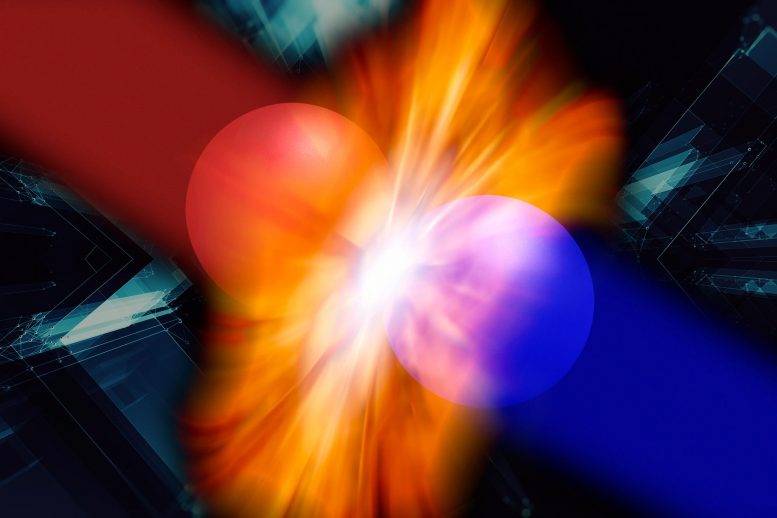
In the moments immediately after the Big Bang, the Universe was caught in a fine balance between matter and antimatter.
From what we understand about the laws of nature, these forms of matter should have annihilated each other and left behind a Universe filled only with light. Yet, against all odds, matter somehow gained the advantage and something was left to form the Universe we know today.
Our best understanding of the physics of the Big Bang tells us that matter and antimatter were created in equal quantities. When they made contact in the (far smaller and far denser) early Universe, all of their combined mass should have been violently transformed into pure energy. Why, and how, matter survived the encounter is one of the most profound mysteries in modern science.
The current theory is that, although matter and antimatter were created as almost perfect mirror images, there must have been some tiny misbalance, or blemish. This meant that some were not perfect reflections. This difference, however tiny, might have been enough to give matter the edge.
Through the Looking Glass
Scientists have already found a small crack in the mirror, called charge-parity (CP) violation. This means that, in some cases, the symmetry of the matter and antimatter reflection becomes broken.
This results in a particle that is not the perfect opposite of its twin, and this ‘broken symmetry’ may mean that one particle could have an advantage over the other.
When this symmetry is broken, an antimatter particle may decay at a different rate than its matter counterpart. If enough of these violations occurred after the Big Bang, it might explain why matter survived.
By behaving differently from their antimatter equivalents, it is possible that matter particles with broken symmetry took just a little bit longer to decay. If this caused matter to stick around just a little bit longer, it could explain how it was the last one standing.

The Deep Unknown
Why matter survived is not the only mystery in the Universe. There is another issue puzzling scientists: what might dark matter be?
Dark matter is an elusive, invisible type of matter that supplies the gravitational glue to keep stars moving around galaxies. Because we do not yet know what dark matter is, it could be that there are other, new particles and forces in the Universe that we have not yet seen.
Discovering anything new could reveal a radically different picture of nature from the one we have. New particles like these could announce themselves by subtly changing the way the particles we can see behave, leaving small but detectable traces in our data.
The Beauty and Charm of VELO
The new VELO detector, which will replace the old VELO detector, will be used to investigate the subtle differences between matter and antimatter versions of particles that contain subatomic particles. These are known as beauty quarks and charm quarks.
These exotic quark-containing particles, also known as B and D mesons, are produced during collisions within the Large Hadron Collider (LHC). They are difficult to study because mesons are very unstable and decay out of existence within a fraction of a fraction of a second.
When they decay, however, they actually transform into something else. Scientists believe that, by studying these different decays and their properties, VELO data will help LHCb to reveal the fundamental forces and symmetries of nature.
Incredibly Precise Measurements
The new VELO detector will sit as close as possible to where the particles collide within the LHCb experiment. These particles decay in less than a millionth of a millionth of a second and travel only a few millimeters. Therefore, this close proximity will give the device the best possible chance of measuring their properties.
VELO’s sensitivity and proximity to the LHC’s beams will allow it to take incredibly precise measurements of the particles as they decay.
By comparing these readings to predictions made by the Standard Model (the guiding theory of particle physics) scientists can look for deviations that might hint at new particles in nature. They can also look for CP violations or other reasons why matter and antimatter behave differently.
These deviations could revolutionize our understanding of why the Universe is what it is.
Building on the Legacy of the Old
The VELO may be brand new and cutting-edge but it will be building on the legacy of the previous VELO detector. The VELO has a state-of-the-art pixel detector made up of grids of tiny squares of silicon that gives high-resolution even in the challenging radiation environment near the LHC beams.
Its predecessor, with its lines of stacked silicon detectors, helped the LHCb make discoveries, including:
- new states of matter
- incredibly rare beauty quark decays
- differences between matter and antimatter charm quarks
- the first intriguing indication of as yet unexplained behavior in beauty quark decay.
Glimpses of Particle Behavior
UK VELO project leader Professor Themis Bowcock, from the University of Liverpool, said:
The data captured by the old VELO detector has given us really tantalising glimpses of particle behaviour.
To make progress, we need to turn this into a really thorough, forensic investigation and this is where the new VELO detector comes in. It gives us the precise set of eyes we need to observe particles at the level of detail we need.
Quite simply, the VELO makes our whole physics programme possible on LHCb.
Unprecedented Detail
New VELO will be able to capture these decays in unprecedented detail.
Couple this with upgraded software and super-fast readout electronics that will allow beauty and charm quarks to be pinpointed in real-time. Scientists will have a device that allows them to track and analyze decays that were previously too difficult to reconstruct.
What also makes the new VELO detector unique is that scientists can lift it out of the way as they prepare the particle beams for collisions. Then, they can move it mechanically into place when LHCb is ready to collect data.
This allows scientists to capture clear information from the first particles that radiate from the collisions without unnecessary wear and tear from the beam.
Never miss a breakthrough: Join the SciTechDaily newsletter.
Follow us on Google and Google News.
1 Comment
thank you