
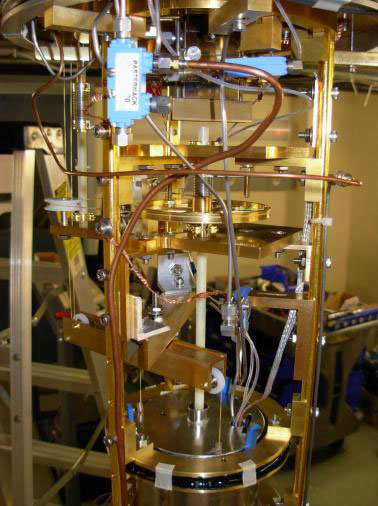
Researchers from Yale University are using a new detection device to search for dark matter in the form of axions, a theorized subatomic particle that may make up as much as 80% of the matter in the universe.
Led by Yale physicist Steve Lamoreaux, a team of scientists announced the first results of the project, called Haloscope At Yale Sensitive To Axion Cold Dark Matter (HAYSTAC). The findings appear in the journal Physical Review Letters.
“The existence of dark matter has been established with a high degree of confidence. However at present nobody knows what it is, and it remains among the outstanding questions of modern science,” said Lamoreaux. “Our work is setting important limits on a leading dark matter theory.”
That theory centers on the axion, a particle that was proposed in the 1980s. Lamoreaux said the axion — which has no charge, no spin, and a miniscule amount of mass — has all of the necessary properties to be a compelling dark matter candidate. The observed dark matter density in our galaxy requires roughly 10 trillion axions per cubic centimeter; however, their direct interactions with ordinary matter are so feeble that their detection requires extremely sensitive experimental techniques.
Using a new instrument built at Yale’s Wright Lab, Lamoreaux, and his colleagues widened the possible parameters for detecting axions. Their study demonstrates the instrument sensitivity required to detect axions that are 10 times heavier than those targeted by previous experiments.
Axion detectors use intense magnetic fields to convert axions into detectable microwave photons at a specific frequency determined by the unknown axion mass. Previous experiments have searched for low-mass axions. Pushing the search to higher masses has been challenging for scientists because it requires high-frequency detectors that are physically smaller, and the signals from axion conversion in such cases is weaker.
“Our major breakthrough was making the detector colder and quieter than ever before, by adapting amplifiers developed for quantum computing research whose noise performance approaches the fundamental limits imposed by the laws of quantum mechanics,” Lamoreaux said. “With the first data from our detector, we have set limits on the interactions of dark matter axions and opened a new portion of the allowed axion mass range to experimental investigation.”
The first author of the paper is Ben Brubaker, a graduate student in the Lamoreaux lab at Yale. Additional Yale co-authors are Ling Zhong, Yulia Gurevich, Sidney Cahn, and Kelly Backes. Other co-authors are from the University of California-Berkeley, the University of Colorado, the National Institute of Standards and Technology, and Lawrence Livermore National Laboratory.
“The axion dark matter experiment at Yale pushes the frontiers of particle astrophysics,” said Karsten Heeger, director of the Wright Laboratory. “It is a shining example of a university-based experiment that uses cutting-edge instrumentation and leverages local infrastructure to address one of the fundamental questions about the universe and train the next generation of scientists. We are excited to have such a world-leading effort here on campus at the Wright Lab.”
The National Science Foundation, the Heising-Simons Foundation, and the U.S. Department of Energy supported the research.
Reference: “First Results from a Microwave Cavity Axion Search at 24 μeV” by B. M. Brubaker, L. Zhong, Y. V. Gurevich, S. B. Cahn, S. K. Lamoreaux, M. Simanovskaia, J. R. Root, S. M. Lewis, S. Al Kenany, K. M. Backes, I. Urdinaran, N. M. Rapidis, T. M. Shokair, K. A. van Bibber, D. A. Palken, M. Malnou, W. F. Kindel, M. A. Anil, K. W. Lehnert and G. Carosi, 9 February 2017, Physical Review Letters.
DOI: 10.1103/PhysRevLett.118.061302
Never miss a breakthrough: Join the SciTechDaily newsletter.
Follow us on Google and Google News.