
Close Menu
    Facebook X (Twitter) Instagram
    SciTechDaily
    • Biology
    • Chemistry
    • Earth
    • Health
    • Physics
    • Science
    • Space
    • Technology
    Facebook X (Twitter) Pinterest YouTube RSS
    SciTechDaily
    Home»Space»Mysterious “Superbubble” Hollows Out Nebula in Stunning New Hubble Image
    Space

    Mysterious “Superbubble” Hollows Out Nebula in Stunning New Hubble Image

    By NASA's Goddard Space Flight CenterNovember 5, 2021No Comments2 Mins Read
    Facebook Twitter Pinterest Telegram LinkedIn WhatsApp Email Reddit
    Share
    Facebook Twitter LinkedIn Pinterest Telegram Email Reddit
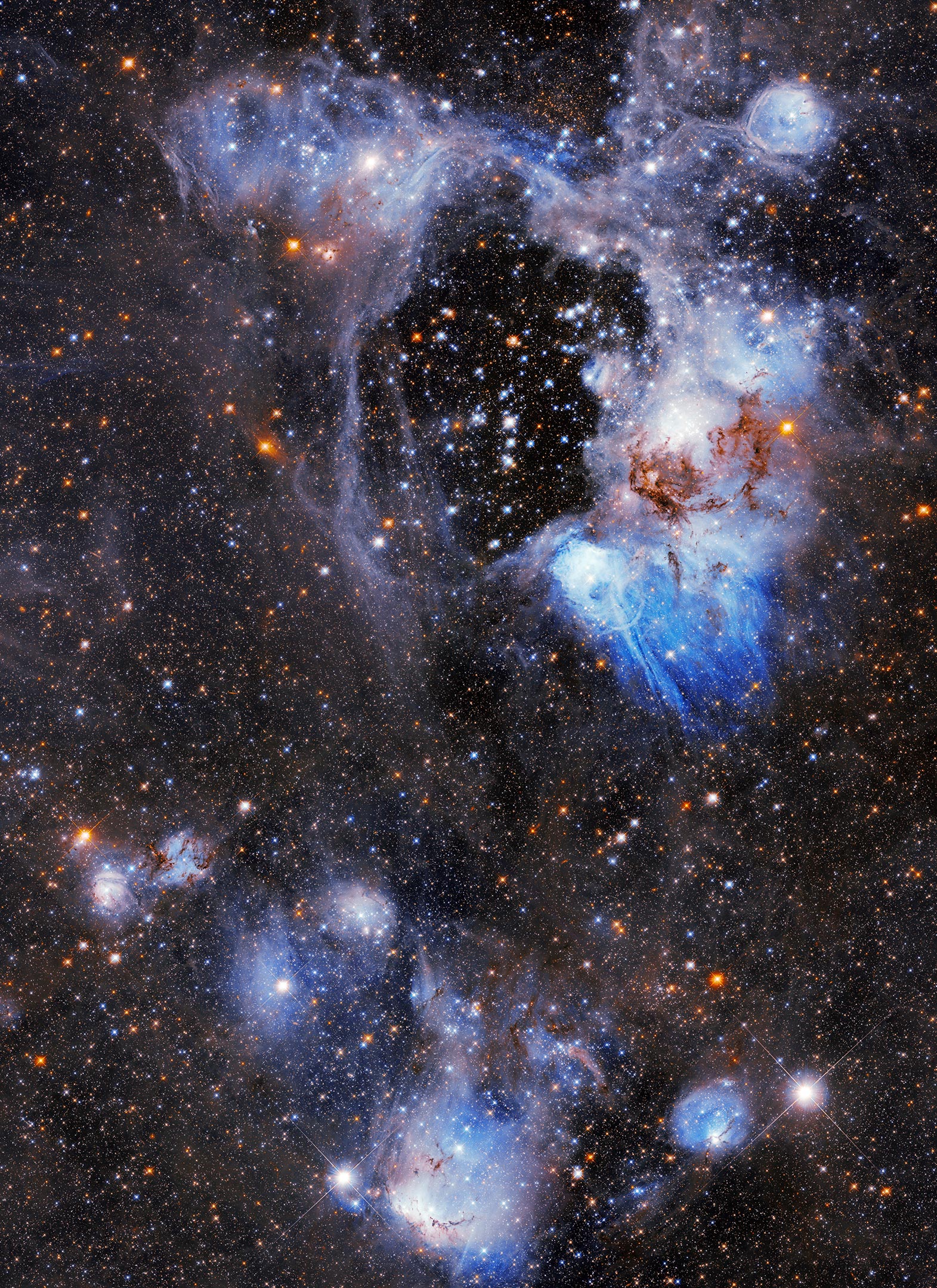
    Complex Nebula N44
    Hubble Space Telescope image of N44, an emission nebula with superbubble structure located in the Large Magellanic Cloud. Credit: NASA, ESA, V. Ksoll and D. Gouliermis (Universität Heidelberg), et al.; Processing: Gladys Kober (NASA/Catholic University of America)

    The nebula N44 in the Large Magellanic Cloud contains stars, dust, and glowing hydrogen gas, highlighted by a 250-light-year-wide “superbubble.” Likely shaped by stellar winds or supernovae, the bubble shows evidence of sequential star formation.

    N44 is a complex nebula filled with glowing hydrogen gas, dark lanes of dust, massive stars, and many populations of stars of different ages. One of its most distinctive features, however, is the dark, starry gap called a “superbubble,” visible in this Hubble Space Telescope image in the upper central region.

    The hole is about 250 light-years wide and its presence is still something of a mystery. Stellar winds expelled by massive stars in the bubble’s interior may have driven away the gas, but this is inconsistent with measured wind velocities in the bubble. Another possibility, since the nebula is filled with massive stars that would expire in titanic explosions, is that the expanding shells of old supernovae sculpted the cosmic cavern.

    Astronomers have found one supernova remnant in the vicinity of the superbubble and identified an approximately 5 million year difference in age between stars within and at the rim of the superbubble, indicating multiple, chain-reaction star-forming events. The deep blue area at about 5 o’clock around the superbubble is one of the hottest regions of the nebula and the area of the most intense star formation.

    N44 is an emission nebula, which means its gas has been energized, or ionized, by the radiation of nearby stars. As the ionized gas begins to cool from its higher-energy state to a lower-energy state, it emits energy in the form of light, causing the nebula to glow. Located in the Large Magellanic Cloud, N44 spans about 1,000 light-years and is about 170,000 light-years away from Earth.

    Never miss a breakthrough: Join the SciTechDaily newsletter.
    Follow us on Google and Google News.

    Astronomy Astrophysics NASA NASA Goddard Space Flight Center Popular
    Share. Facebook Twitter Pinterest LinkedIn Email Reddit

    Related Articles

    Cyclones in Space? See How Hubble Uncovered Extreme Weather on a Distant Planet

    XRISM Unveils the Invisible: A New Era in X-Ray Astronomy

    Cosmic Cinema: NASA Unveils Stunning 14-Year Time-Lapse of the Gamma-Ray Sky

    NASA’s Webb Telescope Discovers Record-Breaking Miniature Brown Dwarf

    Hidden Wonders: Webb Space Telescope Detects Unexplained Structures in Heart of Milky Way

    Webb’s Window Into Cosmic Birth: Ice Pebble Drift Sparks Planetary Life

    Galactic Collision Captured in Stunning Detail: NASA’s Webb & Hubble Unite To Create Most Colorful View of Universe

    Cosmic Alchemy: Webb’s First Glimpse Into Heavy Element Creation

    Microlensing Magic: How NASA’s Roman Telescope Will Illuminate the Milky Way’s Mysteries

    Leave A Reply Cancel Reply

    • Facebook
    • Twitter
    • Pinterest
    • YouTube

    Don't Miss a Discovery

    Subscribe for the Latest in Science & Tech!

    Trending News

    289-Million-Year-Old Reptile Mummy Reveals Origin of Human Breathing System

    New Brain Discovery Challenges Long-Held Theory of Teenage Brain Development

    Scientists Discover Plants “Scream” – We Just Couldn’t Hear Them Until Now

    Scientists Discover a Surprising Reason Intermittent Fasting Extends Life

    This Simple Fruit Wash Could Make Produce Safer and Last Days Longer

    Scientists Say Adding This Unusual Seafood to Your Diet Could Reverse Signs of Aging

    Scientists Say a Hidden Structure May Exist Inside Earth’s Core

    Doctors Surprised by the Power of a Simple Drug Against Colon Cancer

    Follow SciTechDaily
    • Facebook
    • Twitter
    • YouTube
    • Pinterest
    • Newsletter
    • RSS
    SciTech News
    • Biology News
    • Chemistry News
    • Earth News
    • Health News
    • Physics News
    • Science News
    • Space News
    • Technology News
    Recent Posts
    • Nearly 1 in 5 Gray Whales That Enter San Francisco Bay Die There
    • The Ozone Layer Is Healing, But There’s a Hidden Catch
    • Earth’s Crust Is Tearing Open in Africa, and It Could Form a New Ocean
    • Breakthrough Bowel Cancer Trial Leaves Patients Cancer-Free for Nearly 3 Years
    • New Immune Pathway Could Supercharge mRNA Cancer Vaccines
    Copyright © 1998 - 2026 SciTechDaily. All Rights Reserved.
    • Science News
    • About
    • Contact
    • Editorial Board
    • Privacy Policy
    • Terms of Use

    Type above and press Enter to search. Press Esc to cancel.