
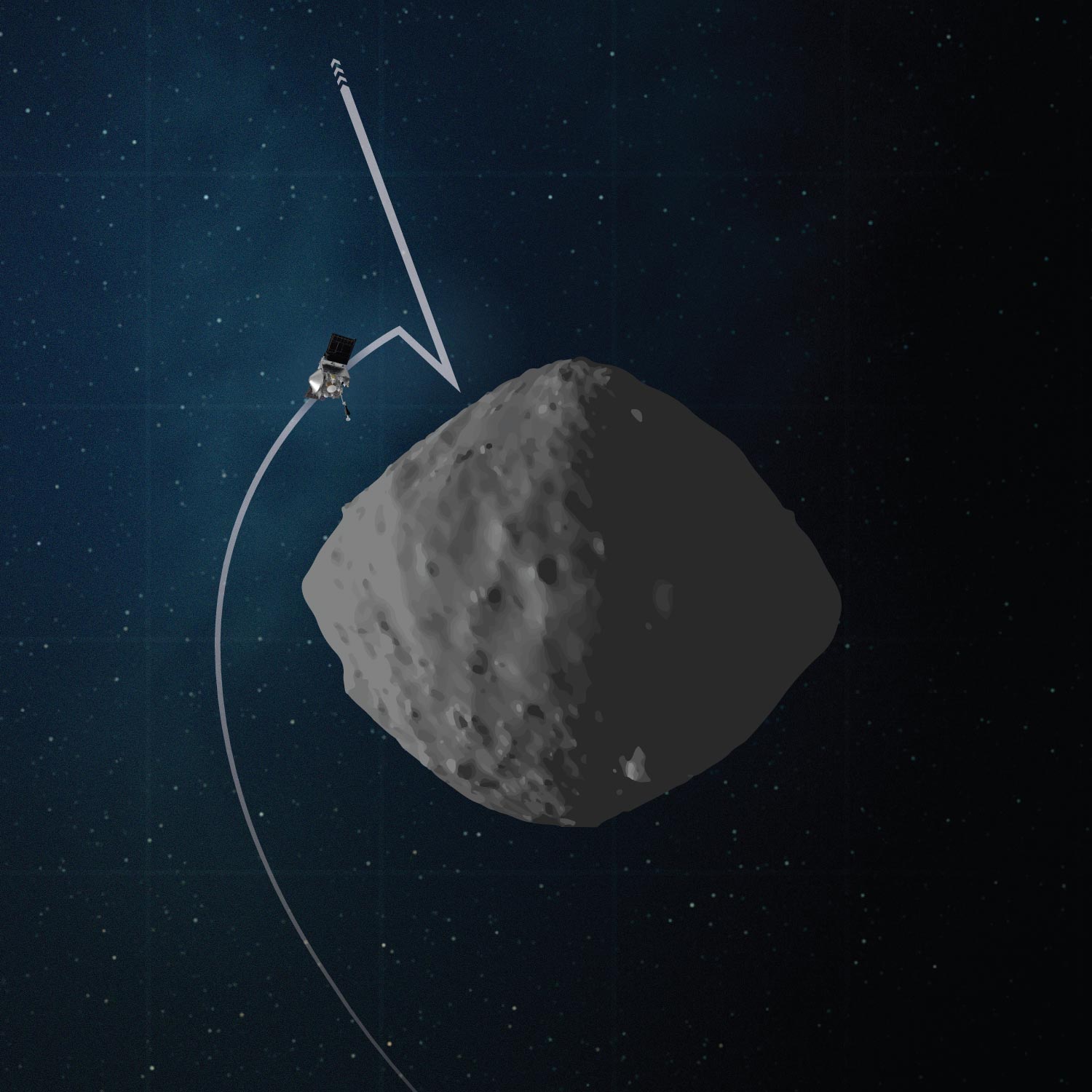
After the successful completion of its “Checkpoint” rehearsal, NASA’s first asteroid-sampling spacecraft is one step closer to touching down on asteroid Bennu. On April 14, NASA’s OSIRIS-REx spacecraft performed the first practice run of its sample collection sequence, reaching an approximate altitude of 246 feet (75 meters) over site Nightingale before executing a back-away burn from the asteroid. Nightingale, OSIRIS-REx’s primary sample collection site, is located within a crater in Bennu’s northern hemisphere.
The four-hour Checkpoint rehearsal took the spacecraft through the first two of the sampling sequence’s four maneuvers: the orbit departure burn and the Checkpoint burn. Checkpoint is so named because it is the location where the spacecraft autonomously checks its position and velocity before adjusting its trajectory down toward the location of the event’s third maneuver.
This series of images, captured on April 14 during the first rehearsal of the OSIRIS-REx mission’s sample collection event, shows the SamCam instrument’s field of view as the spacecraft approaches and moves away from asteroid Bennu’s surface. The rehearsal brought the spacecraft through the first two maneuvers of the sampling event to a point approximately 213 feet (65 meters) above the surface, before backing the spacecraft away. These images were recorded over a ten-minute span between the execution of the rehearsal’s “Checkpoint” burn, approximately 394 feet (120 meters) above the surface, and the completion of the back-away burn, which occurred approximately 213 feet (65 meters) above the surface. The spacecraft’s sampling arm – called the Touch-And-Go Sample Acquisition Mechanism (TAGSAM) – is visible in the central part of the frame, and the relatively clear, dark patch of Bennu’s sample site Nightingale is visible in the later images, at the top. The large, dark boulder that the spacecraft approaches during the sequence is 43 feet (13 meters) on its longest axis. The sequence was created using over 30 images taken by the spacecraft’s SamCam camera. For context, the images are oriented with Bennu’s west at the top. During the sample collection event, which is scheduled for August, the SamCam imager will continuously document the entire event and touchdown maneuver.
Four hours after departing its 0.6-mile (1-km) safe-home orbit, the spacecraft performed the Checkpoint maneuver at an approximate altitude of 410 feet (125 meters) above Bennu’s surface. From there, the spacecraft continued to descend for another nine minutes on a trajectory toward – but not reaching – the location of the sampling event’s third maneuver, the “Matchpoint” burn. Upon reaching an altitude of approximately 246 ft (75 m) – the closest the spacecraft has ever been to Bennu – OSIRIS-REx performed a back-away burn to complete the rehearsal.
During the rehearsal, the spacecraft successfully deployed its sampling arm, the Touch-And-Go Sample Acquisition Mechanism (TAGSAM), from its folded, parked position out to the sample collection configuration. Additionally, some of the spacecraft’s instruments collected science and navigation images and made spectrometry observations of the sample site, as will occur during the sample collection event.
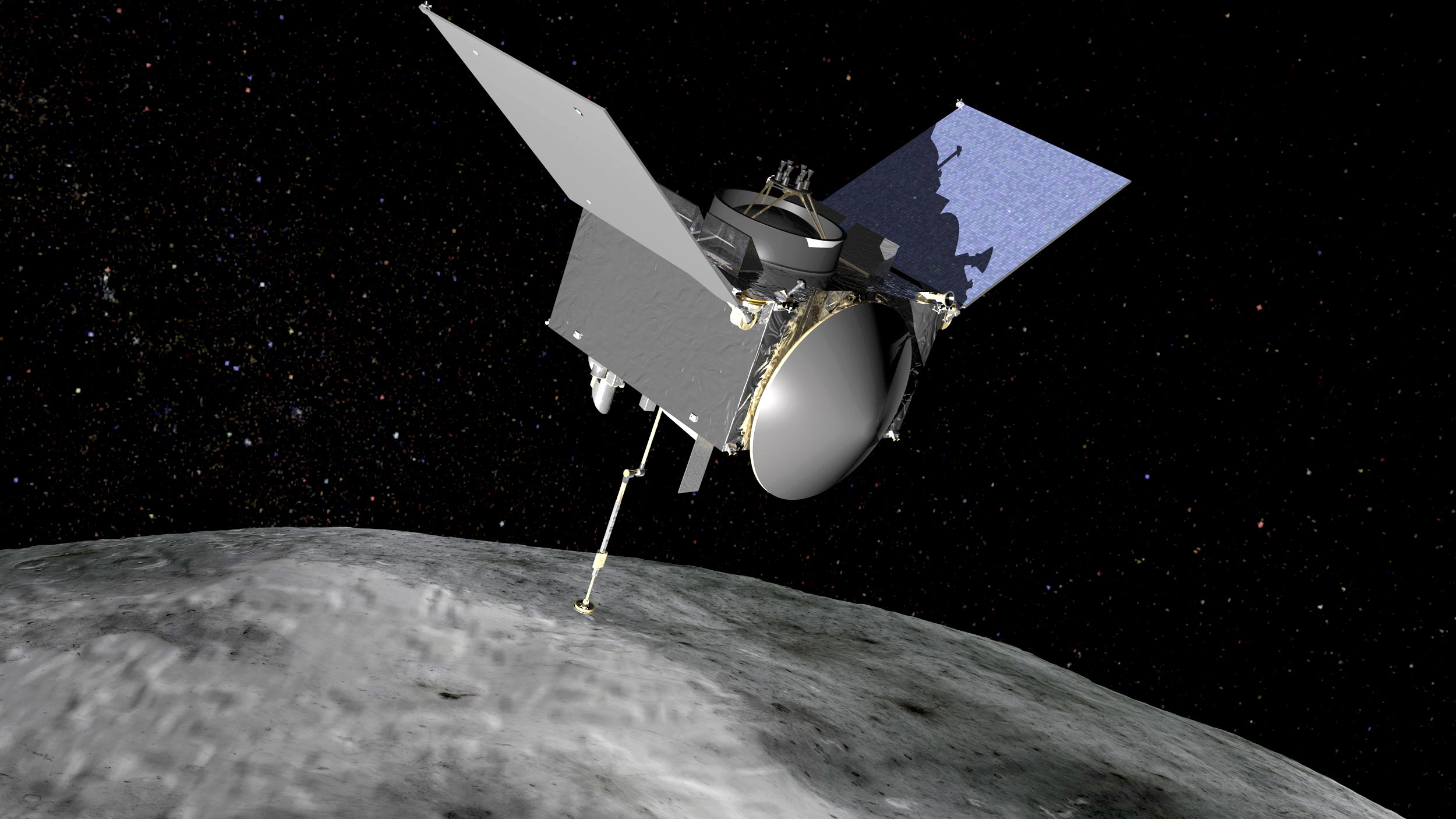
This first rehearsal provided the mission team with practice navigating the spacecraft through both the orbit departure and Checkpoint maneuvers and with an opportunity to verify that the spacecraft’s imaging, navigation and ranging systems operated as expected during the first part of the descent sequence. Checkpoint rehearsal also gave the team confirmation that OSIRIS-REx’s Natural Feature Tracking (NFT) guidance system accurately estimated the spacecraft’s position and speed relative to Bennu as it descended toward the surface.
The mission team has maximized remote work over the last month of preparations for the Checkpoint rehearsal, as part of the COVID-19 response. On the day of rehearsal, a limited number of personnel monitored the spacecraft’s telemetry from Lockheed Martin Space’s facility, NASA’s Goddard Space Flight Center and the University of Arizona, taking appropriate safety precautions, while the rest of the team performed their roles remotely.
“This rehearsal let us verify flight system performance during the descent, particularly the autonomous update and execution of the Checkpoint burn,” said Rich Burns, OSIRIS-REx project manager at NASA’s Goddard Space Flight Center in Greenbelt, Maryland. “Executing this monumental milestone during this time of national crisis is a testament to the professionalism and focus of our team. It speaks volumes about their ‘can-do’ attitude and hopefully will serve as a bit of good news in these challenging times.”
The spacecraft will travel all the way to the asteroid’s surface during its first sample collection attempt, scheduled for August 25. During this event, OSIRIS-REx’s sampling mechanism will touch Bennu’s surface for approximately five seconds, fire a charge of pressurized nitrogen to disturb the surface and collect a sample before the spacecraft backs away. The spacecraft is scheduled to return the sample to Earth on September 24, 2023.
NASA’s Goddard Space Flight Center in Greenbelt, Maryland, provides overall mission management, systems engineering, and the safety and mission assurance for OSIRIS-REx. Dante Lauretta of the University of Arizona, Tucson, is the principal investigator, and the University of Arizona also leads the science team and the mission’s science observation planning and data processing. Lockheed Martin Space in Denver built the spacecraft and provides flight operations. Goddard and KinetX Aerospace are responsible for navigating the OSIRIS-REx spacecraft. OSIRIS-REx is the third mission in NASA’s New Frontiers Program, which is managed by NASA’s Marshall Space Flight Center in Huntsville, Alabama, for the agency’s Science Mission Directorate in Washington.
Never miss a breakthrough: Join the SciTechDaily newsletter.
Follow us on Google and Google News.