
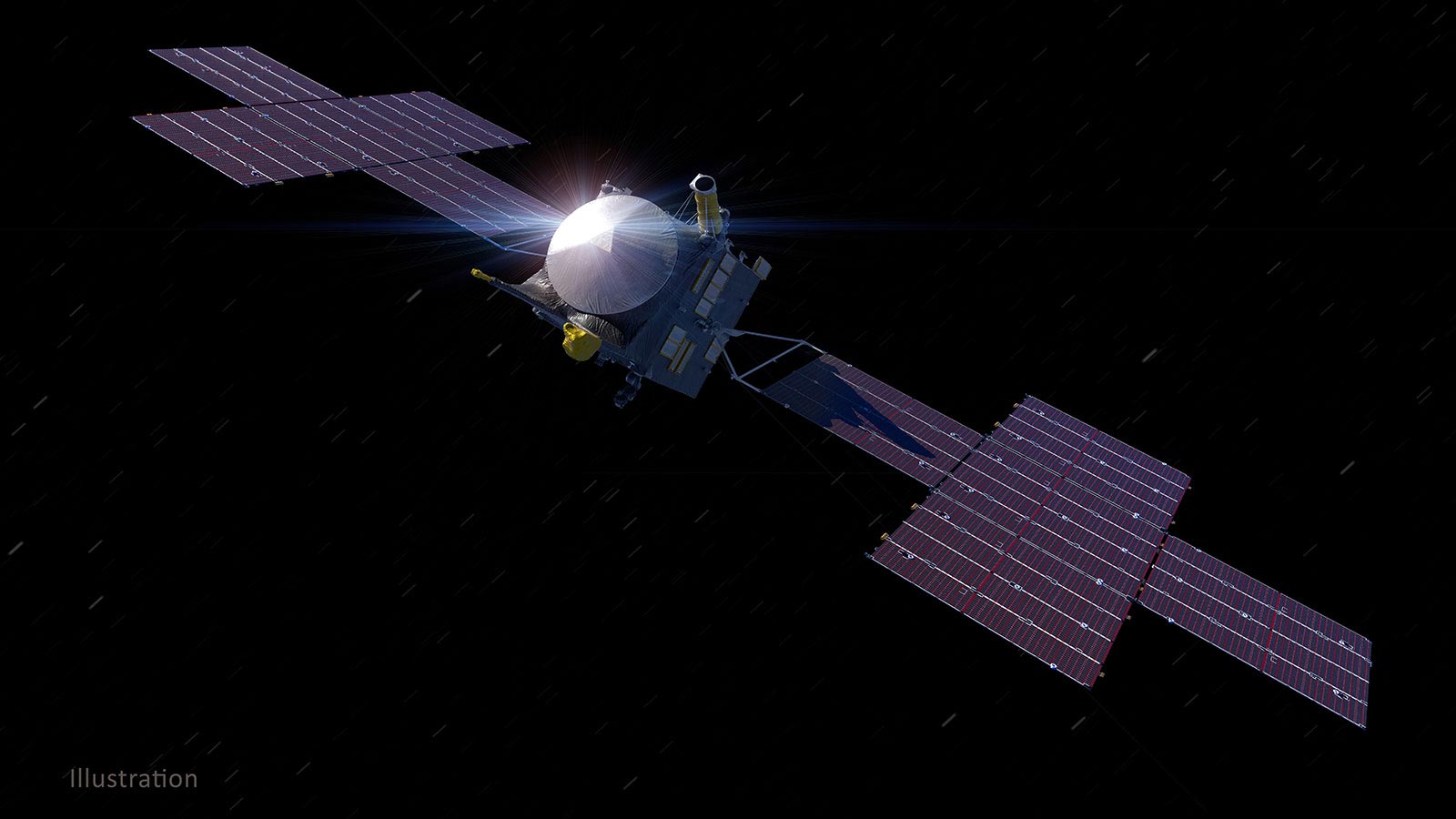
With its solar arrays installed, the spacecraft is close to its final configuration ahead of a planned August launch.
NASA’s Psyche mission is almost ready for its moment in the Sun – a 1.5-billion-mile (2.4-billion-kilometer) solar-powered journey to a mysterious, metal-rich asteroid of the same name. Twin solar arrays have been attached to the spacecraft body, unfolded lengthwise, and then restowed. This test brings the craft that much closer to completion before its August launch.
“Seeing the spacecraft fully assembled for the first time is a huge accomplishment; there’s a lot of pride,” said Brian Bone, who leads assembly, test, and launch operations for the mission at NASA’s Jet Propulsion Laboratory in Southern California. “This is the true fun part. You’re feeling it all come together. You feel the energy change and shift.”
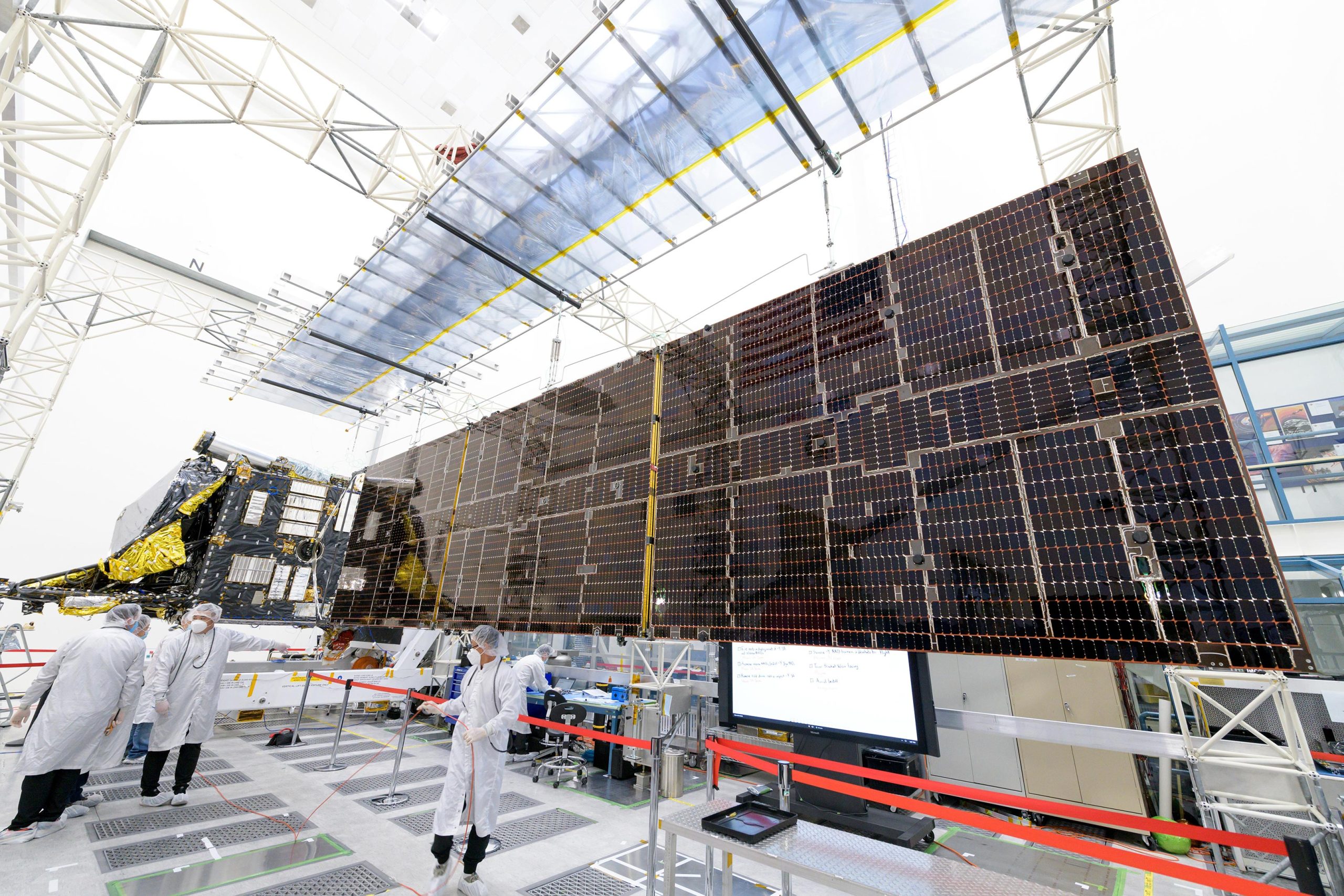
At 800 square feet (75 square meters), the five-panel, cross-shaped solar arrays are the largest ever installed at JPL, which has built many spacecraft over the decades. When the arrays fully deploy in flight, the spacecraft will be about the size of a singles tennis court. After a 3 ½-year solar-powered cruise, the craft will arrive in 2026 at the asteroid Psyche, which is 173 miles (280 kilometers) at its widest point and thought to be unusually rich in metal. The spacecraft will spend nearly two years making increasingly close orbits of the asteroid to study it.
This video shows the deployment of the three center panels on one of the 37-foot-long (11.3-meter-long) twin solar arrays on NASA’s Psyche spacecraft. Because they are so long, only one array at a time can be deployed in JPL’s High Bay 2 clean room. Credit: NASA/JPL-Caltech
Venturing to the asteroid belt between Mars and Jupiter, far from the Sun, presents challenges for this mission, which adapted standard Earth-orbiting commercial satellite technology for use in the cold and dark of deep space. Near Earth, the solar arrays generate 21 kilowatts – enough electricity to power three or four average U.S. homes. But at Psyche, they’ll produce only about 2 kilowatts – sufficient for little more than a hair dryer.
The underlying technology isn’t much different from solar panels installed on a home, but Psyche’s are hyper-efficient, lightweight, radiation resistant, and able to provide more power with less sunlight, said Peter Lord, Psyche technical director at Maxar Technologies in Palo Alto, California, where the arrays and solar electric propulsion chassis were built. “These arrays are designed to work in low-light conditions, far away from the Sun,” he added.

Credit: NASA/JPL-Caltech
After the successful installation and deployment of the three center panels inside a clean room at JPL, Psyche’s arrays were folded back against the chassis and stowed for additional spacecraft testing. The arrays will return to Maxar, which has specialized equipment to test the deployment of the two perpendicular cross panels. Later this spring, the arrays will be reunited with the spacecraft at NASA’s Kennedy Space Center in Florida and stowed for launch from Cape Canaveral.
About an hour after launch, the arrays will deploy and latch into place in a process that will take 7 ½ minutes per wing. They will then provide all the power for the journey to asteroid Psyche, as well as the power needed to operate the science instruments: a magnetometer to measure any magnetic field the asteroid may have, imagers to photograph and map its surface, and spectrometers to reveal the composition of that surface. The arrays also power the Deep Space Optical Communications technology demonstration that will test high-data-rate laser communications.
What those instruments relay to scientists will help them better understand the mysterious asteroid. One possible explanation for Psyche’s unusually high metal content is that it formed early in our solar system’s history, either as remnant core material from a planetesimal – one of the building blocks of rocky planets – or as primordial material that never melted. This mission aims to find out, and to help answer fundamental questions about Earth’s own metal core and the formation of our solar system.
More About the Mission
Arizona State University leads the Psyche mission. JPL, which is managed for NASA by Caltech in Pasadena, California, is responsible for the mission’s overall management, system engineering, integration and test, and mission operations. Maxar is providing the high-power solar electric propulsion spacecraft chassis. Psyche was selected in 2017 as the 14th mission under NASA’s Discovery Program.
Never miss a breakthrough: Join the SciTechDaily newsletter.
Follow us on Google and Google News.
3 Comments
10% of moon craters were caused by metal rich asteroids
I wonder about the kinds of torque that micrometeor impacts have on the spacecraft. I would think a few outliers every now punching holes in the panels might also cause disorientation of the craft. Regarding impactor-driven torques, would the attitude corrections be controllable by gyro or would they need propellant thrusters?
1. Very Interesting. Some Thoughts.
2. When we were kids we used to use a magnifying glass to concentrate the Suns Ray and burn paper! Energy form to be converted to electricity!
3. Increase effciency of Soalr Cells for power conversion. Key is effectiveness of the solar Arrays to power the Spacecraft to go to Psyche! Will need power Robots to mine rare metals rather than dry hair.
4. Minitururise Solar Array Panels to Nano Levels and embed the same to create powerful Nano
arrays.
Views expressed are personal andnot binding on anyone.