
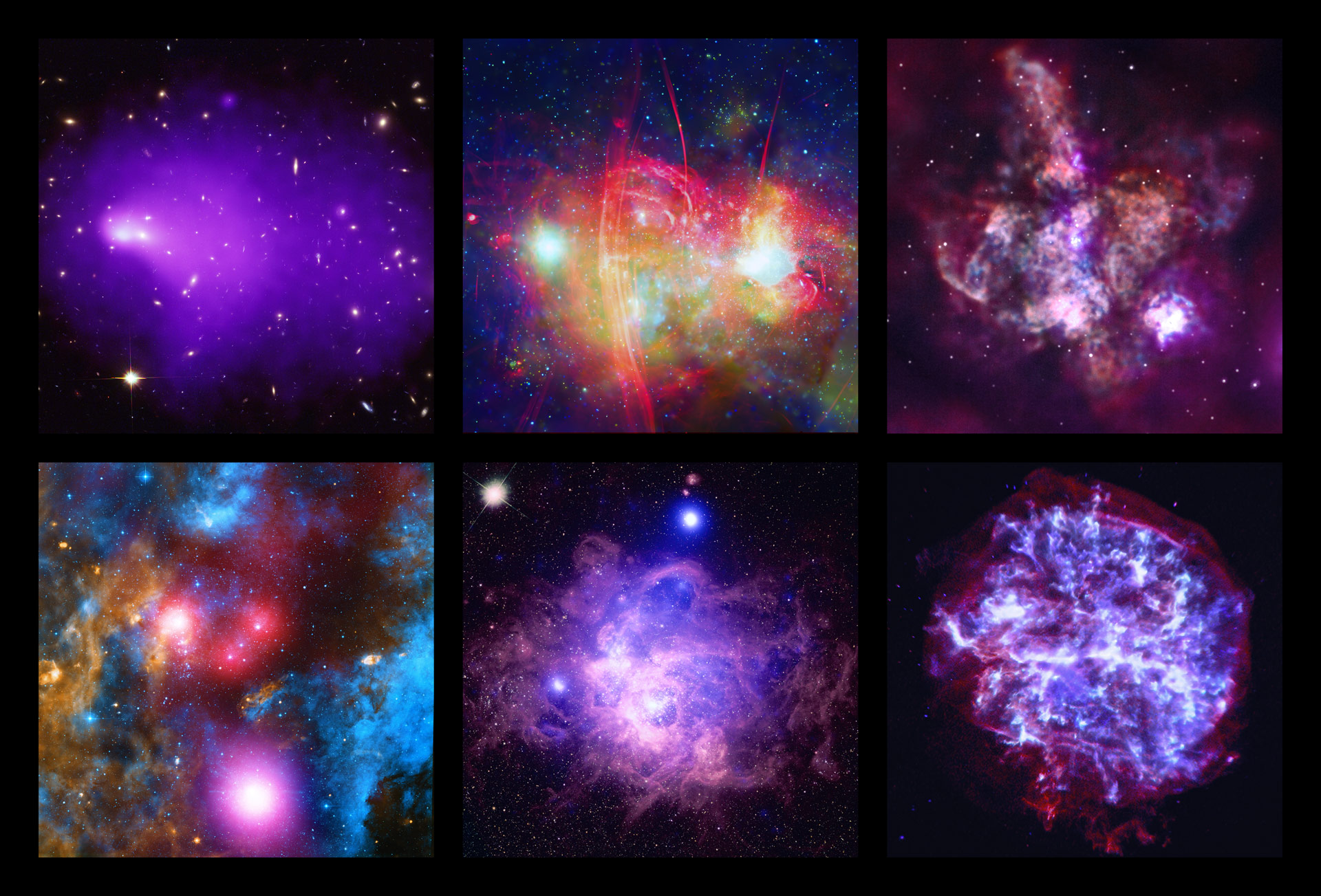
On July 23, 1999, the Space Shuttle Columbia blasted off from the Kennedy Space Center carrying the Chandra X-ray Observatory. In the two decades that have passed, Chandra’s powerful and unique X-ray eyes have contributed to a revolution in our understanding of the cosmos.
“In this year of exceptional anniversaries – 50 years after Apollo 11 and 100 years after the solar eclipse that proved Einstein’s General Theory of Relativity – we should not lose sight of one more,” said Paul Hertz, Director of Astrophysics at NASA. “Chandra was launched 20 years ago, and it continues to deliver amazing science discoveries year after year.”
To commemorate Chandra’s 20th anniversary of science operations, NASA has released new images representing the breadth of Chandra’s exploration, demonstrating the variety of objects it studies as well as how X-rays complement the data collected in other types of light. From the colossal grandeur of a galaxy cluster to the light from infant stars, these new images are a sample of Chandra’s spectacular X-ray vision.
Discover how an X-ray telescope has revolutionized astronomy and our understanding of the Universe. A scientific and engineering marvel, NASA’s Chandra X-ray Observatory has spent two decades (so far) exploring the cosmos unlike any other telescope. What it has found will astound you.
Chandra is one of NASA’s “Great Observatories” (along with the Hubble Space Telescope, Spitzer Space Telescope, and Compton Gamma Ray Observatory), and has the sharpest vision of any X-ray telescope ever built. It is often used in conjunction with telescopes like Hubble and Spitzer that observe in different parts of the electromagnetic spectrum, and with other high-energy missions like the European Space Agency’s XMM-Newton and NASA’s NuSTAR.
Chandra’s discoveries have impacted virtually every aspect of astrophysics. For example, Chandra was involved in a direct proof of dark matter’s existence. It has witnessed powerful eruptions from supermassive black holes. Astronomers have also used Chandra to map how the elements essential to life are spread from supernova explosions.
Many of the phenomena Chandra now investigates were not even known when the telescope was being developed and built. For example, astronomers now use Chandra to study the effects of dark energy, test the impact of stellar radiation on exoplanets, and observe the outcomes of gravitational wave events.
“Chandra remains peerless in its ability to find and study X-ray sources,” said Chandra X-ray Center Director Belinda Wilkes. “Since virtually every astronomical source emits X-rays, we need a telescope like Chandra to fully view and understand our Universe.”
Chandra was originally proposed to NASA in 1976 by Riccardo Giacconi, recipient of the 2002 Nobel Prize for Physics based on his contributions to X-ray astronomy, and Harvey Tananbaum, who would become the first director of the Chandra X-ray Center. It took decades of collaboration – between scientists and engineers, private companies and government agencies, and more – to make Chandra a reality.
“The building and operation of Chandra has always been and continues to be a team effort,” said Martin Weisskopf, Chandra Project Scientist of NASA’s Marshall Space Flight Center. “It’s been an honor and a privilege to be involved with this scientific powerhouse.”
In 2018, NASA awarded a contract extension to continue operation and science support of Chandra through 2024, with the possibility of two three-year options.
The Chandra X-ray Observatory was named in honor of the late Nobel laureate Subrahmanyan Chandrasekhar. NASA’s Marshall Space Flight Center manages the Chandra program. The Smithsonian Astrophysical Observatory’s Chandra X-ray Center controls science and flight operations from Cambridge, Mass.
Never miss a breakthrough: Join the SciTechDaily newsletter.
Follow us on Google and Google News.
1 Comment
So beautiful they could be Christmas ornaments.