
Close Menu
    Facebook X (Twitter) Instagram
    SciTechDaily
    • Biology
    • Chemistry
    • Earth
    • Health
    • Physics
    • Science
    • Space
    • Technology
    Facebook X (Twitter) Pinterest YouTube RSS
    SciTechDaily
    Home»Earth»NASA Satellite Spots Major Hurricane Juliette’s Emerging Eye
    Earth

    NASA Satellite Spots Major Hurricane Juliette’s Emerging Eye

    By Rob Gutro, NASA’s Goddard Space Flight CenterSeptember 3, 2019No Comments2 Mins Read
    Facebook Twitter Pinterest Telegram LinkedIn WhatsApp Email Reddit
    Share
    Facebook Twitter LinkedIn Pinterest Telegram Email Reddit
    NASA Aqua MODIS Hurricane Juliette
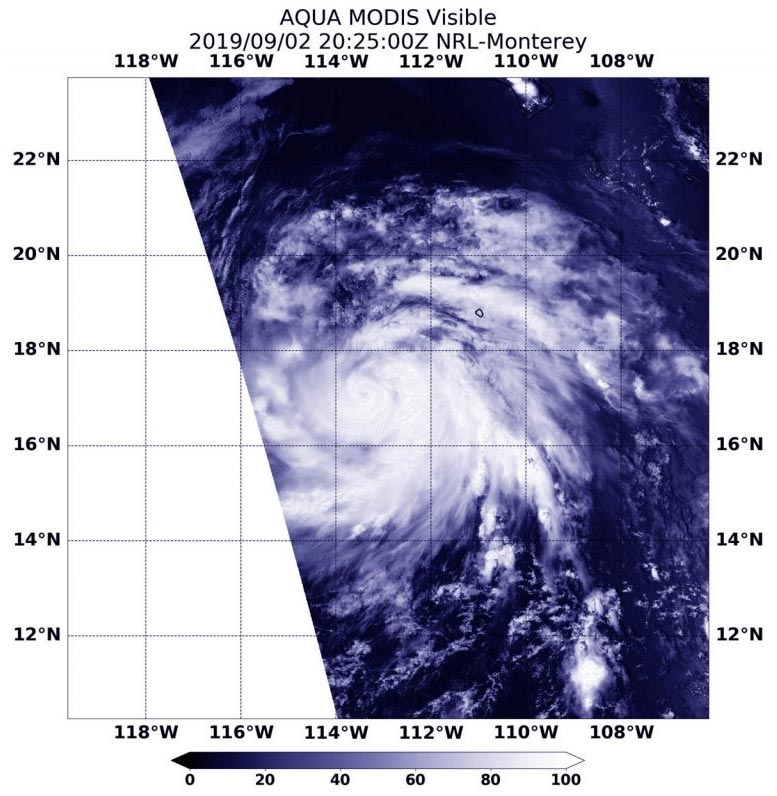
    On September 2, 2019 at 4:25 p.m. EDT (2025 UTC) the MODIS instrument aboard NASA’s Aqua satellite provided a visible image of Hurricane Juliette in the Eastern Pacific Ocean as its eye began to show. Credit: NASA/NRL

    NASA’s Aqua satellite passed over the Eastern Pacific Ocean and provided an image of Hurricane Juliette as its eye began to emerge. Juliette has grown into a major hurricane, about 450 miles southwest of the southern tip of Baja California, Mexico.

    Juliette developed on Sunday, September 1 around 5 a.m. EDT (0900 UTC) as a tropical storm. By 5 p.m. EDT on September 2, the storm had strengthened into a hurricane.

    On September 2, 2019 at 4:25 p.m. EDT (2025 UTC) the Moderate Resolution Imaging Spectroradiometer or MODIS instrument aboard NASA’s Aqua satellite provided a visible image of Hurricane Juliette that revealed its emerging eye around a thick tight circle of powerful thunderstorms. Hurricane-force winds extend outward up to 35 miles (55 km) from the center and tropical-storm-force winds extend outward up to 125 miles (205 km).

    NASA researches hurricanes to better understand their behavior, and provides data to forecasters at NOAA’s NHC or National Hurricane Center to assist in their forecasting.

    On September 3 at 11 a.m. EDT (1500 UTC), NOAA’s National Hurricane Center said the eye of Hurricane Juliette was located near latitude 18.4 degrees north and longitude 115.0 degrees west. That’s about 455 miles (730 km) southwest of the southern tip of Baja California, Mexico. Juliette is moving toward the northwest near 8 mph (13 kph), and a northwest to west-northwest motion is expected through Friday. Maximum sustained winds have increased to near 125 mph (205 kph) with higher gusts. Juliette is a category 3 hurricane on the Saffir-Simpson Hurricane Wind Scale. The estimated minimum central pressure is 953 millibars based on satellite estimates and data from the Mexican Navy station on Clarion Island.

    NHC said. “Some strengthening is possible today, with weakening forecast to begin by late Wednesday and continuing through Friday.”

    Never miss a breakthrough: Join the SciTechDaily newsletter.
    Follow us on Google and Google News.

    Hurricane NASA NASA Goddard Space Flight Center
    Share. Facebook Twitter Pinterest LinkedIn Email Reddit

    Related Articles

    NASA Unveils Astonishing Gravity Waves Caused by Hurricane Helene

    Dramatic NASA Satellite Video Examines Hurricane Ida’s Eye in 3D

    NASA’s Aqua Satellite Finds Hurricane Marie Rapidly Intensifying

    NASA Satellite Data Analysis of Rainfall and Rainmaking Capability in Hurricane Sally

    Catastrophic Flooding Possible: NASA Aqua Satellite Eyes Hurricane Sally and Finds Heavy Rain Potential

    Hurricane Nana Caught Making Landfall Under Cover of Night by NASA-NOAA Satellite

    NASA Sees Hanna Strengthen into First Atlantic Hurricane of 2020

    NASA Estimates Hurricane Dorian’s Rain Using Data From a Fleet of Satellites

    NASA’s GISS Releases Data Showing 2011 was Ninth-Warmest Year on Record

    Leave A Reply Cancel Reply

    • Facebook
    • Twitter
    • Pinterest
    • YouTube

    Don't Miss a Discovery

    Subscribe for the Latest in Science & Tech!

    Trending News

    JWST Finds a “Star” 100 Billion Times Brighter Than Any Star Should Be

    Scientists Find a Hidden Biological Link Across Different Forms of Autism

    Astronomers Discover a Ghostly River of Stars That Could Reveal Dark Matter

    Why Is Colorectal Cancer Rising in People Under 50? New Clues Point to the Environment

    Quantum Fluctuations Break a Crystal’s Symmetry Rules

    Why Does an Irregular Heartbeat Strike 40 Years Early in Some People?

    Scientists Reveal How ADHD Could Fuel Creative Thinking

    Scientists Find Just 3 Minutes of Sprinting Can Transform Blood Chemistry

    Follow SciTechDaily
    • Facebook
    • Twitter
    • YouTube
    • Pinterest
    • Newsletter
    • RSS
    SciTech News
    • Biology News
    • Chemistry News
    • Earth News
    • Health News
    • Physics News
    • Science News
    • Space News
    • Technology News
    Recent Posts
    • A 35,000-Year-Old Neanderthal Pelvis May Explain Why Men and Women Walk Differently
    • Hidden Brain Wiring May Help Preserve Thinking As Gray Matter Shrinks
    • Dual Stem Cell Treatment Restores Vision in First Human Trial
    • Your Waist Size May Reveal More About Your Health Than You Think
    • AI Decodes a Hidden DNA Signal Linked to Disease-Causing Mutations
    Copyright © 1998 - 2026 SciTechDaily. All Rights Reserved.
    • Science News
    • About
    • Contact
    • Editorial Board
    • Privacy Policy
    • Terms of Use

    Type above and press Enter to search. Press Esc to cancel.