
Close Menu
    Facebook X (Twitter) Instagram
    SciTechDaily
    • Biology
    • Chemistry
    • Earth
    • Health
    • Physics
    • Science
    • Space
    • Technology
    Facebook X (Twitter) Pinterest YouTube RSS
    SciTechDaily
    Home»Space»NASA’s Cutting-Edge Space Experiments Launching on 31st SpaceX Resupply Mission
    Space

    NASA’s Cutting-Edge Space Experiments Launching on 31st SpaceX Resupply Mission

    By Jet Propulsion LaboratoryNovember 3, 2024No Comments6 Mins Read
    Facebook Twitter Pinterest Telegram LinkedIn WhatsApp Email Reddit
    Share
    Facebook Twitter LinkedIn Pinterest Telegram Email Reddit
    SpaceX Dragon Cargo Craft Approaches Space Station November 2022
    The SpaceX Dragon cargo craft, loaded with over 7,700 pounds of science, supplies, and cargo, approaches the International Space Station for a docking 264 miles above the Atlantic ocean in between South America and Africa. Credit: NASA

    Projects include the NASA JPL-managed quantum communication experiment known as SEAQUE.

    NASA is set to launch a series of new science experiments to the International Space Station (ISS) aboard its SpaceX 31st commercial resupply mission. These six experiments are designed to support cutting-edge research by NASA scientists and teams. The SpaceX Dragon spacecraft, carried by a Falcon 9 rocket, will lift off from Launch Complex 39A at NASA’s Kennedy Space Center in Florida.

    Among the experiments on board are studies focused on putting out fires in space, testing quantum communication, analyzing antibiotic-resistant bacteria, investigating health issues like blood clotting and inflammation in astronauts, and exploring plant growth by cultivating romaine lettuce and moss in microgravity conditions.

    Developing Firefighting Techniques in Microgravity

    Putting out a fire in space requires a unique approach to prioritize the safety of the spacecraft environment and crew. The SoFIE-MIST (Solid Fuel Ignition and Extinction — Material Ignition and Suppression Test) is one of five investigations chosen by NASA since 2009 to develop techniques on how to contain and put out fires in microgravity. Research from the experiment could strengthen our understanding of the beginning stages of fire growth and behavior, which will assist in building and developing more resilient space establishments and creating better plans for fire suppression in space.
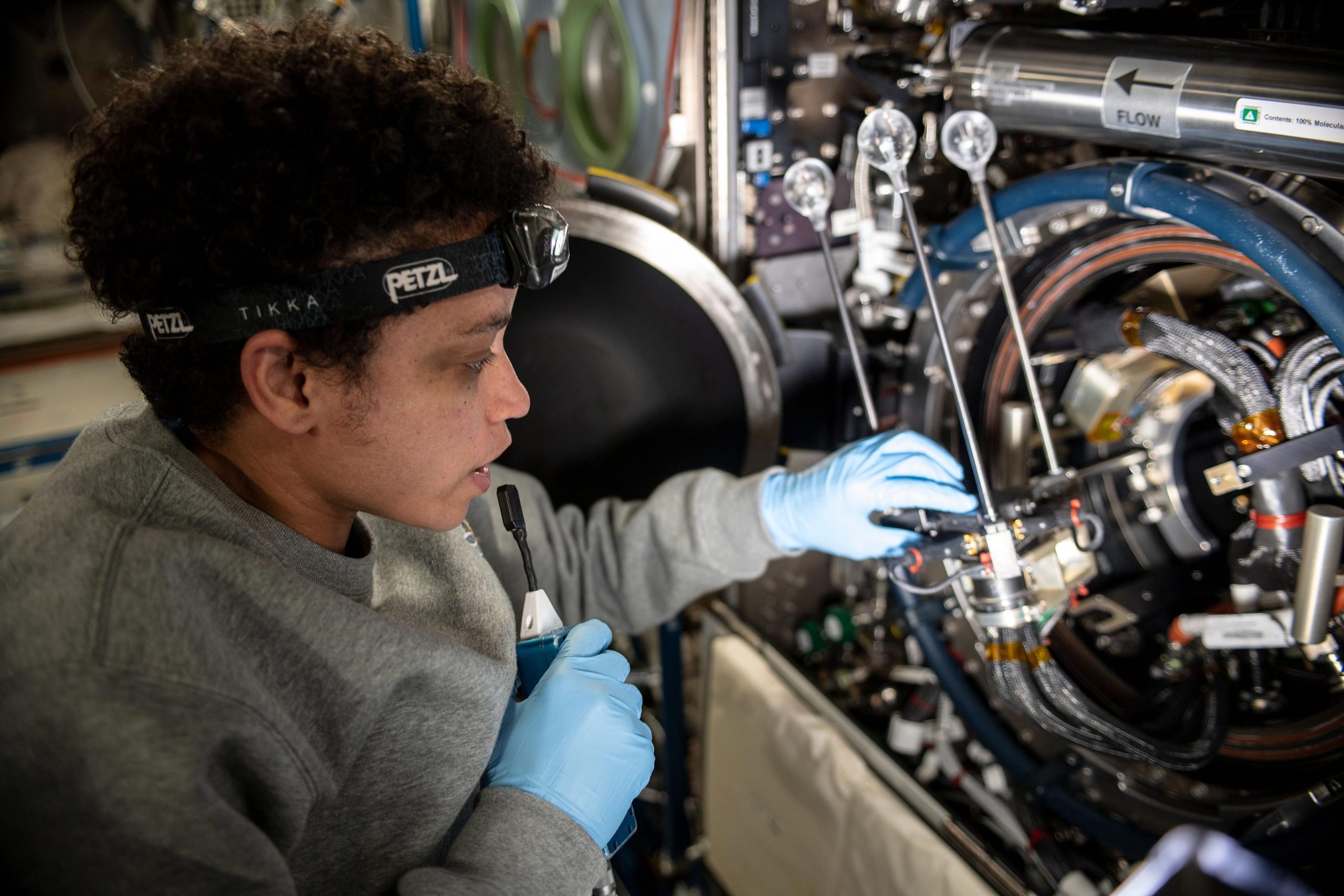
    Jessica Watkins SOFIE Fire Safety Experiment
    NASA astronaut Jessica Watkins services components that support the SOFIE (Solid Fuel Ignition and Extinction) fire safety experiment inside the International Space Station’s combustion integrated rack. Credit: NASA

    Combating Antibiotic Resistance

    Resistance to antibiotics is as much of a concern for astronauts in space as it is for humans on Earth. Research determined that the impacts of microgravity can weaken a human’s immune system during spaceflight, which can lead to an increase of infection and illness for those living on the space station.

    The GEARS (Genomic Enumeration of Antibiotic Resistance in Space) investigation scans the orbiting outpost for bacteria resistant to antibiotics and these organisms are studied to learn how they thrive and adapt to microgravity. Research results could help increase the safety of astronauts on future missions as well as provide clues to improving human health on Earth.

    Genomic Enumeration of Antibiotic Resistance in Space (GEARS) Sample Media Plate
    A sample media plate pictured aboard the International Space Station. The GEARS (Genomic Enumeration of Antibiotic Resistance in Space) investigation surveys the orbiting laboratory for antibiotic-resistant organisms. Genetic analysis could provide knowledge that informs measures to protect astronauts on future long-duration missions. Credit: NASA

    Understanding Inflammation and Blood Clotting

    Microgravity takes a toll on the human body and studies have shown that astronauts have had cases of inflammation and abnormally regulated blood clotting. The MeF-1 (Megakaryocytes Orbiting in Outer Space and Near Earth: The MOON Study (Megakaryocyte Flying-One)) investigation will conduct research on how the conditions in microgravity can impact the creation and function of platelets and bone-marrow megakaryocytes. Megakaryocytes, and their progeny, platelets, are key effector cells bridging the inflammatory, immune, and hemostatic continuum.

    Human Platelets NASA Space Radiation Laboratory
    A scanning electron-microscopy image of human platelets taken at the NASA Space Radiation Laboratory. Credit: NASA Space Radiation Laboratory

    Building the Space Salad Bar

    The work continues to grow food in the harsh environment of space that is both nutritious and safe for humans to consume. With Plant Habitat-07, research continues on “Outredgeous” romaine lettuce, first grown on the International Space Station in 2014.

    This experiment will sprout this red lettuce in microgravity in the space station’s Advanced Plant Habitat and study how optimal and suboptimal moisture conditions impact plant growth, nutrient content, and the plant microbiome. The knowledge gained will add to NASA’s history of growing vegetables in space and could also benefit agriculture on Earth.

    Oscar Monje Harvests Outredgeous Romaine Lettuce
    Pace crop production scientist Oscar Monje harvests Outredgeous romaine lettuce for preflight testing of the Plant Habitat-07 experiment inside a laboratory at the Space Systems Processing Facility at NASA’s Kennedy Space Center in Florida. Credit: NASA/Ben Smegelsky

    Mixing Moss with Space Radiation

    ARTEMOSS (ANT1 Radiation Tolerance Experiment with Moss in Orbit on the Space Station) continues research that started on Earth with samples of Antarctic moss that underwent simulated solar radiation at the NASA Space Radiation Lab at Brookhaven National Lab in Upton, New York.

    After exposure to radiation some of the moss samples will spend time on the orbiting outpost in the microgravity environment and some will remain on the ground in the 1g environment. ARTEMOSS will study how Antarctic moss recovers from any potential damage from ionizing radiation exposure when plants remain on the ground and when plants grow in spaceflight microgravity. This study leads the way in understanding the effects of combined simulated cosmic ionizing radiation and spaceflight microgravity on live plants, providing more clues to plant performance in exploration missions to come.

    Moss Plants ARTEMOSS Mission
    An example of moss plants grown for the ARTEMOSS mission.
    Credit: NASA

    Enabling Communication in Space Between Quantum Computers

    The SEAQUE (Space Entanglement and Annealing Quantum Experiment) will experiment with technologies that, if successful, will enable communication on a quantum level using entanglement. Researchers will focus on validating in space a new technology, enabling easier and more robust communication between two quantum systems across large distances. The research from this experiment could lead to developing building blocks for communicating between equipment such as quantum computers with enhanced security.

    SEAQUE (Space Entanglement and Annealing QUantum Experiment)
    A quantum communications investigation, called SEAQUE (Space Entanglement and Annealing Quantum Experiment), is pictured as prepared for launch to the International Space Station on NASA’s SpaceX 31st commercial resupply services mission. The investigation is integrated on a MISSE-20 (Materials International Space Station Experiment) device, which is a platform for experiments on the outside of space station exposing instrumentation directly to the space environment. SEAQUE will conduct experiments in quantum entanglement while being exposed to the radiation environment of space. Credit: NASA

    NASA’s Biological and Physical Sciences Division pioneers scientific discovery and enables exploration by using space environments to conduct investigations not possible on Earth. Studying biological and physical phenomena under extreme conditions allows researchers to advance the fundamental scientific knowledge required to go farther and stay longer in space, while also benefitting life on Earth.

    Never miss a breakthrough: Join the SciTechDaily newsletter.
    Follow us on Google and Google News.

    International Space Station JPL NASA SpaceX
    Share. Facebook Twitter Pinterest LinkedIn Email Reddit

    Related Articles

    SpaceX Dragon Endeavour Docks to International Space Station

    SpaceX Reaches for Milestone in Spaceflight – A Private Company Launches Astronauts Into Orbit at Low Cost

    NASA Astronaut Robert Behnken Ready for Today’s Historic SpaceX Crew Dragon Liftoff

    Landmark NASA SpaceX Commercial Crew Test Flight Coverage Schedule

    How Astronauts Upgraded a Complex Experiment in Space [Video]

    Cool New Hardware Welcomed Aboard Space Station – Here’s What They Got

    SpaceX Dragon Heads to Space Station With Upgraded Science Hardware – Here’s What It’s For

    “Robot Hotel” Launching to the International Space Station on SpaceX Falcon 9 Rocket

    SpaceX Falcon 9 Launches, Dragon Capsule Headed Towards Space Station

    Leave A Reply Cancel Reply

    • Facebook
    • Twitter
    • Pinterest
    • YouTube

    Don't Miss a Discovery

    Subscribe for the Latest in Science & Tech!

    Trending News

    Millions Take These IBS Drugs, But a New Study Finds Serious Risks

    Scientists Unlock Hidden Secrets of 2,300-Year-Old Mummies Using Cutting-Edge CT Scanner

    Bread Might Be Making You Gain Weight Even Without Eating More Calories

    Scientists Discover Massive Magma Reservoir Beneath Tuscany

    Europe’s Most Active Volcano Just Got Stranger – Here’s Why Scientists Are Rethinking It

    Alzheimer’s Symptoms May Start Outside the Brain, Study Finds

    Millions Take This Popular Supplement – Scientists Discover a Concerning Link to Heart Failure

    The Universe Is Expanding Too Fast and Scientists Can’t Explain Why

    Follow SciTechDaily
    • Facebook
    • Twitter
    • YouTube
    • Pinterest
    • Newsletter
    • RSS
    SciTech News
    • Biology News
    • Chemistry News
    • Earth News
    • Health News
    • Physics News
    • Science News
    • Space News
    • Technology News
    Recent Posts
    • Simple Blood Test May Predict Alzheimer’s Years Before Brain Scans Show Signs
    • Scientists Say Adding This Unusual Seafood to Your Diet Could Reverse Signs of Aging
    • U.S. Waste Holds $5.7 Billion Worth of Crop Nutrients
    • Scientists Say a Hidden Structure May Exist Inside Earth’s Core
    • Doctors Surprised by the Power of a Simple Drug Against Colon Cancer
    Copyright © 1998 - 2026 SciTechDaily. All Rights Reserved.
    • Science News
    • About
    • Contact
    • Editorial Board
    • Privacy Policy
    • Terms of Use

    Type above and press Enter to search. Press Esc to cancel.