
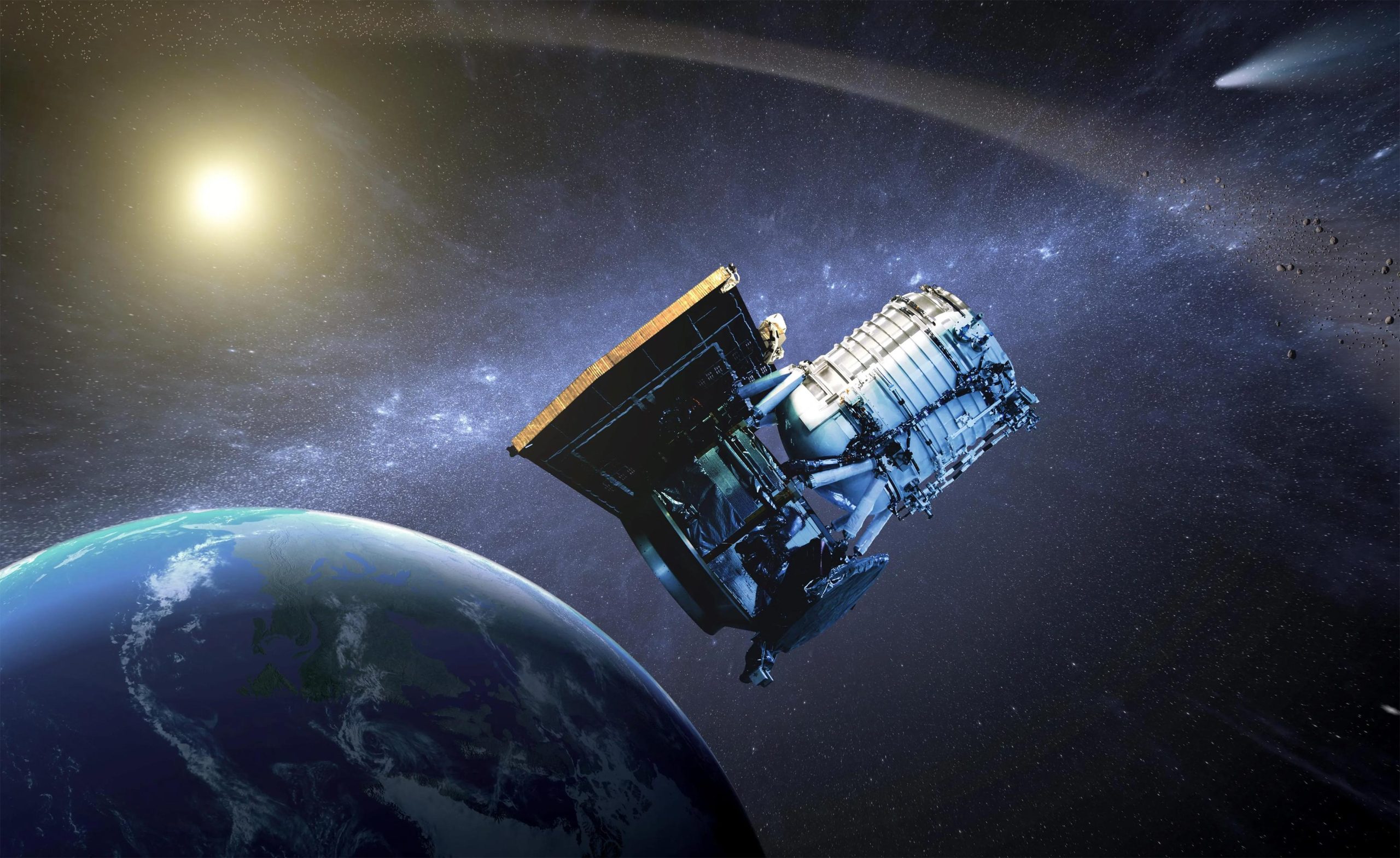
As the infrared space telescope continues its long-duration survey of the universe, it is creating a unique resource for future astronomers to make new discoveries.
NASA’s NEOWISE mission has released its 10th year of infrared data – the latest in a unique long-duration (or “time-domain”) survey that captures how celestial objects change over long periods. Time-domain astronomy can help scientists see how distant variable stars change in brightness and observe faraway black holes flaring as they consume matter. But NEOWISE has a special focus on our planet’s local cosmic neighborhood, producing a time-domain infrared survey used for planetary science, with a particular emphasis on asteroids and comets.
Short for Near-Earth Object Wide-field Infrared Survey Explorer, NEOWISE is a key component of NASA’s planetary defense strategy, helping the agency refine the orbits of asteroids and comets while also estimating their size. One such example is the potentially hazardous asteroid Apophis, which will make a close approach of our planet in 2029.
This top-down animated view of the solar system shows the positions of all the asteroids and comets detected by NEOWISE in the decade since its reactivation in 2014. Credit: IPAC/Caltech/University of Arizona
By repeatedly observing the sky from its location in low-Earth orbit, NEOWISE has made 1.45 million infrared measurements of over 44,000 solar system objects. That includes more than 3,000 NEOs, 215 of which the space telescope discovered. Twenty-five of those are comets, including the famous comet NEOWISE.
“The space telescope has been a workhorse for characterizing NEOs that may pose a hazard to Earth in the future,” said Amy Mainzer, NEOWISE’s principal investigator at the University of Arizona and University of California, Los Angeles. “The data that NEOWISE has generated for free use by the scientific community will pay dividends for generations.”
From Data to Discovery
Managed by NASA’s Jet Propulsion Laboratory, the mission sends data three times a day to the U.S. Tracking and Data Relay Satellite System (TDRSS) network, which then delivers it to IPAC, an astronomical data research center at Caltech in Pasadena, California. IPAC processes the raw data into fully calibrated images that are accessible online. It also generates NEO detections, sending them to the Minor Planet Center – the internationally recognized clearinghouse for the position measurements of solar system bodies. By searching multiple images of the same patch of sky at different times, scientists capture the motions of individual asteroids and comets.
“The science products we generate identify specific infrared sources in the sky with precisely determined positions and brightnesses that enable discoveries to be made,” said Roc Cutri, lead scientist for the NEOWISE Science Data System at IPAC. “The most fun thing when I look at the data for the first time is knowing that no one has seen this before. It puts you in a unique position of doing real exploration.”
IPAC will also produce data products for NASA’s NEO Surveyor, which is targeting a launch no earlier than 2027. Managed by JPL, with Mainzer serving as principal investigator, the next-generation space survey telescope will seek out some of the hardest-to-find near-Earth objects, such as dark asteroids and comets that don’t reflect much visible light but shine brighter in infrared light.
Two Missions, One Spacecraft
The NEOWISE spacecraft launched in 2009, but as a different mission and with a different name: the Wide-field Infrared Survey Explorer, or WISE, which set out to survey the entire sky. As an infrared telescope, WISE studied distant galaxies, comparatively cool red dwarf stars, exploding white dwarfs, and outgassing comets, as well as NEOs.
An infrared telescope requires cryogenic coolant to prevent the spacecraft’s heat from disrupting its observations. After the WISE telescope’s ran out of coolant and was no longer able to observe the universe’s coldest objects, NASA put the spacecraft into hibernation in 2011. But because the telescope could still detect the infrared glow of comets and asteroids as they are heated by the Sun, Mainzer proposed to restart the spacecraft to keep an eye on them. The mission was reactivated in 2014 and renamed NEOWISE, extending the life of a spacecraft that was initially planned for less than a year of operation.
“We are 14 years into a seven-month mission,” said Joseph Masiero, NEOWISE’s deputy principal investigator and a scientist at IPAC. He started at JPL as a postdoctoral researcher working on WISE just two months before the spacecraft launched on December 14, 2009. “This little mission has been with me my entire career – it just kept going, making new discoveries, helping us better understand the universe,” Masiero added. “And if it wasn’t for the tyranny of orbital dynamics, I’m sure the spacecraft would continue to operate for years to come.”
Solar activity is causing NEOWISE to fall out of orbit, and the spacecraft is expected to drop low enough into Earth’s atmosphere that it will eventually become unusable.
“NEOWISE has lasted way past its original spacecraft design lifetime,” said Joseph Hunt, NEOWISE project manager at JPL. “But as we didn’t build it with a way to reach higher orbits, the spacecraft will naturally drop so low in the atmosphere that it will become unusable and entirely burn up in the months following decommissioning. Exactly when depends on the Sun’s activity.”
More About the Mission
NEOWISE and NEO Surveyor support the objectives of NASA’s Planetary Defense Coordination Office (PDCO) at NASA Headquarters in Washington. The NASA Authorization Act of 2005 directed NASA to discover and characterize at least 90% of the near-Earth objects more than 140 meters (460 feet) across that come within 30 million miles (48 million kilometers) of our planet’s orbit. Objects of this size can cause significant regional damage, or worse, should they impact the Earth.
JPL manages and operates the NEOWISE mission for PDCO within the Science Mission Directorate. The Space Dynamics Laboratory in Logan, Utah, built the science instrument. Ball Aerospace & Technologies Corp. of Boulder, Colorado, built the spacecraft. Science data processing takes place at IPAC at Caltech. Caltech manages JPL for NASA.
Never miss a breakthrough: Join the SciTechDaily newsletter.
Follow us on Google and Google News.