
Close Menu
    Facebook X (Twitter) Instagram
    SciTechDaily
    • Biology
    • Chemistry
    • Earth
    • Health
    • Physics
    • Science
    • Space
    • Technology
    Facebook X (Twitter) Pinterest YouTube RSS
    SciTechDaily
    Home»Biology»Natural Sorting Mechanism Allows Bacteria to Preserve Diversity
    Biology

    Natural Sorting Mechanism Allows Bacteria to Preserve Diversity

    By Bill Hathaway, Yale UniversityJune 7, 20184 Comments3 Mins Read
    Facebook Twitter Pinterest Telegram LinkedIn WhatsApp Email Reddit
    Share
    Facebook Twitter LinkedIn Pinterest Telegram Email Reddit
    Diversity in Bacteria
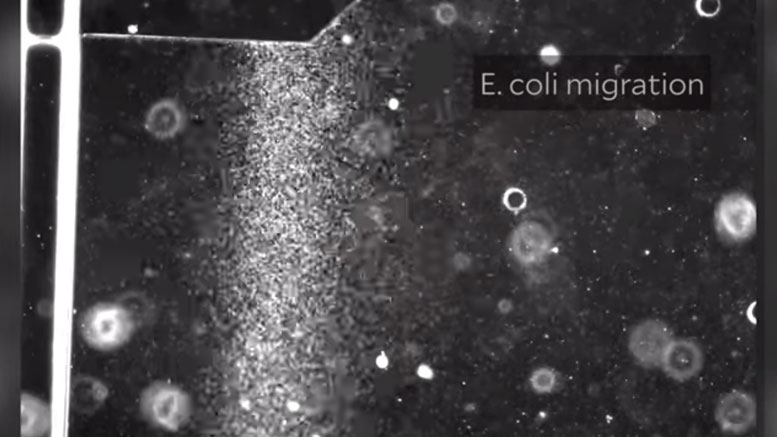
    Yale University researchers have identified a mechanism that enables colonies of E. coli to maintain diversity among individuals while still moving in unison when migrating over long distances.

    Diversity in bacteria — and in all forms of life — ensures the ability to survive random changes in the environment. But when a bacterial band begins to migrate, individual cellular differences present a problem: What happens to the slowpokes?

    Yale University researchers have discovered a natural sorting mechanism that allows colonies of E. coli to preserve individual differences, yet move in concert while migrating over long distances. They report their findings on June 5 in the journal Nature Communications.

    “Cancer cells are all diverse, which helps them survive efforts to eradicate them, but they also move in concert in the body,” said senior author Thierry Emonet, associate professor of molecular, cellular & developmental biology and physics. “Birds are individuals, but when they flock they move together in unison. We found how bacteria can act in the same way.”

    The Yale team tracked groups of E. coli cells as they chase food that recedes as they consume it. At the head of the group, food is plentiful. Behind it, nothing is left. In a process called chemotaxis, cells detect this difference and move accordingly, which results in collective migration.

    When researchers reduced the available food, fewer slow-moving cells could keep up with the group. “The minimum speed required to stay with the group increases,” Emonet said. “This is exactly what we see in human society during times of want — the weakest have a hard time keeping up with a migrating group.”

    However, the study showed that not all of the slow-moving cells were left behind. The fastest cells swam to the front of the group, where only weak cues guided which direction to go. The slowpokes swam behind them, where differences in food abundance were clearer. Matching of swimming ability to the strength of the cues allowed the diverse cells to migrate together at the same speed.

    The observation not only has applications for the study of pathologies like cancer or infections, said the researchers, but is a reminder about the delicate balance in all forms of life between preserving diversity and the need for concerted action.

    “If individual differences are sacrificed, then the colony might not survive in new circumstances,” Emonet said. “But if unchecked individualism dominates, critical collective behavior necessary for survival breaks down.”

    Lead authors of the paper are: Xiongfei Fu and Setsu Kato, formerly of the Emonet lab and now at the Shenzhen Institutes of Advanced Technology (China) and Hiroshima University (Japan), respectively.

    The research was primarily funded by The National Institute of General Medical Sciences and by the Allen Distinguished Investigator Program through The Paul G. Allen Frontiers Group.

    Reference: “Spatial self-organization resolves conflicts between individuality and collective migration” by X. Fu, S. Kato, J. Long, H. H. Mattingly, C. He, D. C. Vural, S. W. Zucker and T. Emonet, 5 June 2018, Nature Communications.
    DOI: 10.1038/s41467-018-04539-4

    Never miss a breakthrough: Join the SciTechDaily newsletter.
    Follow us on Google and Google News.

    Bacteria Cell Biology Molecular Biology Yale University
    Share. Facebook Twitter Pinterest LinkedIn Email Reddit

    Related Articles

    Yale Scientists Open Up New World for Biologics

    Scientists Provide New Insights Into the Origins of Genetic Diseases

    Yale Researchers Track How Cells Repair Rips in DNA

    Yale Research Shows Leptin Spurs Body to Shift from Burning Carbs to Fat

    Yale Study Shows Gut Bacteria Aggressively Protect Their Territory

    Scientists Create an Organism with a New Genetic Code

    New Research Changes the View about the Genetics of Leukemia Risk

    Researchers Identify Molecular Factors that Push the Domino of Life into Motion

    A Closer Look at the Antifreeze Protein That Allows Siberian Beetles to Survive

    4 Comments

    1. google street view on July 17, 2019 9:21 pm

      Tumor suppressing genes are always there in DNA .Otherewise human fingerwebs and tail in thr embryo may not be suppressed. These genes are just modification architecture for animal morphplogy.

      Reply
    2. Addu on July 23, 2019 4:04 am

      I am here for the share this great fun to join get robux this is the best way for the join this tiles game.

      Reply
    3. Jed Resse on December 29, 2021 1:31 am

      nice

      Reply
    4. Ana on January 15, 2022 8:49 pm

      Great article

      Reply
    Leave A Reply Cancel Reply

    • Facebook
    • Twitter
    • Pinterest
    • YouTube

    Don't Miss a Discovery

    Subscribe for the Latest in Science & Tech!

    Trending News

    Researchers Have Found a Dietary Compound That Increases Longevity

    Scientists Baffled by Bizarre “Living Fossil” From 275 Million Years Ago

    Your IQ at 23 Could Predict Your Wealth at 27, Study Finds

    320 Light-Years Away, a Planet Confirms a Fundamental Cosmic Assumption

    The Crown Jewel of Dentistry? Breakthrough Tech Could Transform Tooth Repair

    Python Blood Could Hold the Secret to Weight Loss Without Side Effects

    Naturally Occurring Bacteria Completely Eradicate Tumors in Mice With a Single Dose

    New “Nanozyme Hypothesis” Could Rewrite the Story of Life’s Origins

    Follow SciTechDaily
    • Facebook
    • Twitter
    • YouTube
    • Pinterest
    • Newsletter
    • RSS
    SciTech News
    • Biology News
    • Chemistry News
    • Earth News
    • Health News
    • Physics News
    • Science News
    • Space News
    • Technology News
    Recent Posts
    • Scientists May Have Found the Key to Jupiter and Saturn’s Moon Mystery
    • Scientists Uncover Hidden Clues to the Origin of the Genetic Code
    • Scientists Discover Unexpected Role of Alzheimer’s Protein in Cell Division
    • Scientists Uncover Brain Changes That Link Pain to Depression
    • A New Chapter in Chemistry? Scientists Uncover New Way Metals Bind Oxygen
    Copyright © 1998 - 2026 SciTechDaily. All Rights Reserved.
    • Science News
    • About
    • Contact
    • Editorial Board
    • Privacy Policy
    • Terms of Use

    Type above and press Enter to search. Press Esc to cancel.