
A partial solar eclipse, the scorpion’s sting, and June is for Juno!
- June 13: For the Washington, D.C. area, and similar latitudes, the earliest sunrise of the year occurs at 5:42:11 a.m. EDT.
- June 20: Summer solstice is at 11:32 p.m. EDT.
- June 24: The next full Moon is June 24 and it’s sometimes called the Strawberry Moon.

Following last month’s total lunar eclipse, June brings us a solar eclipse. On June 10th, the Moon will slip briefly between Earth and the Sun, partially obscuring our local star from view.
Whereas May’s lunar eclipse was best viewed around the Pacific, this month’s solar eclipse will be a treat for those in the northeast U.S., eastern Canada, and Northern Europe. For U.S. viewers, this is a sunrise event, with the Moon already appearing to have taken a bite out of the Sun as it’s rising. So you’ll want to find a clear view toward the eastern horizon to observe it. Those farther to the north and east will see more of the Sun obscured by the Moon. For those in northern Europe, it’s more of a lunchtime eclipse.
(Wherever you are, please review eclipse safety practices, and never look at the Sun without proper protection for your eyes.)
On summer evenings, you may notice a curved grouping of stars crawling across the southern sky, among them a brilliant red beacon. This is the constellation Scorpius, the scorpion, and beginning in June, it’s the prime time to look for it.
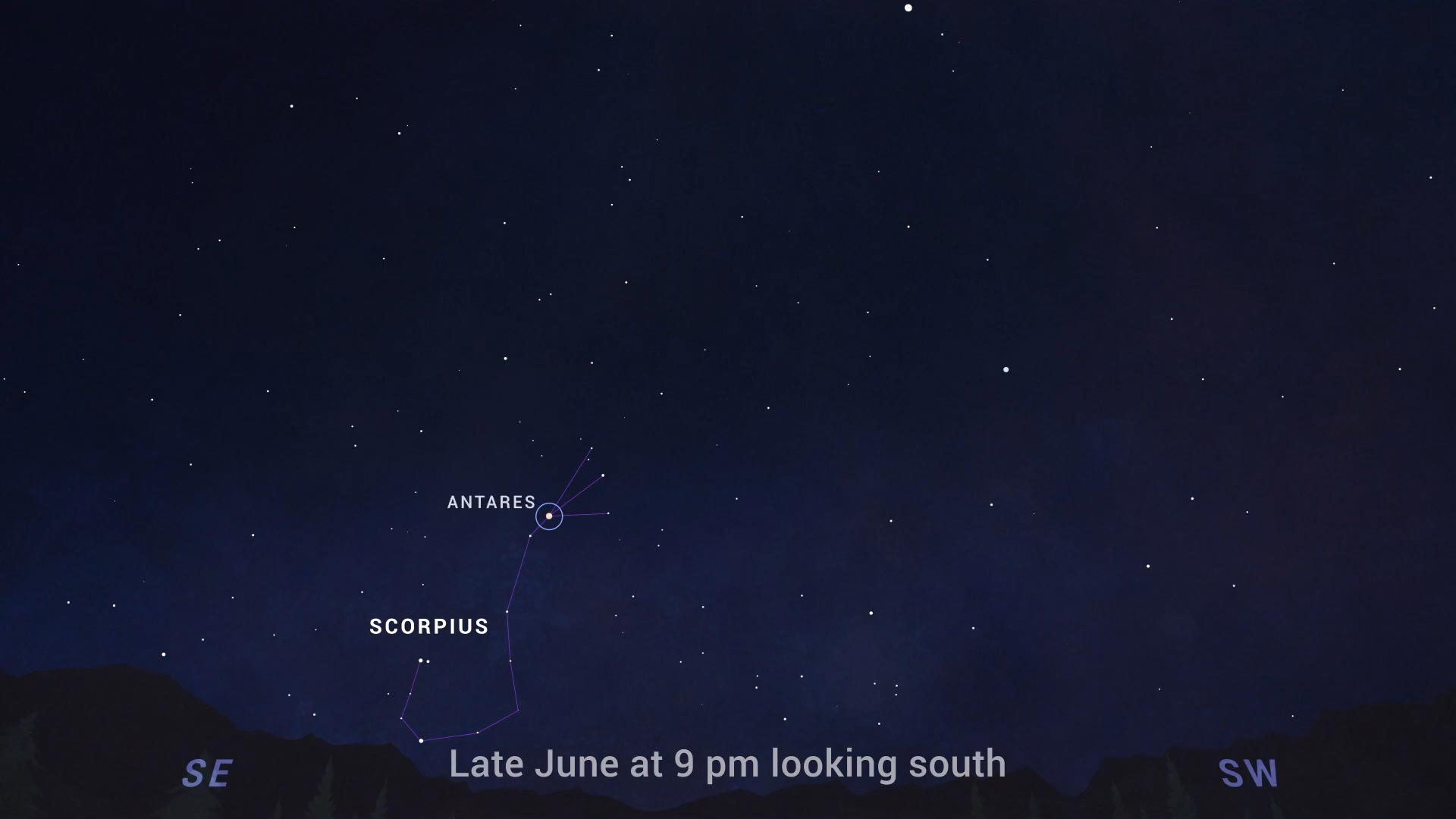
This grouping of stars has been thought of as having the shape of a scorpion going back to ancient times in the Mediterranean and Middle East. In the Greek myth, the scorpion’s deadly sting brought down the great hunter Orion, and that’s why – the story goes – we find them on opposite sides of the sky today.
This pattern of stars also been seen as part of a great dragon, in China, and the fish hook of the demigod Maui in Hawaii. That fish-hook shape also forms the tail of the scorpion.
At the beginning of June, if you’re in the northern hemisphere, the scorpion’s tail might still be below the horizon for you, early in the evening. It rises over the first few hours after dark. But by the end of the month, the scorpion’s tail will be above the horizon after sunset for most stargazers.
That bright, beacon-like star in Scorpius is Antares, which is a huge red giant star, and one of the brightest in the sky. It forms the blazing heart of the scorpion. So look toward the south and use Antares as your guide to find the constellation Scorpius.
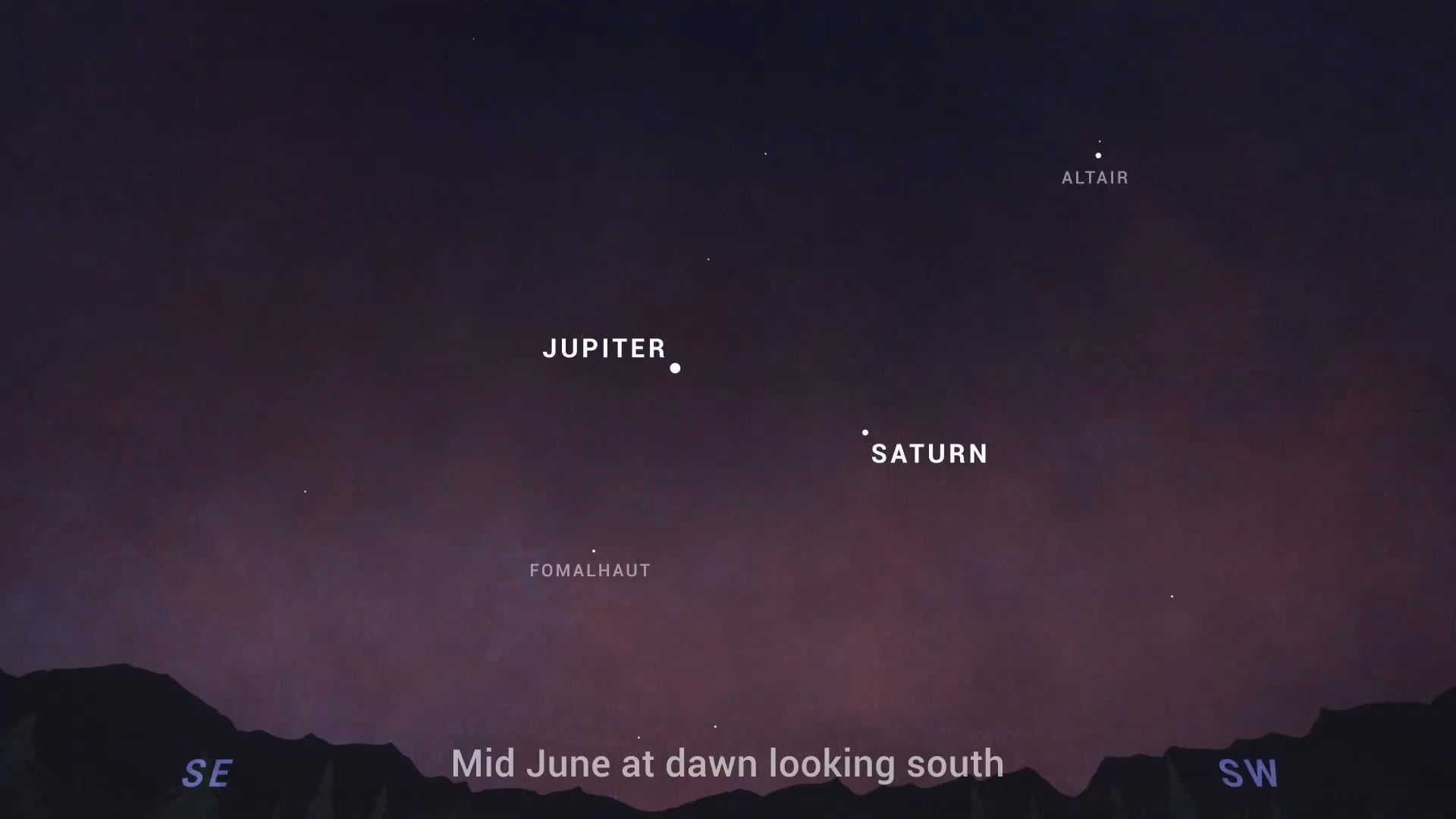
Finally this month, you’ll remember back in December, when Jupiter and Saturn had their incredibly close meetup in the sky. In the runup to that “Great Conjunction,” Jupiter led Saturn across the sky all through 2020. Well, 6 months later, the pair continue to move farther apart, and now Saturn has the lead position as the two planets rise and set. Look for them in the east after midnight, or toward the south at dawn.
And for more Jupiter excitement in June, NASA’s Juno spacecraft is making its next close flyby over Jupiter on June 8th, and this time it will also make a low-altitude flyby over the planet-sized, icy moon Ganymede on June 7th. This is the first of several planned flybys of the Jovian moons by Juno, over the next couple of years, that include encounters with icy Europa and volcanic Io!
Phases of the Moon

Daily Guide
June 7
Monday night, June 7, 2021, at 10:28 p.m. EDT, the Moon will be at apogee, its farthest from the Earth for this orbit.
June 10: Solar Eclipse
Thursday morning, June 10, 2021, at 6:53 a.m. EDT, will be the new Moon, when the Moon passes between the Earth and the Sun. As described above, the Moon will eclipse the Sun. Remember that it is unsafe to look directly at the Sun (unless you have special eclipse glasses to protect your eyes).
Parts of Canada, Greenland, the Arctic Ocean, and Siberia will see an annular eclipse. For much of the rest of northeastern North America, Greenland, Northern Europe, and northern Asia, this will be a partial eclipse. From the Washington, D.C. area, the Moon will be blocking about 80% of the left side of the Sun as they rise together in the east-northeast at 5:42 a.m., causing the Sun to appear as a crescent. As the pair rises higher in the sky, the silhouette of the Moon will gradually shift off the Sun to the lower left, allowing more of the Sun to show until the eclipse ends at around 6:29 a.m., with the Sun about 7 degrees above the horizon in the east-northeast.
On Thursday evening, the planet Mercury will be passing between Earth and Sun as seen from Earth – this is called inferior conjunction. Mercury will be shifting from the evening sky to the morning sky and will begin emerging from the glow of dawn on the eastern horizon after about June 20.
The day of – or the day after the new Moon – marks the start of the new month for most lunisolar calendars. The fifth month of the Chinese calendar starts on June 10, 2021 (at midnight in China’s time zone, which is 12 hours ahead of EDT). Sundown on June 10, marks the start of Tammuz in the Hebrew calendar. In the Islamic calendar, the months traditionally start with the first sighting of the waxing crescent Moon. Many Muslim communities now follow the Umm al-Qura Calendar of Saudi Arabia, which uses astronomical calculations to start months in a more predictable way.
June 11
On Friday evening, June 11, 2021, the thin, waxing crescent Moon will appear to the lower right of the bright planet Venus on the west-northwestern horizon, setting about 12 minutes after evening twilight ends. Venus will likely be easier to spot in the glow of dusk than the thin crescent of the Moon.
June 12
On Saturday evening, June 12, 2021, the bright star Pollux will appear about 5 degrees above the waxing crescent Moon, with the bright planet Venus appearing about 8 degrees to the lower right of the Moon.
June 13
For the Washington, D.C. area (and similar latitudes, at least), the earliest sunrise of the year will occur on Sunday, June 13, 2021, at 5:42:11 a.m. EDT with twilight starting at 4:30 a.m.
On Sunday evening, the planet Mars will appear about 3 degrees below the waxing crescent Moon.
June 14
Monday, June 14, 2021, is the fifth day of the fifth month of the traditional Chinese calendar, the day of the Dragon Boat Festival.
June 15
Tuesday evening, June 15, 2021, the bright star Regulus will appear about 4 degrees to the lower left of the waxing crescent Moon.
June 17
On Thursday night, June 17, 2021, the Moon will appear half-full as it reaches its first quarter at 11:54 p.m. EDT.
June 19
Saturday evening, June 19, 2021, the bright star Spica will appear about 5 degrees below the waxing gibbous Moon.
June 20: Summer Solstice
Beginning the morning of Sunday, June 20, 2021, the planet Mercury will begin appearing above the horizon about 30 minutes before sunrise (approximately when it may start being visible in the glow of dawn). Mercury will not start appearing above the horizon at the time morning twilight begins until July 1.
Sunday night, at 11:32 p.m. EDT, will be the summer solstice, the astronomical end of spring, and the beginning of summer. This will be the day with the longest period of daylight.
June 21
On Monday evening, June 21, 2021, the bright planet Venus (as the Evening Star) and the bright star Pollux will appear at their closest to each other, a little over 5 degrees apart. The pair will appear near each other during the latter part of June.
June 22
Tuesday evening, June 22, 2021, the bright star Antares will appear about 5 degrees below the waxing gibbous Moon.
June 23
Wednesday morning, June 23, 2021, at 5:56 a.m. EDT, the Moon will be at perigee, its closest to the Earth for this orbit.
June 24
The next full Moon will be Thursday afternoon, June 24, 2021, at 2:40 p.m. EDT. The Moon will appear full for about 3 days centered on this time, from early Wednesday morning through early Saturday morning.
Never miss a breakthrough: Join the SciTechDaily newsletter.
Follow us on Google and Google News.
1 Comment
Jupiter is the one who left saturnus behind in capricanus..