
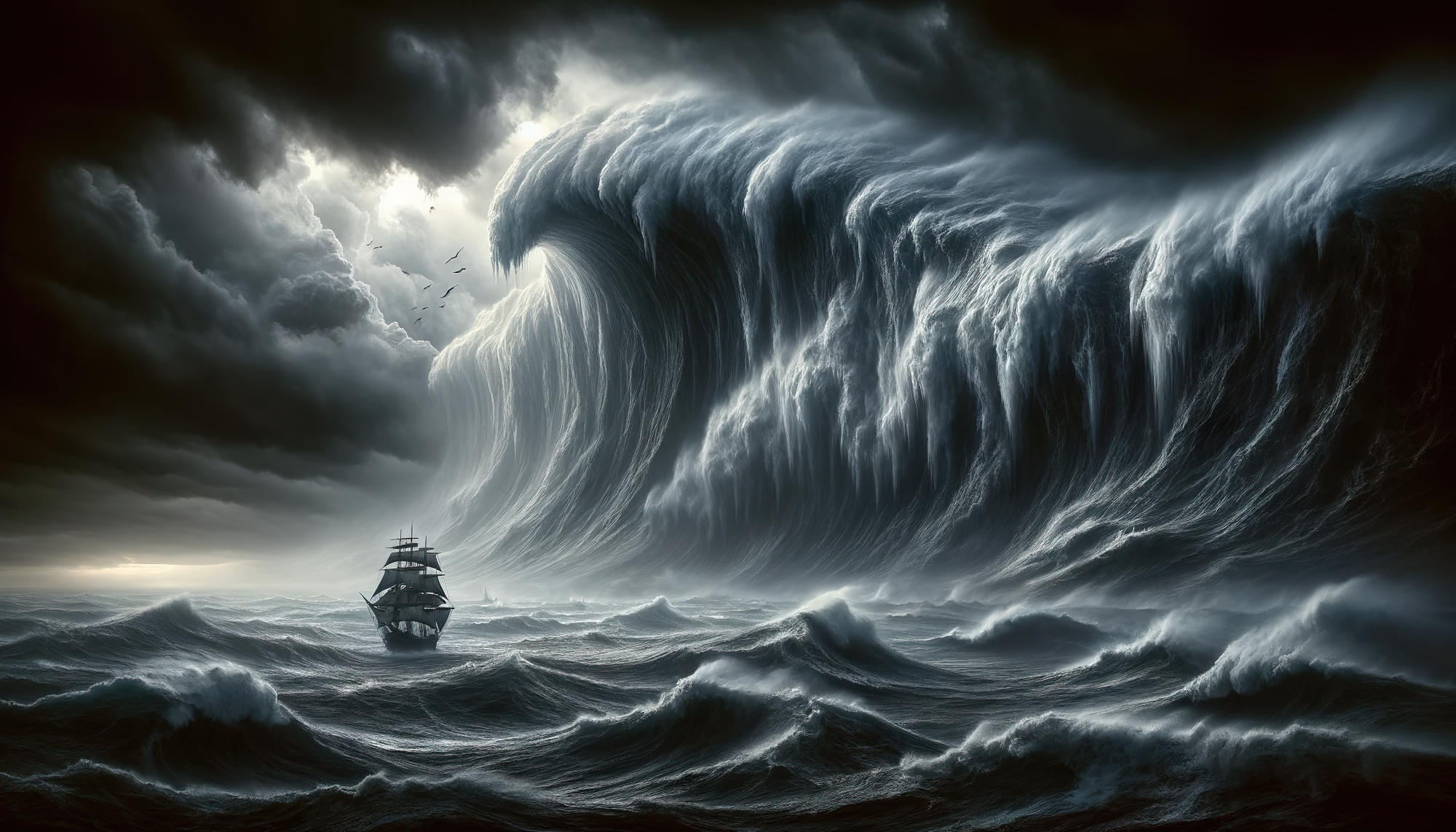
Utilizing seven centuries of oceanic wave data, encompassing over a billion wave observations, researchers from the University of Copenhagen and the University of Victoria have employed advanced artificial intelligence techniques to find a formula for how to predict the occurrence of these maritime monsters.
Long believed to be mere myths, freakishly large rogue waves are very real and can split apart ships and even damage oil rigs. By analyzing seven centuries’ worth of data from over a billion ocean waves, researchers from the University of Copenhagen and the University of Victoria have employed artificial intelligence to devise a predictive formula for these formidable sea giants. The new knowledge can make shipping safer.
Stories about monster waves, called rogue waves, have been the lore of sailors for centuries. But when a 26-metre-high rogue wave slammed into the Norwegian oil platform Draupner in 1995, digital instruments were there to capture and measure the North Sea monster. It was the first time that a rogue had been measured and provided scientific evidence that abnormal ocean waves really do exist.
Since then, these extreme waves have been the subject of much study. And now, researchers from the University of Copenhagen’s Niels Bohr Institute have used AI methods to discover a mathematical model that provides a recipe for how – and not least when – rogue waves can occur.
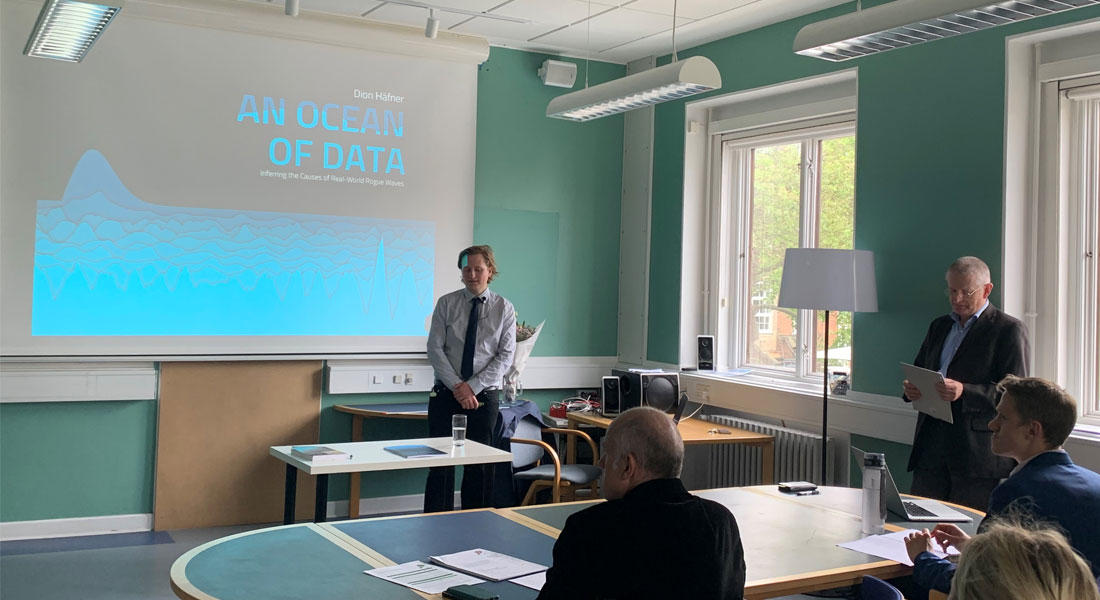
With the help of enormous amounts of big data about ocean movements, researchers can predict the likelihood of being struck by a monster wave at sea at any given time.
“Basically, it is just very bad luck when one of these giant waves hits. They are caused by a combination of many factors that, until now, have not been combined into a single risk estimate. In the study, we mapped the causal variables that create rogue waves and used artificial intelligence to gather them in a model that can calculate the probability of rogue wave formation,” says Dion Häfner.
Häfner is a former Ph.D. student at the Niels Bohr Institute and first author of the scientific study, which has just been published in the prestigious journal Proceedings of the National Academy of Sciences (PNAS).
Rogue waves happen every day
In their model, the researchers combined available data on ocean movements and the sea state, as well as water depths and bathymetric information. Most importantly, wave data was collected from buoys in 158 different locations around US coasts and overseas territories that collect data 24 hours a day. When combined, this data – from more than a billion waves – contains 700 years’ worth of wave height and sea state information.
The researchers analyzed the many types of data to find the causes of rogue waves, defined as being waves that are at least twice as high as the surrounding waves – including extreme rogue waves that can be over 20 meters high. With machine learning, they transformed it all into an algorithm that was then applied to their dataset.
“Our analysis demonstrates that abnormal waves occur all the time. In fact, we registered 100,000 waves in our dataset that can be defined as rogue waves. This is equivalent to around 1 monster wave occurring every day at any random location in the ocean. However, they aren’t all monster waves of extreme size,” explains Johannes Gemmrich, the study’s second author.
Artificial intelligence as a scientist
In the study, the researchers were helped by artificial intelligence. They used several AI methods, including symbolic regression which gives an equation as output, rather than just returning a single prediction as traditional AI methods do.
By examining more than 1 billion waves, the researchers’ algorithm has analyzed its own way into finding the causes of rogue waves and condensed it into equation that describes the recipe for a rogue wave. The AI learns the causality of the problem and communicates that causality to humans in the form of an equation that researchers can analyze and incorporate into their future research.
“Over decades, Tycho Brahe collected astronomical observations from which Kepler, with lots of trial and error, was able to extract Kepler’s Laws. Dion used machines to do with waves which Kepler did with planets. For me, it is still shocking that something like this is possible,” says Markus Jochum.
Phenomenon known since the 1700s
The new study also breaks with the common perception of what causes rogue waves. Until now, it was believed that the most common cause of a rogue wave was when one wave briefly combined with another and stole its energy, causing one big wave to move on.
However, the researchers establish that the most dominant factor in the materialization of these freak waves is what is known as “linear superposition”. The phenomenon, known since the 1700s, occurs when two wave systems cross over each other and reinforce one another for a brief period of time.
“If two wave systems meet at sea in a way that increases the chance to generate high crests followed by deep troughs, the risk of extremely large waves arises. This is knowledge that has been around for 300 years and which we are now supporting with data,” says Dion Häfner.
Safer shipping
The researchers’ algorithm is good news for the shipping industry, which at any given time has roughly 50,000 cargo ships sailing around the planet. Indeed, with the help of the algorithm, it will be possible to predict when this “perfect” combination of factors is present to elevate the risk of a monster wave that could pose a danger for anyone at sea.
“As shipping companies plan their routes well in advance, they can use our algorithm to get a risk assessment of whether there is a chance of encountering dangerous rogue waves along the way. Based on this, they can choose alternative routes,” says Dion Häfner.
Both the algorithm and research are publicly available, as are the weather and wave data deployed by the researchers. Therefore, Dion Häfner says that interested parties, such as public authorities and weather services, can easily begin calculating the probability of rogue waves. And unlike many other models created using artificial intelligence, all of the intermediate calculations in the researchers’ algorithm are transparent.
“AI and machine learning are typically black boxes that don’t increase human understanding. But in this study, Dion used AI methods to transform an enormous database of wave observations into a new equation for the probability of rogue waves, which can be easily understood by people and related to the laws of physics,” concludes Professor Markus Jochum, Dion’s thesis supervisor and co-author.
Reference: “Machine-guided discovery of a real-world rogue wave model” by Dion Häfner, Johannes Gemmrich and Markus Jochum, 20 November 2023, Proceedings of the National Academy of Sciences.
DOI: 10.1073/pnas.2306275120
Never miss a breakthrough: Join the SciTechDaily newsletter.
Follow us on Google and Google News.