
Close Menu
    Facebook X (Twitter) Instagram
    SciTechDaily
    • Biology
    • Chemistry
    • Earth
    • Health
    • Physics
    • Science
    • Space
    • Technology
    Facebook X (Twitter) Pinterest YouTube RSS
    SciTechDaily
    Home»Science»AI Reveals Walking Patterns of Movement Disorders Shared Among Worms, Mice, and Humans
    Science

    AI Reveals Walking Patterns of Movement Disorders Shared Among Worms, Mice, and Humans

    By Osaka UniversitySeptember 17, 2021No Comments4 Mins Read
    Facebook Twitter Pinterest Telegram LinkedIn WhatsApp Email Reddit
    Share
    Facebook Twitter LinkedIn Pinterest Telegram Email Reddit
    Man Walking
    Scientists combined animal location tracking with artificial intelligence to automatically detect common walking behaviors related to movement disorders across species, providing insights into neurological conditions affecting movement.

    Researchers at Osaka University train a deep learning algorithm to find features of movement disorders shared across species distant in evolutionary lineage — such as worms, mice, and humans — which may assist in understanding Parkinson’s disease.

    Scientists from the Graduate School of Information Science and Technology at Osaka University used animal location tracking along with artificial intelligence to automatically detect walking behaviors of movement disorders that are shared across species. By automatically removing species-specific features from walking data, the resulting data can be used to better understand neurological disorders that affect movement.

    Differences in Body Scale
    Differences in body scale among the different species. Locomotion trajectories of different animals (worm, beetle, and mouse) differ in spatial scale. Credit: © 2021 T. Maekawa et al., Nature Communications

    Machine learning algorithms, especially deep learning approaches that use multiple layers of artificial neurons, are well suited for distinguishing between different sources of data. For example, they can determine the species according to the characteristics of its tracks left behind in snow. However, there are times scientists care more about what is the same, rather than what is different, in various datasets. This may be the case when trying to aggregate readings from different types of animals.

    Now, a team of scientists led by Osaka University have used machine learning to obtain patterns from locomotion data created by worm, beetle, mouse, and human subjects that were independent of the species. “A central goal of comparative behavioral analysis is to identify human-like behavioral repertoires in animals,” first author Takuya Maekawa explains.
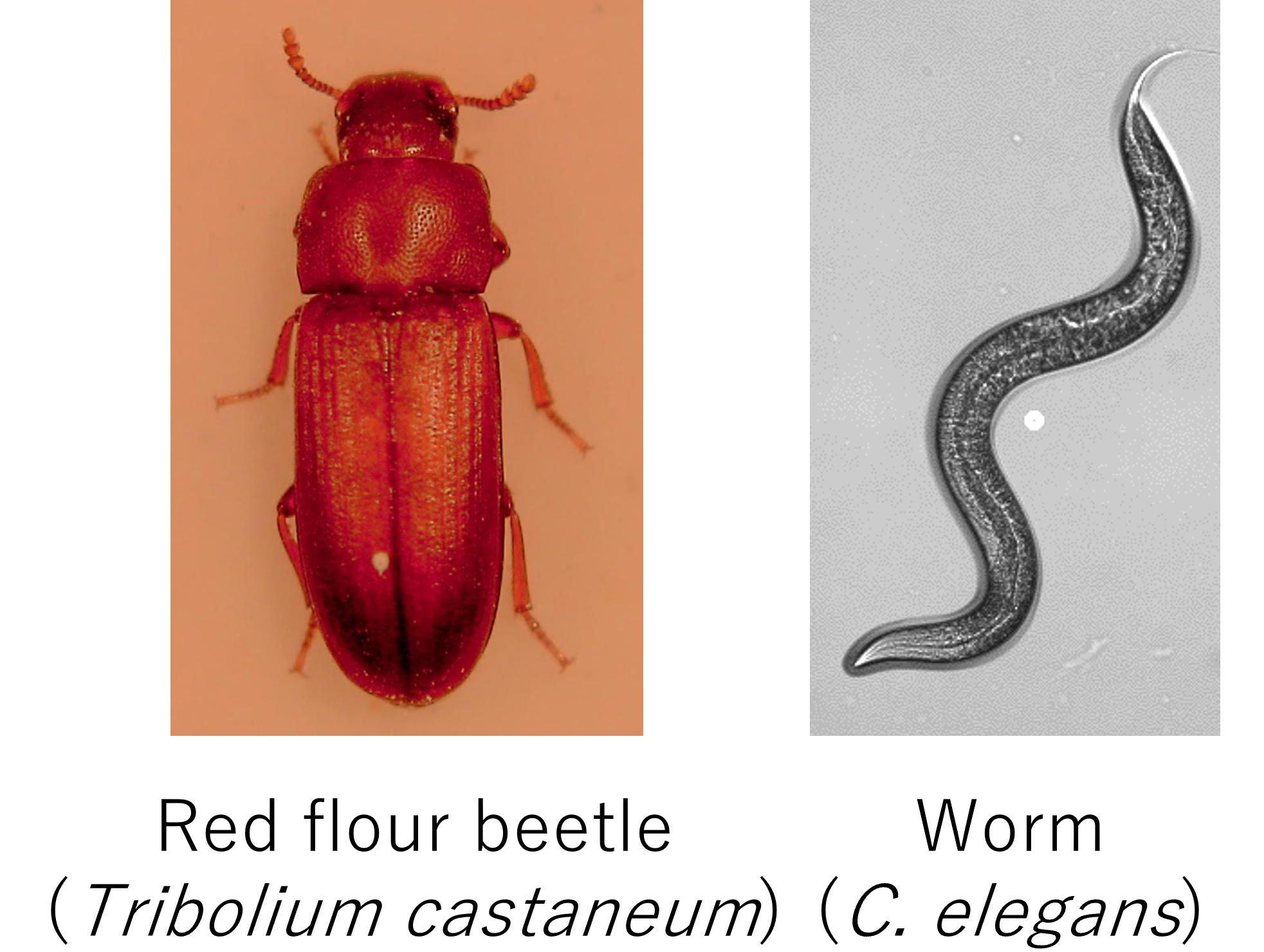
    Red Flour Beetle and Worm
    Animals used in this study. Credit: Nagoya City University and Okayama University

    Targeting Motor Dysfunctions with Shared Movement Patterns

    This method can help scientists study human neurological conditions that cause motor dysfunctions, including those resulting from low dopamine levels. Animal motion data would generate much more information; however, the spatial and temporal scales of animal locomotion vary widely among species. This means that the data cannot be directly compared with human behavior.

    To overcome this, the team designed a neural network with a gradient reversal layer that predicts a) whether or not input locomotion data came from a diseased animal and b) from which species the input data came. From there, the network was trained so that it would fail to predict the species from which the input data was gathered, which resulted in the creation of a network that was incapable of distinguishing between species but capable of identifying specific diseases. This enabled the network to extract locomotion features inherent to the disease.

    Locomotion Speed of Mice
    Locomotion speed of mice. The red-colored parts are the focus of our neural network model that potentially contain cross-species locomotion features. In this example, the network identified short-duration peaks in speed that are characteristic of a mouse with dopamine deficiency. Credit: © 2021 T. Maekawa et al., Nature Communications

    Dopamine Deficiency Reveals Shared Mobility Issues

    Their experiments revealed cross-species locomotion features shared by dopamine-deficient worms, mice, and humans. Despite their evolutionary differences, all of these organisms are unable to move while maintaining high speeds. Also, the speed of these animals was found to be unstable when accelerating. Interestingly, these animals exhibit similar movement disorders in the case of dopamine deficiency even though they have different body scales and locomotion methods. While previous studies had shown that dopamine deficiency was associated with movement disorders in all of these species, this research was the first to identify the shared locomotion features caused by this deficiency.

    “Our project shows that deep learning can be a powerful tool for extracting knowledge from datasets that appear too different to be compared by human researchers,” author Takahiro Hara says. The team anticipates that this work will be used to find other common features for disorders that impact evolutionarily distant species.

    Reference: “Cross-species behavior analysis with attention-based domain-adversarial deep neural networks” by Takuya Maekawa, Daiki Higashide, Takahiro Hara, Kentarou Matsumura, Kaoru Ide, Takahisa Miyatake, Koutarou D. Kimura and Susumu Takahashi, 17 September 2021, Nature Communications.
    DOI: 10.1038/s41467-021-25636-x

    Never miss a breakthrough: Join the SciTechDaily newsletter.
    Follow us on Google and Google News.

    Artificial Intelligence Machine Learning Movement Parkinson's Disease University of Osaka
    Share. Facebook Twitter Pinterest LinkedIn Email Reddit

    Related Articles

    Hidden Signatures of Parkinson’s Disease Uncovered by Artificial Intelligence and Robotics

    Powerful Algorithms Used by Netflix, Amazon and Facebook Could “Crack the Language of Cancer and Alzheimer’s”

    Artificial Intelligence Powers a Disease-Sniffing Device That Rivals a Dog’s Nose

    Counting Elephants From Space: Using Computer Algorithms in Conservation of Endangered Wildlife

    AI Predicts Where and When Lightning Will Strike – Can Even Issue Alerts Before Storm Has Formed

    Artificial Intelligence Model Shows in Striking Detail What Makes Some Images Stick in Our Minds

    New Chip Reduces Neural Networks’ Power Consumption by 95 Percent

    Engineers Develop Automated Process for Discovering Optimal Structure for Metamaterials

    MIT Launches Intelligence Quest To Advance Human and Machine Intelligence Research

    Leave A Reply Cancel Reply

    • Facebook
    • Twitter
    • Pinterest
    • YouTube

    Don't Miss a Discovery

    Subscribe for the Latest in Science & Tech!

    Trending News

    Popular Sugar-Free Sweetener Linked to Liver Disease, Study Warns

    What Is Hantavirus? The Deadly Disease Raising Alarm Worldwide

    Scientists Just Discovered How the Universe Builds Monster Black Holes

    Scientists Unveil New Treatment Strategy That Could Outsmart Cancer

    A Simple Vitamin May Hold the Key to Treating Rare Genetic Diseases

    Scientists Think the Real Fountain of Youth May Be Hiding in Your Gut

    Ravens Don’t Follow Wolves, They Predict Them

    This Common Knee Surgery May Be Doing More Harm Than Good

    Follow SciTechDaily
    • Facebook
    • Twitter
    • YouTube
    • Pinterest
    • Newsletter
    • RSS
    SciTech News
    • Biology News
    • Chemistry News
    • Earth News
    • Health News
    • Physics News
    • Science News
    • Space News
    • Technology News
    Recent Posts
    • Scientists Revive Ancient Chemistry Trick To Engineer Next-Generation Glass
    • Scientists Use AI To Supercharge Ultrafast Laser Simulations by More Than 250x
    • Scientists Just Found a Surprising Way To Destroy “Forever Chemicals”
    • Popular Supplement Ingredient Linked to Shorter Lifespan in Men
    • Scientists May Have Found a Way To Repair Nerve Damage in Multiple Sclerosis
    Copyright © 1998 - 2026 SciTechDaily. All Rights Reserved.
    • Science News
    • About
    • Contact
    • Editorial Board
    • Privacy Policy
    • Terms of Use

    Type above and press Enter to search. Press Esc to cancel.