
Close Menu
    Facebook X (Twitter) Instagram
    SciTechDaily
    • Biology
    • Chemistry
    • Earth
    • Health
    • Physics
    • Science
    • Space
    • Technology
    Facebook X (Twitter) Pinterest YouTube RSS
    SciTechDaily
    Home»Health»New Biochemical Clues in Cell Receptors Help Explain How Coronavirus May Hijack Human Cells
    Health

    New Biochemical Clues in Cell Receptors Help Explain How Coronavirus May Hijack Human Cells

    By American Association for the Advancement of ScienceApril 23, 2021No Comments3 Mins Read
    Facebook Twitter Pinterest Telegram LinkedIn WhatsApp Email Reddit
    Share
    Facebook Twitter LinkedIn Pinterest Telegram Email Reddit
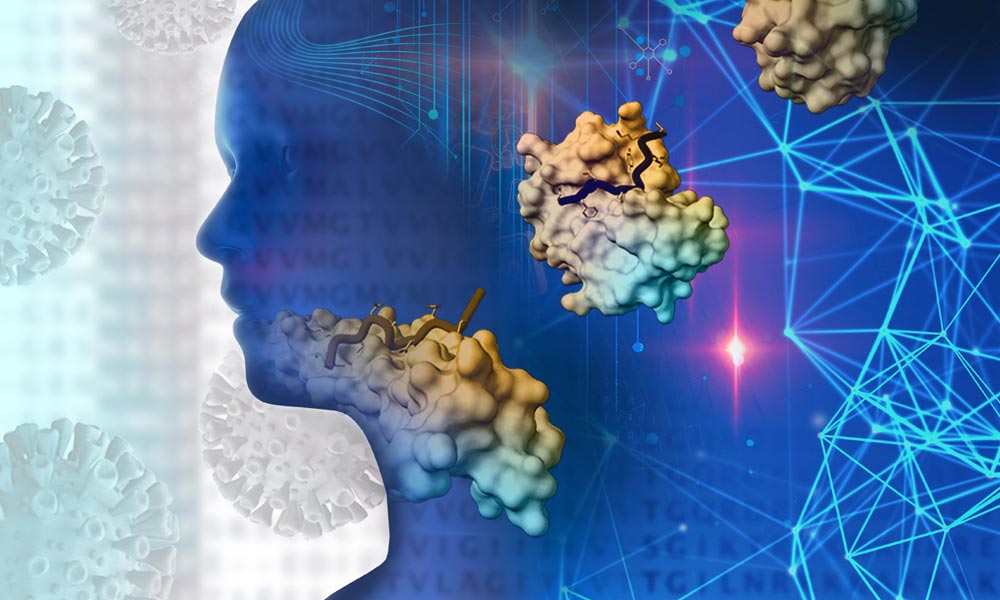
    Protein Sequences COVID Infects Cells
    The analysis of protein sequences allows scientists to predict protein interactions. They can then identify potential new players in the coronavirus infection process. Credit: Rayne Zaayman-Gallant/EMBL

    SARS-CoV-2 may exploit tiny motifs in cell receptors to invade and replicate in cells, revealing new therapeutic targets tied to autophagy and endocytosis.

    The SARS-CoV-2 virus may enter and replicate in human cells by exploiting newly-identified sequences within cell receptors, according to work from two teams of scientists.

    The findings from both groups paint a more complete portrait of the various cellular processes that SARS-CoV-2 targets to not only enter cells, but to then multiply and spread. The results also hint that the sequences could potentially serve as targets for new therapies for patients with COVID-19, although validation in cells and animal models is needed.

    Scientists know that SARS-CoV-2 binds the ACE2 receptor on the surface of human cells, after which it enters the cell through a process known as endocytosis. Research has suggested that the virus may hijack or interfere with other processes such as cellular housekeeping (autophagy) by targeting other receptors called integrins. However, not much is known about exactly how the virus takes advantage of integrins on the biochemical level.

    Short Linear Motifs (SLiMs)

    Analyzing the Eukaryotic Linear Motif database, Bálint Mészáros and colleagues discovered that ACE2 and various integrins contained several short linear motifs (SLiMs ) — small amino acid sequences — that they predicted play a role in endocytosis and autophagy. The scientists then compiled a list of currently used experimental treatments and approved drugs that can target the interactions between SARS-CoV-2 and its target SLiMs.

    Separately, Johanna Kliche and colleagues performed molecular tests to see whether these SLiMs interacted with proteins that contribute to autophagy and endocytosis. The team found that two SLiMs in ACE2 bound to the endocytosis-related proteins SNX27 and SHANK, and one SLiM in the integrin β3 bound to two proteins involved in autophagy.

    In addition to providing a resource for repurposing drugs for SARS-CoV-2, Mészáros et al. say their prediction methods could help identify similar under-the-radar SLiMs that assist with the replication of other viruses that cause disease.

    For more on this research, read The COVID-19 Coronavirus – SARS-CoV-2 – Might Hijack Cellular Processes.

    Reference: “Short linear motif candidates in the cell entry system used by SARS-CoV-2 and their potential therapeutic implications” by Bálint Mészáros, Hugo Sámano-Sánchez, Jesús Alvarado-Valverde, Jelena Calyševa, Elizabeth Martínez-Pérez, Renato Alves, Denis C. Shields, Manjeet Kumar, Friedrich Rippmann, Lucía B. Chemes and Toby J. Gibson, 12 January 2021, Science Signaling.
    DOI: 10.1126/scisignal.abd0334

    Never miss a breakthrough: Join the SciTechDaily newsletter.
    Follow us on Google and Google News.

    American Association for the Advancement of Science Cell Biology COVID-19 Infectious Diseases Molecular Biology Virology
    Share. Facebook Twitter Pinterest LinkedIn Email Reddit

    Related Articles

    Corona Inhibitors: X-ray Screening Identifies Promising Drugs for Treatment of COVID-19

    Experimental Therapy For Parasitic Heart Disease – K777 – May Also Help Stop COVID-19

    Promising At-Home Treatment for COVID-19 Discovered: FDA Approved Drug for Leprosy

    The COVID-19 Coronavirus – SARS-CoV-2 – Might Hijack Cellular Processes

    High-Speed Atomic Force Microscopy Reveals COVID-19 Surface Transmission Mechanism

    Halloween and COVID-19: Scientific Study on the Coronavius Risk of Trick-or-Treating

    Researchers Identify 21 Existing Drugs That Could Treat COVID-19

    COVID-19 Treatment May Lie in Pangolin Genetics – May Possess Evolutionary Advantage Against Coronavirus

    Infection Researchers Identify How Coronaviruses From Animals Need to Change to Spread to Humans

    Leave A Reply Cancel Reply

    • Facebook
    • Twitter
    • Pinterest
    • YouTube

    Don't Miss a Discovery

    Subscribe for the Latest in Science & Tech!

    Trending News

    Scientists Uncover Promising New Strategy To Stop Parkinson’s in Its Tracks

    Experts Reveal the Surprising Cancer Link Behind a Common Vitamin

    This Strange “Golden Orb” Found 2 Miles Deep Stumped Scientists for Years

    Giant “Last Titan” Dinosaur Discovered in Thailand Was Bigger Than 9 Elephants

    This “Longevity Gene” May Protect the Brain From Aging and Dementia

    Common Cleaning Chemical Could Triple Your Risk of a Dangerous Liver Disease

    Scientists Discover Bizarre 100-Million-Year-Old Insect With Giant Claws

    Scientists Discover “Good” Gut Microbes That Could Protect Against Autism and ADHD

    Follow SciTechDaily
    • Facebook
    • Twitter
    • YouTube
    • Pinterest
    • Newsletter
    • RSS
    SciTech News
    • Biology News
    • Chemistry News
    • Earth News
    • Health News
    • Physics News
    • Science News
    • Space News
    • Technology News
    Recent Posts
    • Scientists Discover Surprising Way Cranberry Juice Could Fight Antibiotic Resistance
    • Researchers Discover the Body’s Hidden “Off Switch” for Inflammation
    • Scientists Discover Metformin Doesn’t Work the Way We Thought
    • Tea or Coffee? Your Daily Choice Could Affect Osteoporosis Risk
    • Scientists Discover Brain Pathway That May Slow Parkinson’s Disease – but Only in Women
    Copyright © 1998 - 2026 SciTechDaily. All Rights Reserved.
    • Science News
    • About
    • Contact
    • Editorial Board
    • Privacy Policy
    • Terms of Use

    Type above and press Enter to search. Press Esc to cancel.