
Close Menu
    Facebook X (Twitter) Instagram
    SciTechDaily
    • Biology
    • Chemistry
    • Earth
    • Health
    • Physics
    • Science
    • Space
    • Technology
    Facebook X (Twitter) Pinterest YouTube RSS
    SciTechDaily
    Home»Technology»New Circuits That Can Control Light and Sound
    Technology

    New Circuits That Can Control Light and Sound

    By Jim Shelton, Yale UniversityMarch 5, 2015No Comments3 Mins Read
    Facebook Twitter Pinterest Telegram LinkedIn WhatsApp Email Reddit
    Share
    Facebook Twitter LinkedIn Pinterest Telegram Email Reddit
    A New Way to Control Information by Mixing Light and Sound
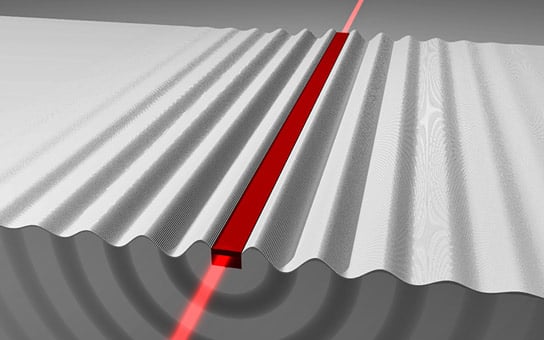
    This illustration shows the emission of phonons (sound waves) from a nanometer scale waveguide, as optical waves flow through it. Credit: Yale University

    A team of researchers has developed hybrid technologies that can control light and sound, allowing information to be stored, filtered, and manipulated with far greater efficiency.

    For once, slower is better in a new piece of technology.

    A Yale lab has developed a new, radio frequency processing device that allows information to be controlled more effectively, opening the door to a new generation of signal processing on microchips. One of the keys to the technology involves slowing information down.

    The new system, described in the March 5 edition of the journal Nature Communications, combines photons and phonons — electromagnetic energy and sound energy — to conduct sophisticated signal processing tasks by harnessing the properties of lower-velocity acoustic waves. In this case, the sound waves are a million times higher in frequency than anything a human can hear.

    For decades, researchers have explored ways to shrink down signal processing technologies by encoding information on light. Using circuits that control photons rather than electrons, individual components can be made far smaller and support immense information bandwidths. Yet one thing was missing: an effective way to incorporate acoustic waves, which hold onto information longer, in an even smaller space.

    By creating new circuits that can control light and sound, researchers at Yale have developed hybrid technologies that combine the best of both worlds.

    “This is definitely something that’s going to be built upon in the years to come,” said co-author Peter Rakich, a Yale assistant professor of applied physics and principal investigator of the research. “It’s a very different approach because of its flexibility. We’ve made something that is smaller as well as lighter, and can go on the same microchip with a processor.”

    The result is that information can be stored, filtered, and manipulated with far greater efficiency. Because the device is small enough to be placed on a silicon chip, it has the potential to be less expensive than other systems. It also has the potential to be adapted to a variety of complex, signal processing designs.

    “Our work here is a combination of physics and engineering,” said Heedeuk Shin, an associate research scientist in applied physics at Yale, and the study’s first author. “We demonstrate a powerful new signal processing operation that isn’t possible with photons alone.”

    Additional authors of the research are Jonathan Cox, Robert Jarecki, Andrew Starbuck of Sandia National Laboratories, and Zheng Wang of the University of Texas-Austin.

    Reference: “Control of coherent information via on-chip photonic–phononic emitter–receivers” by Heedeuk Shin, Jonathan A. Cox, Robert Jarecki, Andrew Starbuck, Zheng Wang and Peter T. Rakich, 5 March 2015, Nature Communications.
    DOI: 10.1038/ncomms7427
    arXiv: 1409.0580

    Never miss a breakthrough: Join the SciTechDaily newsletter.
    Follow us on Google and Google News.

    Computer Science Sandia National Laboratory University of Texas Yale University
    Share. Facebook Twitter Pinterest LinkedIn Email Reddit

    Related Articles

    These Brain-Inspired Computers Are Shockingly Good at Math

    ‘Robotic Skins’ Turn Inanimate Objects Into Multifunctional Robots

    Newly Developed “Variable Friction” Fingers Enable Better Robot Hands

    Scientists Observe Self-Healing of a Confined Phase Change Memory Device

    Ultra-Thin ‘Atomristors’ Pave the Way for More Powerful Computing

    Teaching Artificial Intelligence Humor

    TrueNorth Computer Chip Emulates Human Cognition

    Scientists Develop “PV Value” to Accurately Appraise PV Systems

    Self-Guided Bullet Accurate From One Mile Away

    Leave A Reply Cancel Reply

    • Facebook
    • Twitter
    • Pinterest
    • YouTube

    Don't Miss a Discovery

    Subscribe for the Latest in Science & Tech!

    Trending News

    Two Drinks a Day May Be Riskier Than Many Americans Think

    A Lost Human Lineage May Have Left a Genetic Legacy in People Today

    Study Reveals a Surprising Link Between Birth Control Pills and Binge Eating

    NASA’s HiRISE Captures Perseverance Rover Completing a Marathon on Mars

    Ancient DNA Reveals the Hidden Origins of China’s Mysterious Shimao Civilization

    Scientists Discover a Surprising Link Between Sleep, Genes, and Alzheimer’s

    Popular Childhood Drinks Linked to Higher Blood Pressure Later in Life

    Scientists Just Challenged a 70-Year-Old Myth About the Human Brain

    Follow SciTechDaily
    • Facebook
    • Twitter
    • YouTube
    • Pinterest
    • Newsletter
    • RSS
    SciTech News
    • Biology News
    • Chemistry News
    • Earth News
    • Health News
    • Physics News
    • Science News
    • Space News
    • Technology News
    Recent Posts
    • New Fossil Study Challenges the Classic Story of Human Evolution
    • The Surprising Chocolate Trick That Could Boost Your Gym Performance
    • 6 Simple Scent Games That Can Make Your Dog Happier
    • Common Mouth Bacteria May Trigger Dangerous Calcium Buildup in the Heart
    • New CRISPR Tool Gives Scientists Control Over Cellular Protein Production
    Copyright © 1998 - 2026 SciTechDaily. All Rights Reserved.
    • Science News
    • About
    • Contact
    • Editorial Board
    • Privacy Policy
    • Terms of Use

    Type above and press Enter to search. Press Esc to cancel.