
Close Menu
    Facebook X (Twitter) Instagram
    SciTechDaily
    • Biology
    • Chemistry
    • Earth
    • Health
    • Physics
    • Science
    • Space
    • Technology
    Facebook X (Twitter) Pinterest YouTube RSS
    SciTechDaily
    Home»Technology»Newly Developed “Variable Friction” Fingers Enable Better Robot Hands
    Technology

    Newly Developed “Variable Friction” Fingers Enable Better Robot Hands

    By School of Engineering & Applied Science, Yale UniversitySeptember 10, 2018No Comments4 Mins Read
    Facebook Twitter Pinterest Telegram LinkedIn WhatsApp Email Reddit
    Share
    Facebook Twitter LinkedIn Pinterest Telegram Email Reddit
    Surfaces a Key Element in Robotic Fingers
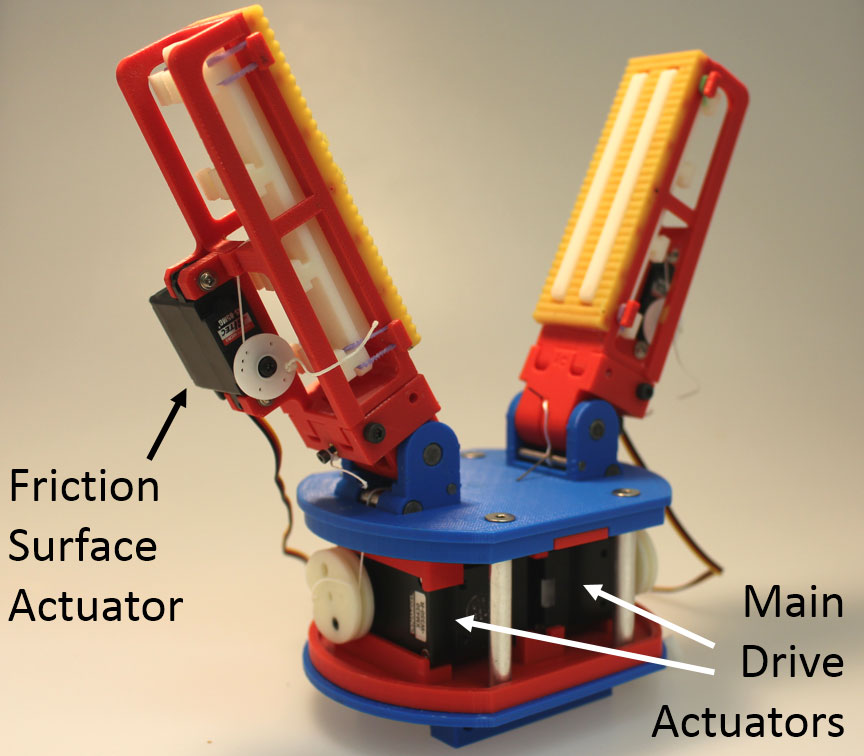
    The newly developed ‘Variable Friction’ robot fingers combine a surface made of soft urethane (high-surface friction), a surface made of hard 3D-printed plastic (low-surface friction), and some rubber bands to suspend one surface behind the other. Two of these mechanical fingers face each other to form a robot hand, each with pivot joints at the bottom moved by electrical motors that allow the fingers to be controlled in multiple ways. At low-grip forces, the urethane acts as the finger pad, but switches to the hard surface made from Acrylonitrile Butadiene Styrene (ABS) at higher forces.

    Picking up a pen off a desk and writing with it might seem easy to you, but it’s no small feat to a robot.

    For one thing, once you pick up the pen, you then have to shift it in your hand to get it in the writing position. “You move the pen from an initial grasp to something more stable, but to do that, you’re gripping it with certain surfaces of the fingers and sliding it against other surfaces of the fingers,” said Adam Spiers, a former associate research scientist in Aaron Dollar’s lab. “It’s really quite complicated as far as all the force and frictional interactions go, but we all take it for granted as a very simple thing to do.”

    So Dollar’s lab tried a simpler tack that focuses on the variation in friction of finger surfaces. Their results were recently published in IEEE Robotics and Automation Letters and will also soon be presented at the International Conference on Intelligent Robots and Systems (IROS 2018).

    “I think one of the key features of human hands that’s often overlooked is the surface properties of our fingers and what that allows us to do as far as moving objects within the hand,” Spiers said. “For example, when you make a light touch with your finger pads they are able to slide over objects, while using a bit more force deforms the soft internal tissue and causes them to grip.”

    The newly developed ‘Variable Friction’ robot fingers combine a surface made of soft urethane (high-surface friction), a surface made of hard 3D-printed plastic (low-surface friction), and some rubber bands to suspend one surface behind the other. Two of these mechanical fingers face each other to form a robot hand, each with pivot joints at the bottom moved by electrical motors that allow the fingers to be controlled in multiple ways. At low-grip forces, the urethane acts as the finger pad, but switches to the hard surface made from Acrylonitrile Butadiene Styrene (ABS) at higher forces.

    “We can get some pretty interesting behaviors where we can move objects within the hand, while they are being grasped,” said Spiers, now a research scientist at the Max Planck Institute for Intelligent Systems. “The object can be made to slide up and down the fingers, or we can make objects roll between the fingers. Then, we can actually combine those motions to reposition objects anywhere within the workspace of the hand.”

    It’s kind of like a human hand, but not entirely.

    “There’s a lot to be said for taking inspiration from nature, but not copying it too much,” he said. “With a human finger, you’re getting very good behaviors out of it, but it’s also attached to a really powerful brain.”

    The origins of the intuitive way that humans can effortlessly perform complicated tasks are unclear, Spiers said. Is it because we have sophisticated brains that allow us to control our bodies with complex maneuvers, or because our fingers have a structure that includes the ability to vary surface friction?

    In either case, he said, he sought to replicate the end results with the robotic device. It’s a proof-of-concept, so it still doesn’t perform some of the more subtle tasks that a human hand does, but they’ve made the design open-source so that other researchers could expand on it, and increase its dexterity.

    “This is a new platform that other people can now build on and maybe implement those more difficult but common behaviors that humans do effortlessly but robots struggle with,” he said.

    Reference: “Variable-Friction Finger Surfaces to Enable Within-Hand Manipulation via Gripping and Sliding” by Adam J. Spiers, Berk Calli and Aaron M. Dollar, 16 July 2018, IEEE Robotics and Automation Letters.
    DOI: 10.1109/LRA.2018.2856398

    Never miss a breakthrough: Join the SciTechDaily newsletter.
    Follow us on Google and Google News.

    Computer Science Robotics Yale School of Engineering & Applied Science Yale University
    Share. Facebook Twitter Pinterest LinkedIn Email Reddit

    Related Articles

    New Shape-Changing Robots Take on Changing Terrains

    ‘Robotic Skins’ Turn Inanimate Objects Into Multifunctional Robots

    Teaching Artificial Intelligence Humor

    Printable Robots That Self-Assemble When Heated

    Robotic RoboBees Achieve First Controlled Flight

    Engineers at SEAS Develop a Microelectronic Device That Mimics Functions of Real Cells

    Algorithms Improve AUV Navigation and Detecting Capabilities

    Using Chitosan to Remove Arsenic From Water Supplies

    Algorithm Enables Robots to Learn and Adapt to Help Complete Tasks

    Leave A Reply Cancel Reply

    • Facebook
    • Twitter
    • Pinterest
    • YouTube

    Don't Miss a Discovery

    Subscribe for the Latest in Science & Tech!

    Trending News

    New Research Shows Vitamin B12 May Hold the Key to Healthy Aging

    These Simple Daily Habits Can Quickly Improve Blood Pressure and Heart Risk Factors

    A Common Nutrient May Play a Surprising Role in Anxiety

    Doing This After 9 p.m. Could Double Your Risk of Gut Issues

    Scientists Discover How Coffee Impacts Memory, Mood, and Gut Health

    Why Did the Neanderthals Disappear? Scientists Reveal Humans Had a Hidden Advantage

    Physicists Propose Strange Experiment Where Time Goes Quantum

    Magnesium Magic: New Drug Melts Fat Even on a High-Fat, High-Sugar Diet

    Follow SciTechDaily
    • Facebook
    • Twitter
    • YouTube
    • Pinterest
    • Newsletter
    • RSS
    SciTech News
    • Biology News
    • Chemistry News
    • Earth News
    • Health News
    • Physics News
    • Science News
    • Space News
    • Technology News
    Recent Posts
    • This New Memory Technology Could Make Devices Last Months on One Charge
    • Scientists Turn Cancer’s Own Bacteria Against It in Breakthrough Therapy
    • Cannabis Can Make You Remember Things That Never Happened
    • Doctors Are Surprised by What This Vaccine Is Doing to the Heart
    • Quantum Breakthrough Turns Simple Forces Into Powerful New Interactions
    Copyright © 1998 - 2026 SciTechDaily. All Rights Reserved.
    • Science News
    • About
    • Contact
    • Editorial Board
    • Privacy Policy
    • Terms of Use

    Type above and press Enter to search. Press Esc to cancel.