
Close Menu
    Facebook X (Twitter) Instagram
    SciTechDaily
    • Biology
    • Chemistry
    • Earth
    • Health
    • Physics
    • Science
    • Space
    • Technology
    Facebook X (Twitter) Pinterest YouTube RSS
    SciTechDaily
    Home»Space»Outstanding Hubble Image Shows Fully-Illuminated Saturn and Its Rings
    Space

    Outstanding Hubble Image Shows Fully-Illuminated Saturn and Its Rings

    By A. Simon (GSFC) and the OPAL TeamSeptember 10, 2018No Comments3 Mins Read
    Facebook Twitter Pinterest Telegram LinkedIn WhatsApp Email Reddit
    Share
    Facebook Twitter LinkedIn Pinterest Telegram Email Reddit
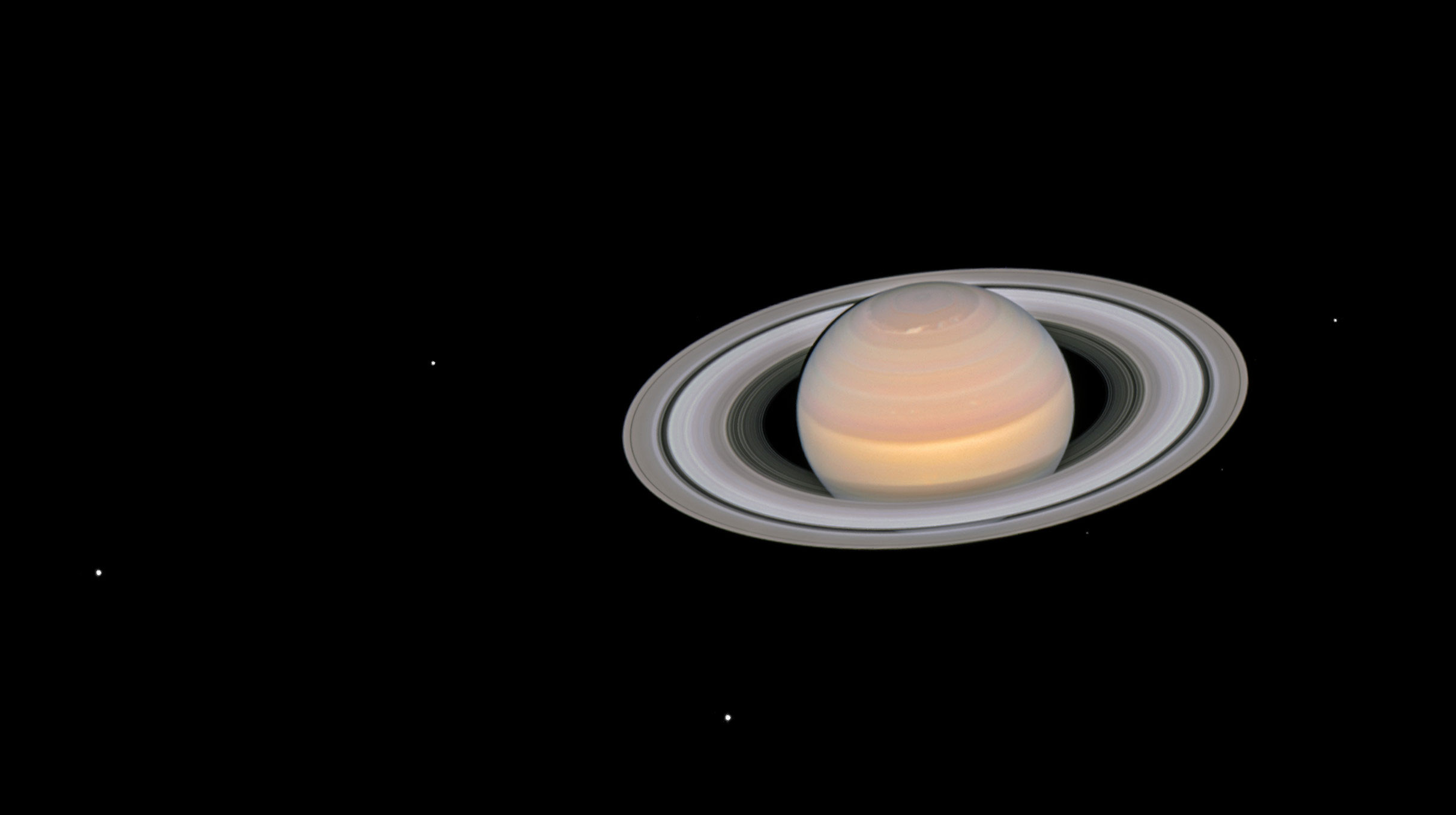
    Saturn and Its Moons at Opposition
    This is a composite image taken by Hubble on June 6, 2018 showing a fully-illuminated Saturn and its rings, along with six of its 62 known moons. Credit: NASA, ESA, A. Simon (GSFC) and the OPAL Team, and J. DePasquale (STScI); CC BY 4.0

    Cassini ended its 13-year mission at Saturn on September 15, 2017 when it plunged into the gas giant’s atmosphere, but the NASA/ESA Hubble Space Telescope is still keeping an eye on the ringed planet.

    This is a composite image taken by Hubble on June 6, 2018 showing a fully-illuminated Saturn and its rings, along with six of its 62 known moons. The visible moons are (from left to right) Dione, Enceladus, Tethys, Janus, Epimetheus, and Mimas (click here for an annotated version). Dione is the largest moon in the picture, with a diameter of 1123 km (698 m), compared to the smallest, oddly-shaped Epimetheus with a diameter of around 116 km (72 m).

    During Cassini’s mission, Enceladus was identified as one of the most intriguing moons, with the discovery of water vapor jets spewing from the surface implying the existence of a subsurface ocean. Icy moons with subsurface oceans could potentially offer the conditions to harbor life, and understanding their origins and properties are essential for furthering our knowledge of the Solar System. ESA’s JUpiter ICy moons Explorer (Juice), due to launch in 2022, aims to continue this theme by studying Jupiter’s ocean-bearing moons: Ganymede, Europa, and Callisto.

    The Hubble image shown here was taken shortly before Saturn’s opposition on June 27, when the Sun, Earth, and Saturn were aligned so that the Sun fully illuminated Saturn as seen from Earth. Saturn’s closest approach to Earth occurs around the same time as opposition, which makes it appear brighter and larger and allows the planet to be imaged in greater detail.

    In this image, the planet’s rings are seen near their maximum tilt toward Earth. Towards the end of Cassini’s mission, the spacecraft made multiple dives through the gap between Saturn and its rings, gathering spectacular data in this previously unchartered territory.

    The image also shows a hexagonal atmospheric feature around the north pole, with the remnants of a storm, seen as a string of bright clouds. The hexagon-shaped cloud phenomenon is a stable and persistent feature first seen by the Voyager 1 space probe when it flew past Saturn 1981. In a study published just last week, scientists using Cassini data collected between 2013 and 2017, as the planet approached northern summer, identified a hexagonal vortex above the cloud structure, showing there is still much to learn about the dynamics of Saturn’s atmosphere.

    The Hubble observations making up this image were performed as part of the Outer Planet Atmospheres Legacy (OPAL) project, which uses Hubble to observe the outer planets to understand the dynamics and evolution of their complex atmospheres. This was the first time that Saturn was imaged as part of OPAL. This image was first published on July 26.

    Never miss a breakthrough: Join the SciTechDaily newsletter.
    Follow us on Google and Google News.

    Astronomy Hubble Space Telescope Planetary Science Saturn
    Share. Facebook Twitter Pinterest LinkedIn Email Reddit

    Related Articles

    New Hubble Space Telescope Photos of Mars and Saturn

    Hubble Views Auroral Lights at Saturn’s North Pole

    Solving the Mystery of Saturn’s Moonlets

    Storm Spawns the Largest Tropospheric Vortex Ever Seen on Saturn

    Impact May Have Deformed Saturn’s Moon Iapetus

    Asteroid Belts and Their Potential Significance for Life

    New Study Revives Doubted Exoplanet Fomalhaut b

    Simulation May Explain Saturnian System

    Titan Experiences Seasonal Changes

    Leave A Reply Cancel Reply

    • Facebook
    • Twitter
    • Pinterest
    • YouTube

    Don't Miss a Discovery

    Subscribe for the Latest in Science & Tech!

    Trending News

    Walking for Just 20 Minutes Caused an Immediate Change in the Gut

    Scientists Have Uncovered Previously Hidden Microbial Activity on Human Skin

    Stacked Mummies Reveal 700 Years of Changing Burial Rituals in Ancient Egypt

    Scientists Discover a Butterfly That Barely Seems To Age

    Astronomers Detect a Faint Hydrogen Signal From Billions of Light-Years Away

    Fighting Fire With Fire Could Save Giant Sequoias

    Scientists Just Found a Hidden Factor That Could Trigger an Atlantic Ocean Collapse

    Scientists Find a Berry Compound That Helps Muscle Cells Burn Fat

    Follow SciTechDaily
    • Facebook
    • Twitter
    • YouTube
    • Pinterest
    • Newsletter
    • RSS
    SciTech News
    • Biology News
    • Chemistry News
    • Earth News
    • Health News
    • Physics News
    • Science News
    • Space News
    • Technology News
    Recent Posts
    • Scientists Discover a Key Reason Why the Aging Eye Struggles To Regrow Lost Neurons
    • New Study Reveals a Major Shift Behind Rising ADHD and Autism Diagnoses
    • New Treatment Cuts “Bad” Cholesterol in Half for a Full Year
    • Scientists Discover Trees Have a Hidden “Muscle” That Helps Them Straighten Themselves
    • Scientists Digitize One of the World’s Rarest Animals Before It Disappears
    Copyright © 1998 - 2026 SciTechDaily. All Rights Reserved.
    • Science News
    • About
    • Contact
    • Editorial Board
    • Privacy Policy
    • Terms of Use

    Type above and press Enter to search. Press Esc to cancel.