
A new study from Brown University examines a specialized pollination mechanism in conifers whose traits are linked through function but not development, exploring how integration influences patterns of trait evolution.
Providence, Rhode Island (Brown University) — A new study offers not only a sweeping analysis of how pollination has evolved among conifers but also an illustration of how evolution — far from being a straight-ahead march of progress — sometimes allows for longstanding and advantageous functions to become irrevocably lost. Moreover, the authors show that the ongoing breakdown of the successful but ultimately fragile pollination mechanism may have led to a new diversity of traits and functions.
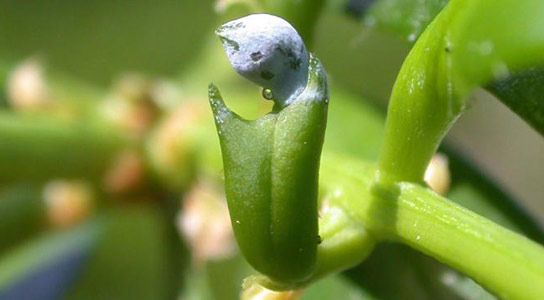
Andrew Leslie, assistant professor of ecology and evolutionary biology, and his co-authors studied more than 460 conifer species to order and trace the evolution of a trio of traits that provide an ancient function of pollination. Many pine and spruce species still exhibit these attributes: pollen grains that are buoyant because of structures called sacci (air-filled bladders), downward-facing ovules, and the well-timed emission of a drop of liquid.
For a few days a year these trees send their pollen into the wind. The pollen that land on the cone under the ovule become engulfed in the droplet and, because they are buoyant, float up into the ovule. The process has the advantages of filtering out non-buoyant particles, and of guiding a concentration of pollen saccae to the otherwise well-shielded ovule.
“People thought these traits were correlated,” said Leslie, first author of the paper in the journal Evolution. “What we did was put this in an evolutionary context.”
A loose and fragile alliance
What they found is that while the mechanism had apparently served the wide world of conifers well for hundreds of millions of years, it is gradually disappearing. The traits are not strongly linked in the developmental way that, say, bones and muscles and connective tissue would seem to be in a human arm. Instead in the conifers, the linkage among these pollination traits is almost entirely based on their shared function, not on some intermeshed physiology.
Eventually, the loose federation began to break down in many species. Losing any single trait is enough to break the mechanism and for various reasons that remain unknown, some conifer clades lost buoyant saccate pollen, others dropped the droplet and some re-oriented their ovules.
In evolution, the research shows, selection pressure or pure chance can break a functional relationship among such loosely related traits such as the one Leslie studied, even if that relationship has been working well.
In fact, once this pollination mechanism was lost in a species, Leslie’s analysis found, it never returned.
Instead, though, the evolutionary record suggests that when the mechanism broke down for conifer species, they became “free” to put the traits to other use, or to evolve entirely new ones, a phenomenon Leslie refers to as “stasis and release.”
“In some sense, perhaps, these traits being loosely integrated like this might actually allow them to stumble upon better solutions from time to time,” Leslie said.
Many species now have some but not all three of the traits. Junipers, for example, still emit liquid drops to capture pollen from the wind but they no longer have buoyant saccate pollen and while many have downward-facing ovules, some do not, Leslie said. Hemlocks, meanwhile, seem to have moved on completely, evolving pollen that can land anywhere on the cone and grow tubes to make their way to the ovule.
Leslie said he hopes the study will draw attention to the pollination-by-flotation mechanism as an interesting case study of plant evolution.
“The thing that’s interesting about this system is that it’s a long-term functional integration that seems to have operated over hundreds of millions of years, but this system shows really well what happens when these functional interactions break down,” Leslie said. “And then traits go off in their own direction.”
The paper’s other authors are Jeremy Beaulieu of the University of Tennessee, Peter Crane and Michael Donoghue of Yale University, and Patrick Knopf of Botanischer Garten Rombergpark in Germany.
Reference: “Trait integration and macroevolutionary patterns in the pollination biology of conifers” by Andrew B. Leslie, Jeremy M. Beaulieu, Peter R. Crane, Patrick Knopf and Michael J. Donoghue, 22 April 2015, Evolution.
DOI: 10.1111/evo.12670
Never miss a breakthrough: Join the SciTechDaily newsletter.
Follow us on Google and Google News.