
Close Menu
    Facebook X (Twitter) Instagram
    SciTechDaily
    • Biology
    • Chemistry
    • Earth
    • Health
    • Physics
    • Science
    • Space
    • Technology
    Facebook X (Twitter) Pinterest YouTube RSS
    SciTechDaily
    Home»Space»New Evidence on How Dust Production Alters Observed Starlight
    Space

    New Evidence on How Dust Production Alters Observed Starlight

    By Tyler Jump, Harvard-Smithsonian Center For AstrophysicsNovember 4, 20181 Comment4 Mins Read
    Facebook Twitter Pinterest Telegram LinkedIn WhatsApp Email Reddit
    Share
    Facebook Twitter LinkedIn Pinterest Telegram Email Reddit
    Dust Production in Evolved Exoplanetary Systems
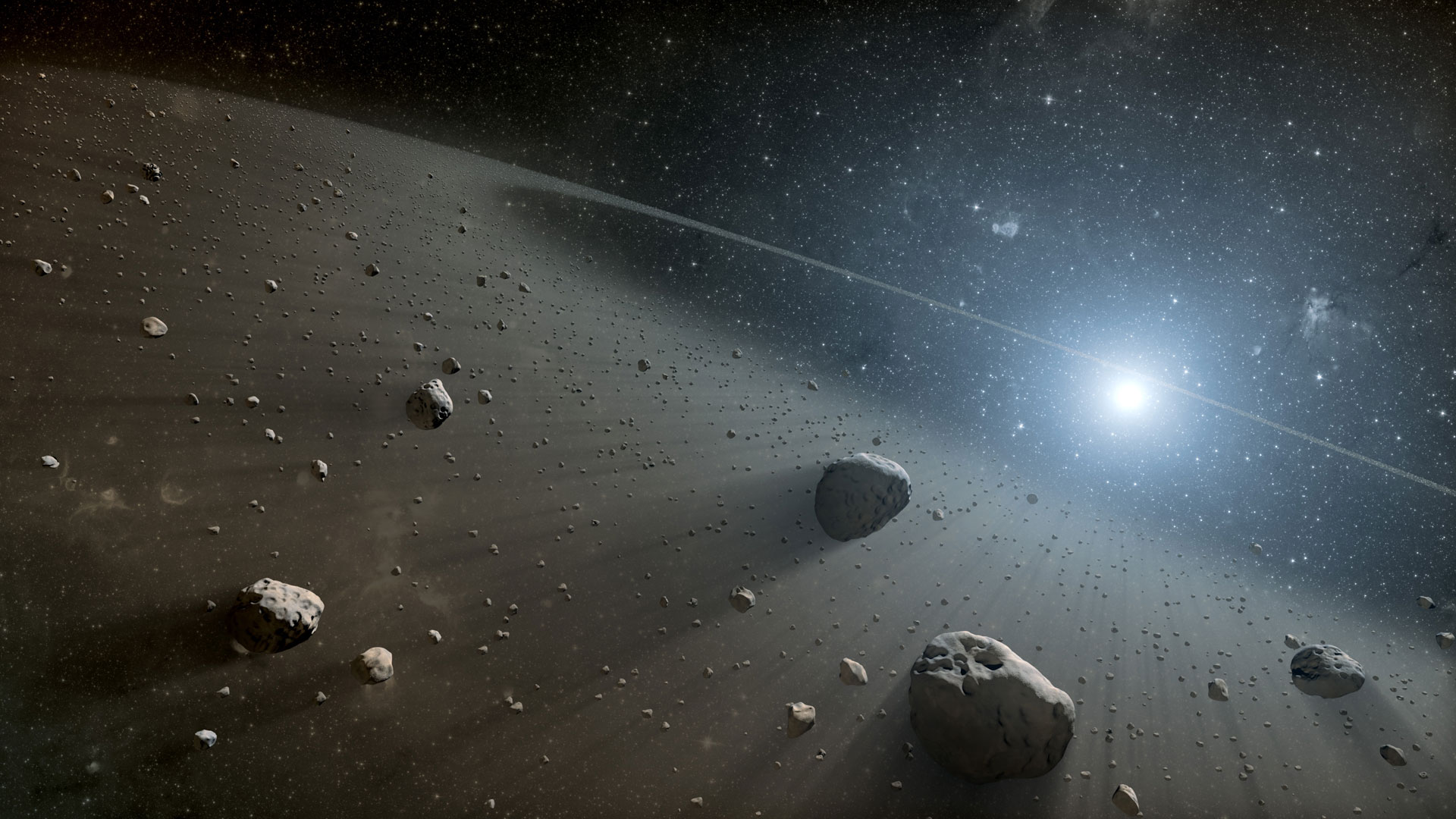
    An artist’s conception of a dust belt around a bright star. Evidence for such a ring of debris with a time-variable composition was found around a faint white dwarf star, leading scientists to propose that collisions and agglomerations between disk components can lead to the brightening and dimming of the starlight as observed. Credit: NASA’s Spitzer Space Telescope and the European Space Agency’s Herschel Space Observatory

    Stellar variability has long offered insights into stars’ physical properties. The star Mira (Omicron Ceti), for example, was so-named in 1596 by Dutch astronomers who were amazed by its miraculous brightening because of what we now know to be due to periodic changes in its size and temperature. Much less dramatic variability can also be caused when a star has a disk of dust that occasionally blocks some of its light as seen from the Earth. Smaller and fainter stars are typically out of reach for variability studies, but sometimes their disks (when they have them) can generate enough debris to affect detectable changes in the starlight.

    For astronomers interested in how planets formed from dust disks around stars of all types, these smaller systems have the potential to constrain the bigger picture of planet formation and evolution, especially if they signal some dramatic event or important evolutionary phase like the Late Heavy Bombardment phase of our solar system. Some changes in exoplanetary disks have already been spotted. Comets, for example, are known to be present in a handful of systems through variations in the stars’ optical and ultraviolet spectra and via irregular stellar dimming.

    A white dwarf star is the evolutionary end product of stars like our sun which, in another seven billion years or so, will no longer be able to sustain burning its nuclear fuel. With only about half of its mass then remaining, it will shrink to a fraction of its radius and become a white dwarf. White dwarf stars are common, the most famous one being the companion to the brightest star in the sky, Sirius.

    Harvard-Smithsonian Center For Astrophysics (CfA) astronomer Scott Kenyon was part of a team that has been studying the white dwarf star GD56 for 11.2 years, and has seen its light rise and fall by about 20% consistent with dust production or depletion from its disk. The team used the IRAC camera on Spitzer, the WISE mission, and ground-based observations from the UKIRT and Keck telescopes to characterize these fluctuations. They found that there was no change to the color of the light, implying that all the dust being destroyed or created was at about the same temperature, and hence was probably located at about the same distance from the star.

    The scientists hypothesize that gravitational attraction or collisional grinding between particles in the disk are responsible for the decreases or increases, respectively, in the disk’s dusty area and hence in the varying obscuration. These kinds of disk activities are known to be commonplace in disks around young stars, but were unexpected in much older stars like this white dwarf.

    The authors conclude by noting that active processing of dust like that occurring here can result in material falling onto the star and being detected in enhanced element abundances in the stellar spectra.

    Reference: “Dust Production and Depletion in Evolved Planetary Systems” by J. Farihi, R. van Lieshout, P. W. Cauley, E. Dennihy, K. Y. L. Su, S. J. Kenyon, T. G. Wilson, O. Toloza, B. T. Gansicke, T. von Hippel, S. Redfield, J. H. Debes, S. Xu, L. Rogers, A. Bonsor, A. Swan, A. F. Pala and W. T. Reach, 27 August 2018, MNRAS.
    DOI: 10.1093/mnras/sty2331 

    Never miss a breakthrough: Join the SciTechDaily newsletter.
    Follow us on Google and Google News.

    Astronomy Cosmology Harvard-Smithsonian Center for Astrophysics
    Share. Facebook Twitter Pinterest LinkedIn Email Reddit

    Related Articles

    Astronomers Just Reconstructed a Galaxy’s 12-Billion-Year History

    Webb’s Mysterious “Little Red Dots” May Be the Cradle of the First Black Holes

    Mysterious Radio Signals Reveal What’s Hiding Between Galaxies

    Cosmic Mystery Solved: Astronomers Have Discovered the Universe’s “Missing” Matter

    Invisible Storm Lights Up Galaxy Cluster With Record-Breaking Radio Glow

    Herschel Observations Help Identify the Physical Processes Underway in Cold, Dense Clouds

    CfA Scientists Measure the Rate of Expansion of the Universe

    New Study Challenges Planck Results

    Calculations Show the Ideal Time to Study the Cosmos

    1 Comment

    1. kate sisco on November 4, 2018 10:06 am

      Baffled about the initial assumption and then correction to Mira as its brightening and dimming is due to the star itself, disproving the dust theory yet because we do not have overt evidence of other self regulating stars, we fall back onto the dust theory and even hypothesize reasons like gravity or dust ‘grinding’ to be the cause.

      Reply
    Leave A Reply Cancel Reply

    • Facebook
    • Twitter
    • Pinterest
    • YouTube

    Don't Miss a Discovery

    Subscribe for the Latest in Science & Tech!

    Trending News

    Bone-Strengthening Discovery Could Reverse Osteoporosis

    Scientists Uncover Hidden Trigger Behind Stem Cell Aging

    Scientists Find Way to Reverse Fatty Liver Disease Without Changing Diet

    Could Humans Regrow Limbs? New Study Reveals Promising Genetic Pathway

    Scientists Reveal Eating Fruits and Vegetables May Increase Your Risk of Lung Cancer

    Scientists Reverse Brain Aging With Simple Nasal Spray

    Scientists Uncover Potential Brain Risks of Popular Fish Oil Supplements

    Scientists Discover a Surprising Way To Make Bread Healthier and More Nutritious

    Follow SciTechDaily
    • Facebook
    • Twitter
    • YouTube
    • Pinterest
    • Newsletter
    • RSS
    SciTech News
    • Biology News
    • Chemistry News
    • Earth News
    • Health News
    • Physics News
    • Science News
    • Space News
    • Technology News
    Recent Posts
    • Europe’s Most Active Volcano Just Got Stranger – Here’s Why Scientists Are Rethinking It
    • Why Are Giant Ants Letting Tiny Ants Crawl All Over Them?
    • Revolutionary Technique Sends Healthy Mitochondria Exactly Where They’re Needed
    • This Student Recreated the Universe in a Bottle. What She Discovered Could Help Reveal How Life Started on Earth
    • Alzheimer’s Symptoms May Start Outside the Brain, Study Finds
    Copyright © 1998 - 2026 SciTechDaily. All Rights Reserved.
    • Science News
    • About
    • Contact
    • Editorial Board
    • Privacy Policy
    • Terms of Use

    Type above and press Enter to search. Press Esc to cancel.